
15 to 30 Minute Golden Hour Wedding Photos That Fit Couples' Timelines
Updated: Sep 6

Yes, golden hour wedding photos are worth building into your timeline. Plan a 15 to 30 minute slot around sunset, check the exact time for your date now, and flag it with your photographer and coordinator this week. The window shifts with the season and your venue’s surroundings, so the earlier you plan it, the less it clashes with speeches, dinner, or dancing.
TL;DR:
Planning a 15 to 30 minute slot around sunset is essential, as weather and season heavily influence the window’s duration and timing.
Photographers use sun-tracking apps and scout locations in advance to maximize the quality and consistency of golden hour images.
Couples should communicate the exact timing and location of the golden hour window to their planner and photographer weeks beforehand to ensure proper scheduling.
Light conditions during golden hour produce softer, more flattering portraits, but weather shifts like clouds can reduce or erase the window, requiring backup plans.
Lighter, flowing fabrics and warm earthy tones work best, and a well-coordinated plan allows capturing iconic images without sacrificing too much reception time.
Table of Contents
What is golden hour and why does it flatter wedding photos?
Golden hour is the stretch shortly after sunrise or before sunset when the sun sits low enough that its light travels through more atmosphere, scattering the blue wavelengths and leaving a warm, reddish glow). That low angle also softens shadows across the face, which is why photographers chase it rather than midday sun that carves harsh lines under the eyes and chin.
For a wedding, that translates into:
Warmer, more even skin tones with none of the squinting that comes from overhead sun
Long, dramatic light that rakes across a couple rather than flattening them
Natural rim lighting and backlight, especially through a veil or loose hair
A softer, more cinematic mood than any flash-lit indoor portrait can match
Season and location both change how long that window lasts, and a wedding on an exposed hilltop will see the light drop faster than one tucked into a valley.
Are golden hour wedding photos actually worth the disruption?
Most couples decide they are, and it usually comes down to what ends up on the wall afterwards. A short golden hour session tends to produce the images that outlast the trend of the year: silhouetted first kisses, a veil glowing amber against the light, close-up portraits where the sun rims the hair rather than the flash flattening it. Professional photographers prioritise this window because it delivers consistently flattering light without any lighting kit at all.
That said, it isn’t free. Two honest trade-offs worth knowing before your wedding day:
You’ll step away from the reception for a portion of your golden hour, which for some couples feels like missing the party
The whole plan depends on weather, and a heavy cloud bank can shrink or erase the window entirely
Neither is a reason to skip it, but both are reasons to plan around them rather than hope for the best on the day.
How do you calculate and schedule the golden hour window?
Sunset times shift by weeks across the calendar, so the first job is finding the exact figure for your date and venue rather than guessing. Apps such as PhotoPills and The Photographer’s Ephemeris map the sun’s exact trajectory over a specific location, showing not just when golden hour starts but which direction the light will fall from at that venue. That direction matters as much as the time, because a west-facing lawn works completely differently to one boxed in by trees on that side.
Once you know the time, slot it into the day using this sequence:
Check sunset time and golden hour start for your date, ideally a season ahead rather than the week before
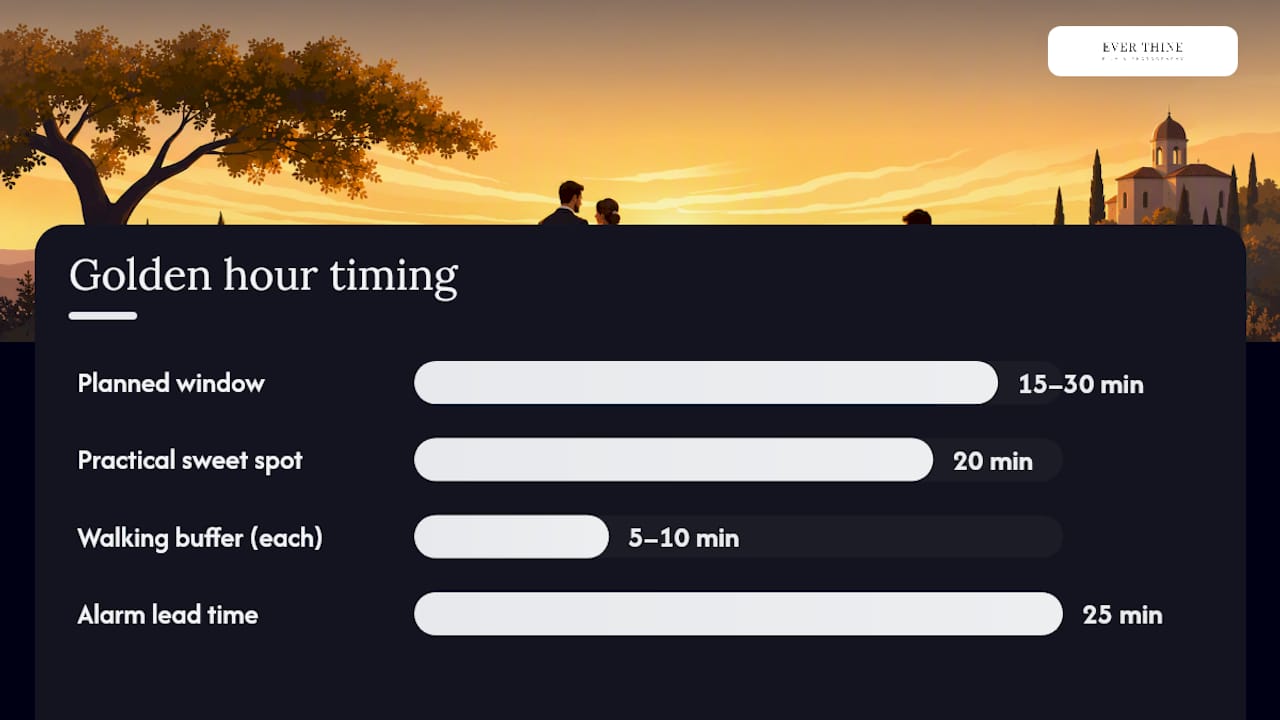
Block 15 to 30 minutes in the written timeline, with 20 minutes being the practical sweet spot most professional guides recommend
Add 5 to 10 minutes either side for walking to the spot and getting positioned, since that time is easy to lose and rarely gets accounted for
Choose a natural break point, such as cocktail hour, the gap between ceremony and reception, or between courses at the meal
Tell your planner, DJ, and photographer the exact slot so they can cover for your absence without guests noticing
Wedding planning guides consistently recommend building this 15 to 30 minute window into the schedule deliberately, rather than hoping to squeeze it in between other commitments. Leave it unplanned and it tends to lose out to speeches running long or a bar queue that won’t move.
Pro Tip: Set a phone alarm for 25 minutes before your calculated golden hour start. That gives you time to finish a conversation, find your photographer, and walk to the spot without the light already dropping by the time you arrive.
Scouting locations and planning for British weather
Walk your venue with the sun in mind, not just the view. Look for west-facing, open ground where the light has a clear run at you, elevated spots that catch the sun a few minutes longer than the valley floor, or a room with tall west-facing windows as a backup. If you can visit at a similar time of day and year to your wedding, do it. Sun angles change dramatically between June and October, so scouting in spring for an autumn wedding can put you in entirely the wrong spot.

Once you’ve found a location that works, mark it clearly. A photo, a pin, or simply agreeing coordinates with your photographer in advance saves time on the day.
A few practical points worth settling before the day arrives:
If cloud rolls in, a shift to a large west-facing window, warm-toned flash, or an earlier session slot can rescue the shots without losing the mood
Overcast skies aren’t a disaster either; diffused light is soft and forgiving, just cooler in tone than a clear golden hour
Decide whether you want an escort to fetch you discreetly or a set callback time, so your absence doesn’t turn into a search party
If you’d rather guests stay involved, use the same light for candid table shots or venue details rather than disappearing entirely
Pro Tip: Ask your photographer to note two backup spots, not just one. If the light clears the treeline earlier than expected, having an alternative ready means you don’t lose the window scrambling to find it.
What will your photographer actually be doing during golden hour?
A good photographer switches into a specific set of habits once the light turns warm, and knowing what they’re doing helps you understand why the session needs its full slot rather than five rushed minutes.
Shooting in RAW with manual exposure, rather than letting the camera guess, to hold detail in both skin and sky
Spot-metering on skin tone directly rather than relying on the whole scene, which keeps faces properly exposed even against a bright horizon
Setting ISO low, typically 100 to 400, with a wide aperture around f/1.8 to f/2.8 to separate you from the background
Choosing white balance manually rather than trusting auto, since auto white balance can neutralise exactly the warm tones you’re paying for
Positioning you so the sun rims your hair or shoulders rather than blasting straight into the lens, sometimes using a gold or silver reflector to bounce light back into the face
Letting a veil or loose fabric catch the backlight deliberately, which is where a lot of the most striking golden hour images come from
Some photographers extend the session into blue hour, the cooler, 20 to 30 minute window after sunset when the sky deepens to a rich blue and venue lighting starts to glow. It needs longer exposures and often a tripod or subtle flash, so it’s worth asking in advance if your photographer offers it. Worth asking too: how they handle white balance, whether they shoot manual, and what their backup plan is if cloud rolls in.
What experience shows about planning golden hour on the day
A well-run golden hour session rarely takes more than 15 to 20 minutes, yet it’s often where the standout images in an album come from. That’s less about luck and more about groundwork done beforehand: scouting the direction the light will fall from, timing the slot against sunset rather than the clock on the wall, and having reflectors or a backup spot ready if the weather shifts.
For couples, the reassurance is simple. The scouting, timing, and equipment side of golden hour is the photographer’s job to manage, not yours. Your part is agreeing the slot, wearing something that will catch the light well, and trusting the fifteen minutes you’ve set aside.
Our take on the golden hour obsession
Golden hour has become shorthand for “good wedding photos”, and that’s slightly misleading. The light matters, but the planning matters more. Couples who skip the timeline conversation and simply hope the light will be nice at some point in the evening usually end up with rushed, awkward portraits squeezed between the first dance and the cake cutting.
What the conventional advice gets wrong is treating golden hour as something that happens to you. It doesn’t. It’s a 20 minute window that has to be fought for on a day where everyone else wants your time too. The couples who get the images they hoped for are the ones who told their planner and DJ about the slot weeks in advance, not the ones who assumed their photographer would sort it on the fly.
If you take one thing from this, prioritise the conversation over the aesthetic. Agree the time, agree the spot, agree who’s fetching you. The light will do its own work once you’re standing in it.
— Dawn & Carl
Booking a photographer who plans golden hour properly
A DIY approach to golden hour means juggling a sun-tracking app, a scouting trip, and a written timeline on top of everything else a wedding demands. Weddingfilmphotography builds that groundwork into every booking, so the scouting, the timing, and the backup plan are handled before you arrive at the venue, not worked out on the day.
[
Packages across Staffordshire, Derbyshire, and Worcestershire include venue scouting for sun direction, a timeline built around your actual sunset time, and reflectors or lighting on hand if cloud rolls in. If you’re choosing an outfit with golden hour in mind, lighter or flowing fabrics from a source like Darius Cordell tend to catch the backlight far better than heavy, structured cuts. Get in touch to check availability for your date and talk through how a golden hour slot would fit your specific venue and timeline.
Sources
FAQ
Are golden hour photos worth it for a wedding?
Most couples find them worth the short break in the schedule, since the warm, soft light produces some of the most lasting images in the album, though the trade-off is a brief absence from the reception and some dependence on the weather.
How long before sunset should you do golden hour photos?
Start the slot right as golden hour begins, which is roughly 20 to 30 minutes before sunset, and check the exact time for your date with a tool like PhotoPills rather than estimating.
What colours work best for golden hour photos?
Warm, earthy, and jewel tones such as terracotta, sage, or burgundy tend to complement the amber light, while flowing or lightweight fabrics catch the backlight better than stiff, structured materials.
Is golden hour good for wedding pictures generally?
Yes, the low sun angle produces soft, even light with fewer harsh shadows than midday sun, which is why most professional photographers plan around it whenever the schedule allows.
How long should a golden hour session actually last?
Fifteen to thirty minutes is the practical range, with 20 minutes offering enough time for a handful of setups without pulling you away from the reception for too long.
Recommended


Comments