
UK Wedding Photo Turnaround: 4–8 Weeks and What to Contract

Most couples get their full edited gallery within four to eight weeks, with a good sneak peek landing in your inbox within 48 hours to two weeks of the wedding. Peak season, running roughly May to September, commonly pushes that full-gallery window out to a longer period. Always check the exact figure written into your contract rather than relying on the average.
TL;DR:
The full wedding photo gallery typically takes four to eight weeks to deliver, but peak season can extend this period up to 12 weeks.
A sneak peek of 5 to 25 images is usually shared within 48 hours to two weeks after the wedding, with a preview gallery arriving within two to four weeks.
Editing involves several stages and can require 15 to 36 hours per wedding, depending on the complexity of retouching and gallery size, often spread over scheduled days.
Delays are mainly caused by busy seasons, editing style, workload, additional deliverables, and studio workflow tools such as AI-assisted editing.
Couples should secure written guarantees for maximum delivery dates, quick delivery options, and specific timelines for albums and prints before booking.
Table of Contents
Wedding photo turnaround time: what to expect at each stage
“Wedding photo turnaround time” isn’t one number. It’s a sequence of milestones, and knowing them stops you from panicking three weeks in.
Sneak peek: 48 hours to two weeks. Usually 5 to 25 hand-picked images, shared on social media or a private link, depending on what the photographer promises.
Online gallery preview: 2 to 4 weeks. A slightly larger curated set, sometimes password-protected, sometimes public.
Full edited gallery: 4 to 8 weeks is the industry norm, with an average sitting around six weeks. Book a September wedding and that can stretch to 8 to 12 weeks purely because of demand.
Albums and prints: Add several more weeks on top of gallery delivery, depending on the lab’s production schedule and how quickly you approve the album design.
That last point catches people out. A “12 week delivery” quote for an album package often means 12 weeks to the gallery, then a design and approval cycle before the album itself ships.
What actually happens to your photos after the wedding
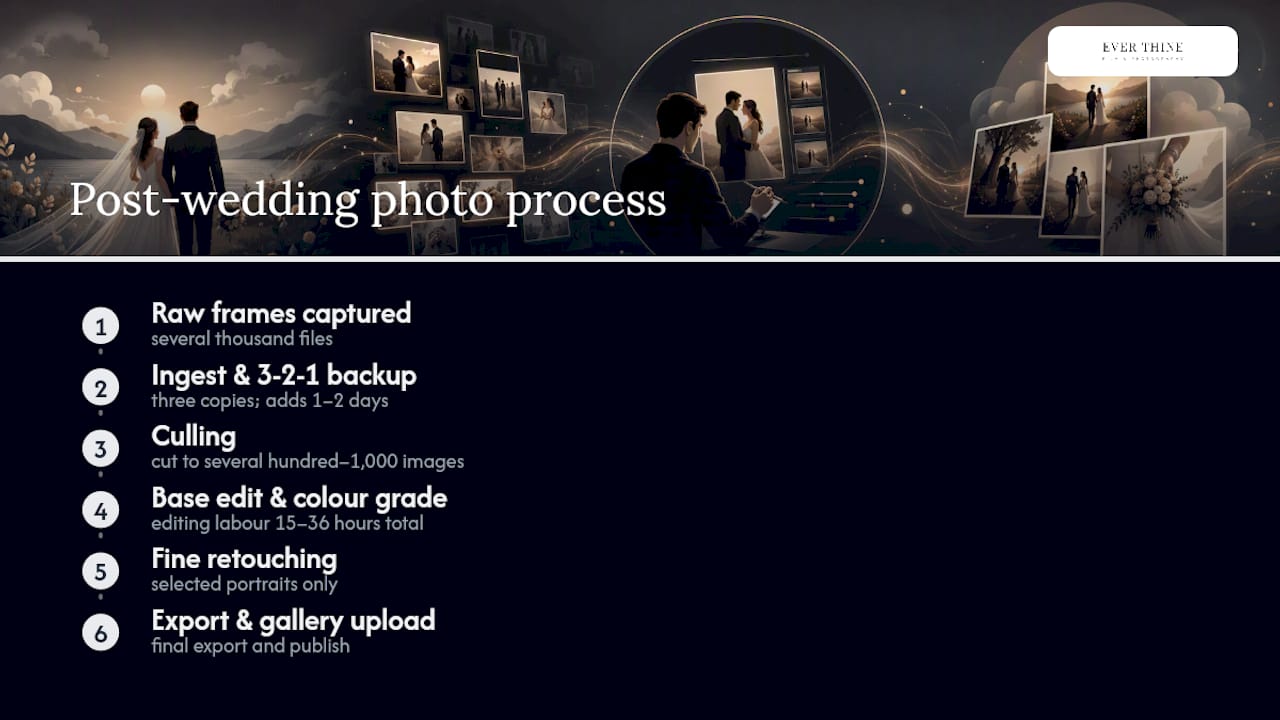
The wait isn’t photographers sitting idle. A typical wedding produces several thousand raw frames, and every one of them has to pass through a fixed sequence before it reaches your gallery.
First comes ingest and backup. Most studios follow a 3-2-1 approach: three copies of every file, on two different media types, with one stored off-site. It sounds like overkill until you remember these are the only copies of your day that will ever exist, and it typically adds a day or two before any actual editing starts.
Culling follows, cutting several thousand frames down to the strongest few hundred to a thousand. Then comes base editing and colour grading, followed by fine retouching on selected portraits, then export and gallery upload.
Editing labour alone commonly runs 15 to 36 hours per wedding, depending on gallery size and how much retouching each image needs. That’s not one sitting. It’s spread across scheduled editing days, fitted around every other wedding already in the queue.
Why some galleries take longer than others
A quoted timeframe only means something once you know what’s driving it. Five variables explain almost every delay you’ll come across.
Peak-season backlog. Book a Saturday in July and you’re one of dozens of weddings a busy studio shot that month, all queued for editing at once.
Editing style. Hand-graded, film-inspired editing with consistent tonal work across every image takes longer than preset-driven quick edits.
Workload. A photographer shooting two weddings a month clears the queue faster than one shooting ten.
Extra deliverables. Albums, large-format prints, a same-day highlight film, or a destination wedding with travel and logistics all add time on top of the standard edit.
Workflow tools. Some studios now lean on AI-assisted editing systems to speed up repetitive tasks, though many still keep portrait retouching and storytelling sequencing entirely human-led to protect quality.
None of these are red flags on their own. They’re just the reasons an honest 6 week quote can become 10 weeks for a September wedding with an album add-on.
What to put in the contract before you book
A verbal estimate isn’t a guarantee. Get these in writing before you sign anything.
Ask for a maximum delivery date, not just an estimate. “6 to 8 weeks” should have a hard outer limit stated somewhere in the contract.
Confirm the sneak-peek window in writing, including roughly how many images and how they’ll be shared.
Ask who can request rush delivery and what it costs, so you know the option exists before you need it.
Agree the final image count, file formats, and how long the online gallery stays live before it’s taken down.
Check what happens if the deadline is missed. A credible studio will offer some form of remedy or discount rather than leaving you with no recourse.
Ask separately about album and print timelines, since these run on their own schedule after the gallery ships.
A studio confident in its own process won’t flinch at any of this, and a list of pre-booking questions is worth working through before you ever discuss dates.
How to handle the wait without driving your photographer mad
A realistic sneak-peek package is usually a handful of hero shots, not a full narrative of the day, so don’t expect the ceremony, speeches, and first dance all in one preview. If you want a couple of extra images for social media, ask for a small, specific selection rather than the entire preview set reworked. Many studios are happy to oblige.
Expect the sneak peek within the window written in your contract, not the day after the wedding.
One polite check-in around the midpoint of the quoted timeframe is reasonable; daily messages aren’t.
Photographers often time preview releases to coincide with album sales conversations, so don’t be surprised if a lovely preview arrives alongside an upsell.
Pro Tip: Save your one follow-up message for the week the quoted range ends, not the week it begins. You’ll get a more useful answer, and you’ll look far less anxious doing it.
Rush and express delivery: is it worth paying for?
Most studios that offer rush editing will trim the standard 4 to 8 week window down to 2 to 4 weeks, with a smaller number offering 1 to 2 weeks for a premium fee. Rush fee amounts vary by studio and should always be confirmed in writing.
Expect a narrower deliverable set: fewer retouched hero images, faster (sometimes simpler) colour work.
Some studios outsource rush edits to a second editor, which can affect consistency across the gallery.
Agree rush terms and pricing before the wedding, not after, when you’re negotiating from a position of urgency.
How Weddingfilmphotography handles wedding photo delivery
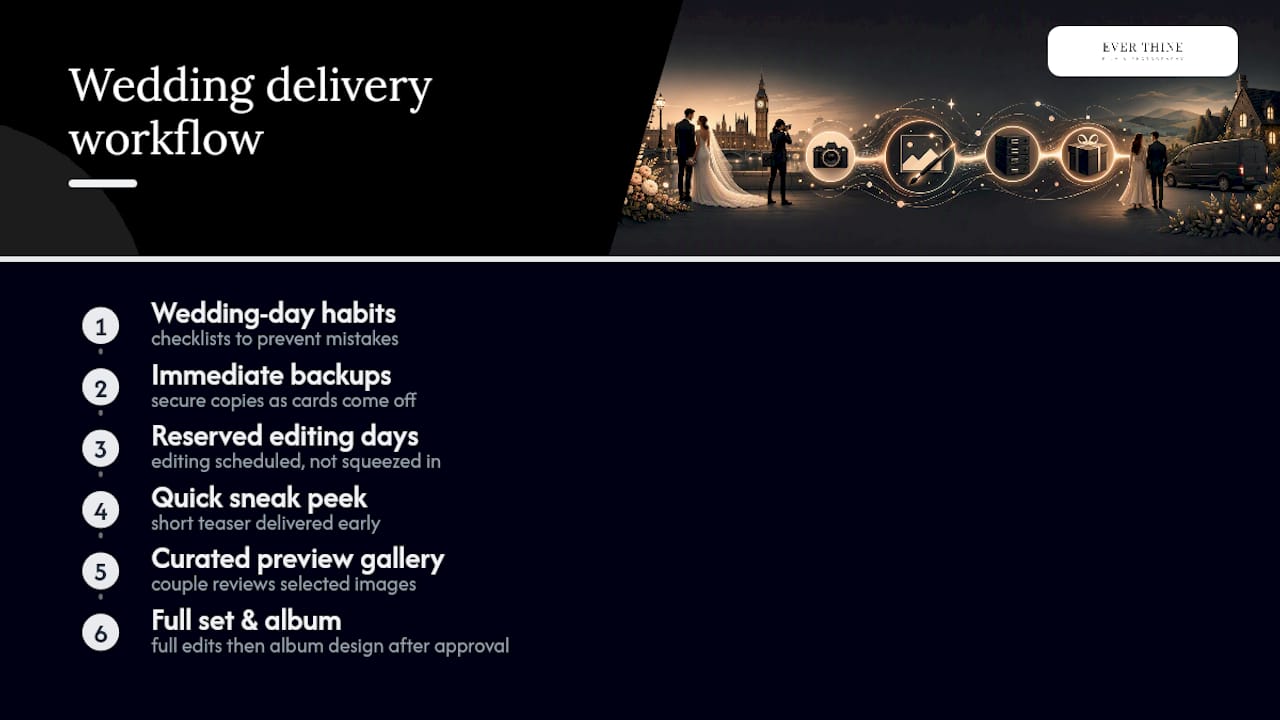
A typical delivery process involves stages such as a quick sneak peek, a curated preview gallery, then the full edited set, with album design following once the gallery’s approved. Behind that sits a fairly unglamorous set of habits, checklists on the wedding day itself, secure backups the moment cards come off cameras, and editing days scheduled in advance rather than squeezed in wherever there’s a gap.
Those habits exist specifically to stop delays creeping in. A documented delivery process and a clear wedding-day timeline both feed directly into how quickly (and how well) a gallery comes together afterwards. Couples who want the operational detail, right down to how culling and retouching are sequenced, can see the full breakdown in the detail photography workflow guide.
Why we sometimes take a little longer, and why it’s worth it
Editing time and image quality aren’t opposites fighting for your patience. They tend to move together. A slower, hand-graded pass across your whole gallery keeps the story consistent from the first look to the last dance, rather than treating each image as a separate job. We’d rather commit to a realistic date and hit it than promise something fast and hand back work we’re not proud of. You’ll always know roughly where things stand, because we tell you before you have to ask.
— Dawn & Carl
Book your wedding coverage and lock in a delivery promise
An advantage of some photographers can be delivering work in stages with written schedules, including sneak peeks, defined preview galleries, and agreed full-gallery dates.
[
Every package includes those staged delivery commitments as standard, so you’re never left wondering whether “a few weeks” means three or nine. Couples working with digital marketing partners such as SEO services built for photographers will recognise the same principle: clear, written expectations beat vague promises every time.
If you’re planning a wedding in Staffordshire or the wider West Midlands, take a look at the Staffordshire wedding photography page for packages and availability, or check the Derbyshire service page if you’re getting married nearby. Get in touch to check your date and ask for a bespoke delivery promise in writing before you book.
Sources
FAQ
What is the 30 minute rule for weddings?
It’s a planning guideline suggesting couples build some buffer time into each part of the wedding-day timeline, covering things like group photos or travel between venues, so delays on the day don’t cascade into missed shots or a longer editing job later.
Is three months too long to wait for wedding photos?
Three months exceeds the typical 4 to 8 week industry standard, so it’s worth asking your photographer directly why the timeline is longer, particularly if your contract didn’t specify a maximum delivery date.
How long do wedding photos take to get back in the UK?
Most UK photographers deliver the full edited gallery within 4 to 8 weeks, with sneak peeks arriving much sooner, often within 48 hours to two weeks of the wedding.
How long should it take to get my wedding photos?
For a standard wedding outside peak season, six weeks is a reasonable expectation for the full gallery; during peak season (May to September), 8 to 12 weeks is common and shouldn’t be treated as unusual.
Recommended


Comments