
Plan for £1500: Wedding Photographer Prices in the UK by Dawn & Carl

Most UK couples pay between £800 and £3,000 for their wedding photographer, with the realistic mid-market figure sitting closer to £1,800 for full-day coverage. London and the South East typically add £200 to £500 on top of that. Second shooters, albums and extra hours are the usual reasons a quote climbs above the headline number.
TL;DR:
Most full-day wedding photography in the UK costs between £1,500 and £2,500, with the national average around £1800, but typical full-day coverage is closer to £2,200.
Coverage hours significantly impact price, with extra hours costing £100–£250 each, and a second shooter adding between £300–£900 depending on experience.
Additional costs such as albums, expedited delivery, travel, and overtime can raise the final bill by several hundred pounds each, and VAT adds 20% if the photographer is VAT-registered.
London and South East weddings usually cost £200–£500 more than comparable events in other UK regions, mainly due to higher overheads and demand.
Always check quote details, including hours, image rights, travel, and overtime rates, to avoid surprises and ensure the package aligns with your full-day needs.
Table of Contents
Wedding photographer prices UK: typical ranges by tier
The published UK average sits at £1800, but that figure hides a lot. Bridebook’s own range runs from £500 to £2,500, and that spread exists because “wedding photographer” covers everything from a mate with a decent camera to a full-time professional with two decades of weddings behind them. Understanding the tiers matters more than fixating on one average.
Budget tier (£500–£1,200). This band typically buys part-day coverage, often ceremony through to the speeches rather than a full day from getting-ready to first dance. Expect a smaller number of edited images (perhaps 200 to 350), online gallery delivery, and little in the way of albums or prints. It suits couples with tight guest lists, registry-style weddings, or those prioritising videography or venue spend over photography.
Mid tier (£1,500–£2,500). This is where most full-day UK weddings land, and it is the band worth planning around rather than the national average. You should expect around eight hours of coverage, 400 to 700 edited images, an online gallery with a print release, and a photographer who has shot enough weddings to handle a chaotic timeline without needing hand-holding. Hitched’s guide to price drivers backs up this range as the realistic centre of the market.
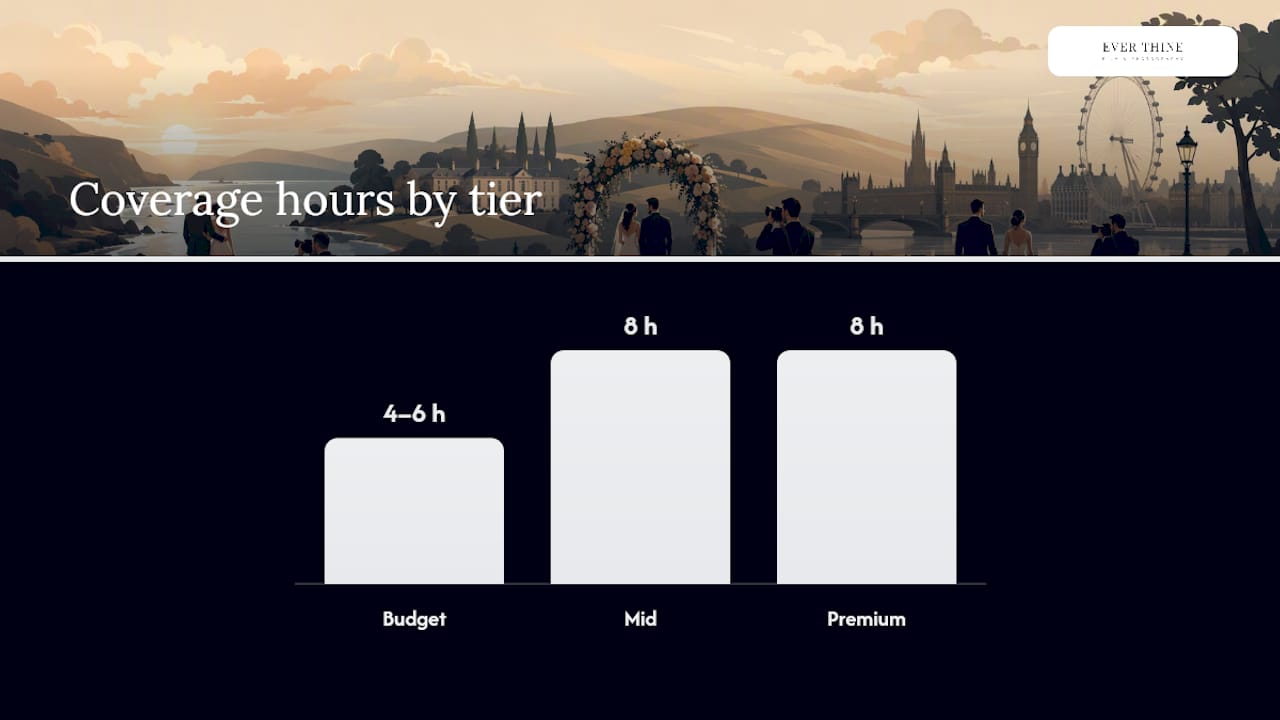
Premium tier (£3,000+). Above £3,000, you are usually paying for a second shooter as standard, a printed album included in the package rather than as an add-on, and often a photographer with award recognition or a distinctive editorial style. Some premium packages also bundle an engagement shoot or a next-day sneak peek gallery.
Practitioner guides argue the true planning figure for a conventional full-day wedding is closer to £2,200, because survey averages get pulled down by short-coverage and registry bookings that never represent a full wedding day. If you’re planning a traditional Saturday wedding with a ceremony, reception and evening party, budget nearer that £2,200 mark than the £1,484 headline average.
Tier | Typical price | Hours covered | What’s usually included | Best for |
Budget | £500–£1,200 | 4–6 hours | 200–350 edited images, online gallery | Small or part-day weddings, registry ceremonies |
Mid | £1,500–£2,500 | 8 hours | 400–700 edited images, gallery, print release | Most full-day UK weddings |
Premium | £3,000+ | 8 hours | Second shooter, printed album, priority editing | Large weddings, style-led couples, London/SE bookings |
Your own sample wedding photography packages will look slightly different photographer to photographer, but the shape of these tiers holds true across the market.
What drives wedding photography cost UK-wide
Coverage hours are the biggest lever. Going from six hours to a full eight or ten hours typically adds several hundred pounds, since those extra hours usually cover the getting-ready shots at one end and the evening dancing at the other, both of which need a second set of batteries, cards and often a flash setup.
A second shooter is the next major cost driver, and Bridebook’s data suggests it earns its keep specifically when preparations happen in two separate locations or the guest list runs past 100. Below that, a single experienced photographer with a good workflow usually covers everything that matters.
Experience and demand set the baseline rate before any of the above gets added. A photographer booked eighteen months in advance for peak Saturdays commands a different price to someone with spare dates in January. Weddings Hub notes that photographers with strong post-production workflows and clear backup procedures for image storage tend to charge more, and couples generally accept that premium because it removes a genuine anxiety.
Here’s what typically shifts the final number on a quote:
Coverage hours: each additional hour beyond a standard 8-hour day often adds £100–£250.
Second shooter: adds £300–£900 depending on experience and hours.
Editing and culling time: a full wedding day can generate 3,000–5,000 raw images, all of which need sorting before delivery.
Travel and accommodation: charged per mile or as a flat fee for venues beyond a photographer’s usual radius.
VAT: VAT-registered photographers must add 20% to the quoted price, which can catch couples out if they compare a VAT-inclusive quote against one that isn’t.
Pro Tip: Always ask “is that price plus VAT?” before you compare two quotes. A £1,800 quote from a VAT-registered photographer is actually £2,160, while a £1,900 quote from a non-registered sole trader might be the cheaper option once tax is added.
Post-production is the part couples rarely see and almost always underestimate. Culling five thousand images down to a curated gallery of five hundred, colour-grading each one, and backing everything up across multiple drives can take a professional twenty to forty hours after the wedding itself. That labour is baked into the price whether or not it’s itemised on your quote.
Common extras and what they typically cost
Beyond the headline package price, most couples end up adding at least one extra. Knowing the typical bands helps you budget rather than get surprised at the contract stage.
Second photographer: £300–£900, usually worthwhile for split preparations or guest lists over 100.
Engagement shoot: £150–£400, often bundled free into premium packages but charged separately at budget and mid tiers.
Wedding album: £300–£1,200+ depending on size, cover material and whether parent albums are included.
Extra hours on the day: £100–£250 per hour, best agreed in advance rather than negotiated at 11pm when the party’s in full swing.
Expedited delivery: some photographers charge £100–£300 to turn around a full gallery in one to two weeks instead of the standard six to eight.
Travel: typically charged at 25 to 60 pence per mile beyond a set radius, or as a flat day rate for genuinely remote venues.
Albums deserve a closer look because the range is so wide. A basic 20-page album from a budget supplier might cost £300, while a hand-bound, leather-covered album from a specialist supplier can run past £1,200 once you add a matching parent album or two. If a printed album matters to you, ask to see a physical sample rather than judging from a website photo, since paper stock and binding quality vary enormously between suppliers.
An engagement shoot is worth considering even if it’s not included as standard. Beyond the images themselves, it’s a low-pressure trial run with your photographer, useful for spotting whether you actually get on with how they direct a shoot before the far higher-stakes wedding day arrives.

Regional pricing: London premium and off-peak savings
Location changes the number more than almost anything else. Bridebook’s regional data shows London and the South East running £200 to £500 above the national picture, driven by higher photographer overheads and denser demand rather than better skill on average.
Season and day of the week matter almost as much. Saturdays between May and September carry a premium simply because that’s when every photographer’s diary fills first. Move your date to a Friday, a Sunday, or a winter month, and you’ll often find the same photographer quoting several hundred pounds less, partly because they’re filling a date that would otherwise sit empty.
A few practical points worth weighing when location and timing come into play:
London and South East weddings typically sit £200–£500 above the equivalent Midlands or Northern quote for the same coverage.
Peak Saturdays (May to September) often carry the highest prices of the year; winter weekday weddings can be noticeably cheaper.
Remote venue travel may trigger accommodation charges if the photographer needs to stay overnight rather than drive home after a long day.
Regional photographers who travel can offer London-quality documentary work at Midlands prices, since they’re not carrying London overheads.
Staffordshire, Derbyshire and the wider West Midlands sit well below the London premium while still giving couples access to photographers with genuine national experience. If you’re weighing up wedding photography prices in Staffordshire against a London quote for a comparable full-day package, the difference is rarely small.
How to read a quote and questions worth asking
A headline day rate tells you almost nothing on its own. Two photographers quoting £1,800 can offer wildly different value once you look at what’s actually included.
Line items to check on any quote:
Hours of coverage — does it start at getting-ready or only at the ceremony?
Number of edited images — a vague “all the best shots” isn’t a number.
Image rights and usage licence — do you get a print release, or does every reprint need the photographer’s approval?
VAT status — is the quoted figure inclusive or exclusive of VAT?
Travel costs — flat fee, per-mile rate, or included within a set radius?
Overtime rate — what happens if the first dance runs an hour late?
Turnaround time — is six to eight weeks standard, and what’s the cost to expedite?
Ask these questions early, ideally on your first call: What happens if you’re ill on the day, is there a backup photographer? How do you back up images during and after the wedding? Can I see a full gallery from a wedding at a similar venue, not just highlights? That last one matters more than it sounds. A practitioner tip worth taking seriously is asking to see an entire gallery from a similarly sized venue in the same season, because highlight reels hide inconsistency that a full gallery reveals immediately.
Contract red flags are worth memorising before you sign anything. Practitioner guidance flags four recurring issues: vague deliverable counts (“hundreds of images” with no firm number), no written licence covering how you can use and print your photos, unexplained travel or overtime charges that appear only after booking, and missing cancellation or rescheduling terms.
Pro Tip: Compare quotes on hours plus deliverables, never on the headline price alone. A £1,600 quote for six hours and 300 images is not cheaper than a £1,900 quote for nine hours and 600 images, it’s more expensive per hour of coverage and per image delivered.
For a deeper look at negotiating and comparing quotes side by side, this guide to understanding wedding photographer costs in the UK walks through the process in more detail.
Budgeting for your photographer: a worked example
Take a fairly typical UK wedding: 100 guests, full-day coverage, a mid-tier photographer, one second shooter, and a modest album. Here’s how that adds up.
Base package (8 hours, mid tier): £1,800
Second shooter (justified by the 100-guest count and split morning preparations): £500
Wedding album (mid-range, 30 pages): £450
VAT (if the photographer is registered, at 20%): £550
Total realistic budget: roughly £3,300
That’s higher than the £1,484 national average, and deliberately so. It reflects a genuine full day of coverage with the extras most couples with a 100-guest wedding actually want, rather than the shortest, cheapest booking that pulls survey averages down.
Albums, extra hours and expedited delivery have a habit of appearing after the initial booking, once you’ve seen your gallery and realised you want more than the base package delivered.
If your total wedding budget sits around £20,000, that puts photography spend somewhere between £1,600 and £2,400 before extras, which lines up closely with the mid-market figures throughout this guide. Couples with tighter overall budgets sometimes flip this ratio, spending proportionally more on photography because images are the one thing that outlasts the day itself.
Why photographer experience shapes what you pay
Higher fees rarely reflect vanity pricing. They usually map onto a specific set of tasks that happen almost entirely out of sight.
Every wedding we shoot involves hours of work the couple never sees: culling thousands of images down to a coherent story, colour-grading for consistency across changing light through the day, backing up every card in triplicate before we even leave the venue, and carrying insurance that protects both the couple and the venue if anything goes wrong. That’s the part a headline day rate never explains.
Insurance is one of the most overlooked line items in this entire conversation. Public liability cover and equipment insurance protect the venue as much as the couple, and increasingly, venues won’t allow a photographer through the door without proof of it. Backup workflow matters just as much: shooting to dual memory cards, backing up to two separate drives before leaving site, and keeping a cloud copy until the final gallery is delivered. None of that shows up in a sample gallery, but it’s the difference between a wedding day fully captured and a disaster if a card fails.
Credentials and awards act as a shorthand for all of this. A multi-award-winning photographer with years of full-time wedding experience has usually refined this entire backend process through repetition, which is part of why their pricing sits where it does. It’s not the only signal worth trusting, but it’s a genuine one.
Hourly rate versus fixed package pricing
Most UK wedding photographers price by package rather than by the hour, and for good reason. A fixed package (say, £1,800 for eight hours, a set number of edited images, and gallery delivery) gives both sides certainty. You know your total cost upfront, and the photographer can plan editing time and travel logistics around a known scope.
Hourly pricing appears more often at the budget end of the market or for couples who genuinely only need partial coverage, a ceremony and a handful of formal portraits, for instance. The risk with pure hourly pricing is that costs can climb unexpectedly if the day runs long, and there’s less incentive built in for the photographer to deliver a large, carefully edited gallery since the hours themselves are what’s being sold.
The most transparent quotes tend to blend the two: a fixed package price for a defined block of hours, with a clearly stated hourly overtime rate if the timeline slips. That structure protects you from a vague “extra charges may apply” clause while still giving the photographer fair compensation if your first dance runs two hours later than planned. When comparing quotes, check whether the overtime rate is stated as a specific figure or left open, since an open-ended overtime clause is one of the more common sources of an unexpectedly large final invoice.
Does photography style change the price?
Style genuinely affects cost, and not just as marketing spin. Documentary-style photographers, who capture the day as it unfolds with minimal posing or direction, tend to shoot far more frames per hour than a heavily directed, fine art style photographer who builds carefully composed portrait scenes. That difference in shooting approach translates into different editing workloads afterwards, and pricing reflects it.
Fine art and editorial-style photography, with its considered lighting, styled details and often a second shooter to capture candid moments while the lead handles posed shots, tends to sit at the premium end of the market. The upfront planning, styling consultations and heavier retouching all add time.
Documentary and reportage-style photographers, who prioritise authentic, unposed storytelling over staged compositions, can sometimes price more efficiently precisely because there’s less staging time built into the day. That said, an experienced documentary photographer with a strong reputation for candid storytelling commands premium rates too, since the skill lies in anticipating unrepeatable moments rather than directing them. Neither style is inherently better value, but knowing which one you actually want changes which photographers and price points are worth comparing.
Our take: plan around the real number, not the average
The published averages aren’t wrong, but they’re not the number you should budget around either. A £1,484 national average includes short registry bookings and part-day coverage that most full-day couples will never choose. Plan nearer £2,000 to £2,500 for a genuine full-day wedding, and treat anything below that as a tier decision, not a bargain.
Where conventional advice falls short is in treating “average” as a target. It’s a market statistic, not a recommendation. The couples who end up disappointed are usually the ones who booked to the average and only discovered afterwards what that price excluded, hours, images, or usage rights.
Prioritise coverage hours and deliverable numbers before you even look at style or portfolio. A beautiful portfolio built from six-hour bookings tells you nothing about how a photographer handles the exhausting eleventh hour of a wedding day. Ask for a full gallery, check the hours against the price, and only then let aesthetic preference decide between two photographers who are otherwise comparable.
— Dawn & Carl
Get a tailored quote from Weddingfilmphotography
Weddingfilmphotography gives you a fixed, transparent package price instead of a headline day rate that grows once VAT, travel and overtime get added. A typical full-day booking includes eight-plus hours of coverage, a curated online gallery, the option to add a second shooter for larger guest lists, and album choices ranging from simple to heirloom quality, all agreed upfront rather than itemised as surprises later.
[
Dawn & Carl bring multi-award-winning, documentary-style experience across Staffordshire and the wider West Midlands, with the same relaxed, unobtrusive approach whether the wedding is a local Staffordshire barn or a destination booking further afield. Their Staffordshire wedding photography page sets out proof points and package detail, and there’s regional coverage available for couples in Derbyshire and Worcestershire too.
If you’ve read this far and want a number specific to your own date, venue and guest list, get in touch for a tailored quote rather than relying on a national average that was never built around your wedding.
Sources
The pricing figures throughout this guide come from a mix of UK-wide wedding surveys and practitioner cost guides, each covering a different angle of the market.
Each source draws on a different sample, survey respondents, booked couples, or working photographers, so cross-referencing them gives a more reliable picture than relying on any single figure.
FAQ
How much does a 100-person wedding cost for photography in the UK?
For a full-day wedding with around 100 guests, budget roughly £1,800 to £2,500 for a mid-tier photographer, rising to around £3,300 once a second shooter and album are added.
Is £500 cheap for a wedding photographer?
£500 sits at the very bottom of the UK price range and typically buys only a few hours of part-day coverage rather than a full wedding day, so it’s worth checking exactly what hours and deliverables are included before assuming it’s a bargain. Also check out the experience and reviews of the photographer, you get one chance to have your day captured, do not regret going too cheap and booking someone with little or no experience.
How much should I budget for three hours of wedding photography?
Three hours of coverage generally falls at the lower end of the budget tier, often £400 to £700, and usually covers only the ceremony and a short period of formal photos rather than the full day.
How much is a wedding photographer in 2026?
The UK average sits around £1,800, but a realistic planning figure for a conventional full-day wedding is closer to £2,200, with London and the South East typically £200 to £500 above that.
Recommended


Comments