
What is a first dance photo?

TL;DR:
First dance photos are intentional images capturing a symbolically significant wedding moment rather than casual dancing. The style, lighting, and creative ideas shape unique, emotionally resonant photographs that tell the couple’s story. Proper planning, communication with the photographer, and authentic engagement enhance the quality and lasting impact of these cherished images.
There is a moment at almost every wedding reception where the room goes quiet, the lights shift, and two people step into the centre of the floor together. A first dance photo is the image that captures that precise moment. It is not a random snapshot of people swaying to music. It is an intentional, photogenic record of one of the most symbolically charged moments in a wedding day, and when photographed well, it becomes one of the images couples return to again and again across a lifetime.
Table of Contents
Key takeaways
Point | Details |
First dance photos are intentional | They document a specific, symbolic wedding tradition rather than casual dancing on the floor. |
Style shapes the image | Candid, posed, and choreographed dances each produce very different photographic results. |
Lighting and timing matter | Soft, low lighting and a dance of 2.5 to 3.5 minutes give photographers the best conditions. |
Creative ideas personalise memories | Silhouettes, confetti, and varied angles transform standard shots into genuinely memorable images. |
Albums give these photos lasting meaning | First dance images are central to wedding album storytelling and deserve careful curation. |
The history behind the first dance tradition
Long before it became a wedding staple, the first dance had its roots in formal balls and social gatherings where the most honoured couple would open the dancing for the assembled guests. It signalled status, unity, and a shared celebration. That tradition filtered into weddings over generations, and by the mid twentieth century it had become a near-universal feature of Western receptions.
What has changed significantly is the range of styles couples bring to it. Consider the difference between:
A slow, close waltz in near-darkness, the couple’s foreheads nearly touching
A fully choreographed routine with lifts, spins, and a surprise mid-song tempo change
A relaxed, informal shuffle that turns into a circle of guests joining in
A cultural first dance rooted in tradition, such as a Greek circle dance or a Bollywood-inspired performance
Each of these creates an entirely different set of photographic opportunities. The variation in dance style is not just a personal preference. It directly shapes what kind of images are possible, what emotions are visible, and what story the photographs will tell. A couple doing a surprise choreographed routine will produce dynamic, high-energy images. A couple choosing a slow, intimate moment will generate quiet, tender close-ups. Neither is better. Both demand a photographer who understood the plan in advance.
Photography itself evolved alongside this tradition. Early wedding photography was stiff and formal, taken in controlled light with long exposures. Modern first dance photography, by contrast, relies on fast lenses, high ISO capability, and a documentary eye. The result is images that feel lived-in and genuine rather than posed and performative.
What a first dance photo actually looks like
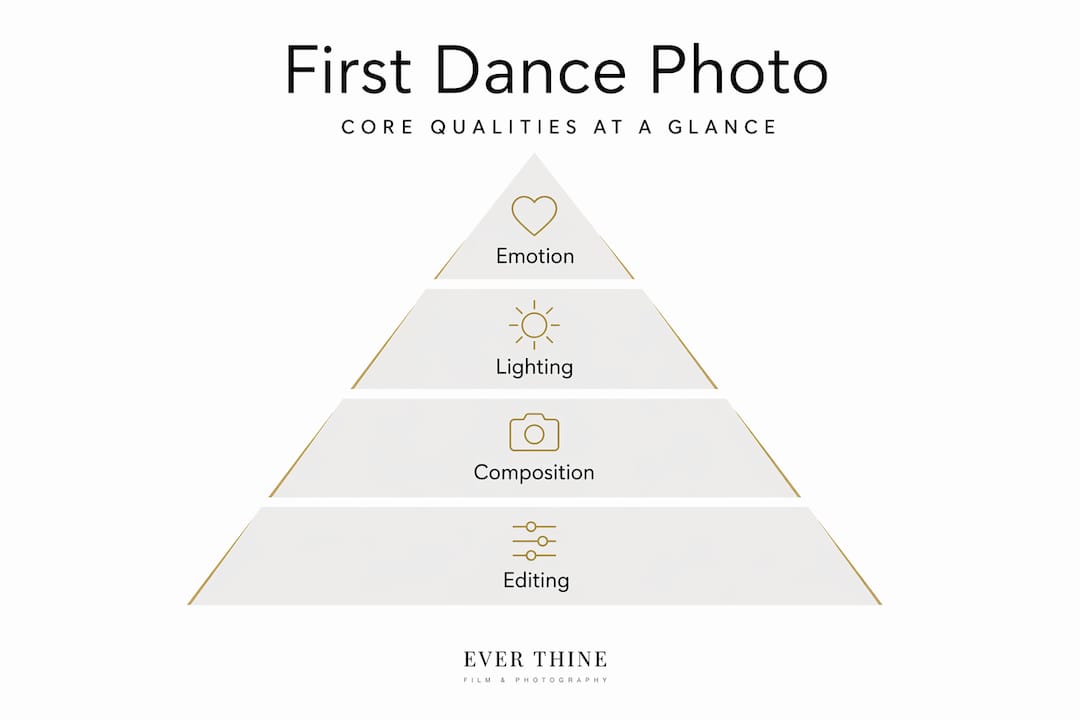
Not every image from the first dance qualifies as the first dance photo. The best ones share certain qualities, regardless of style or setting.
The typical composition moves through several types of shot across the duration of the dance. A wide establishing shot places the couple in the room, showing the lights, the guests watching, and the atmosphere. A mid-shot captures movement and connection without losing the environment. A tight close-up on hands, expressions, or a whispered word is where the real emotional weight often lives.
Mood matters enormously. There is a meaningful difference between:
Romantic and intimate: Soft lighting, shallow depth of field, the couple lost in each other
Joyful and energetic: Wider angles, motion blur used deliberately, guests laughing in the background
Tender and quiet: A close-up of closed eyes, a tear, a hand on a cheek
Celebratory and dynamic: Multiple exposures, high contrast editing, dramatic angles
Lighting conditions are one of the biggest technical challenges in first dance photography. Most venues dim the lights and add coloured or spotlit effects during the first dance, which looks beautiful to the human eye but creates genuinely difficult conditions for cameras. This is why first dance photography rewards photographers who work with fast lenses and understand how to read changing light in real time.
Pro Tip: Ask your venue coordinator exactly what the lighting plan is for the first dance before the day. Share this with your photographer in advance so they can prepare the right equipment and positioning.

The broad demand for these images across the industry reflects how central they have become. But the best first dance photos are not generic. They reflect the specific chemistry of that specific couple in that specific room on that specific evening.
Tips and ideas for capturing your first dance
The quality of your first dance photos is not purely down to your photographer’s skill. The decisions you make in planning play a significant role too.
Brief your photographer thoroughly. Tell them the song, the rough length, whether you have any choreography, and any specific moments you want captured. A photographer walking into the first dance blind will be reactive. One who knows what is coming can be intentional.
Choose your song length carefully. A first dance of roughly 2.5 to 3.5 minutes gives your photographer enough time to move around and capture variety without the moment feeling drawn out.
Position yourselves with light in mind. Where you begin your dance matters. Starting closer to a warm light source, whether a window, a chandelier, or a dedicated spotlight, gives your photographer something beautiful to work with from the opening frame.
Move naturally, not for the camera. The couples who look best in their first dance photos are almost always the ones who forgot there was a camera in the room. Talk to each other, laugh, whisper, let the moment actually happen.
Consider creative angles and ideas. Some of the most memorable first dance picture ideas involve the photographer shooting from above on a balcony, capturing a silhouette against a lit backdrop, or timing a shot with confetti or sparklers. These require advance planning but produce images that feel genuinely different.
Do not ignore the guests. Some of the best first dance images are reaction shots: a parent wiping an eye, friends cheering, children peeking through the crowd. These contextual shots are what transforms a portrait of two people into a story of a whole room.
Pro Tip: If you are having confetti or sparklers during the first dance, coordinate with your photographer beforehand so they know exactly when it will happen. Timing is everything for those shots.
For specific guidance on posing naturally during your wedding photography, it is worth reading up before the day. The couples who feel most comfortable in front of the camera are those who have thought about it in advance.
Selecting and displaying your first dance photos
Once you have your gallery, the work of choosing which images to keep and how to present them begins. This is where a lot of couples underestimate the importance of first dance photography in the broader wedding story.
Format | Best for | Consideration |
Printed wedding album | Long-term preservation and storytelling | Select 3 to 5 images that show variety: wide, mid, and close-up |
Digital gallery | Sharing with family and online | Curate rather than share everything. Quality over quantity. |
Social media | Immediate celebration and sharing | Choose one hero image with strong visual impact |
Wall prints or framed display | Home display | Opt for images with strong composition and timeless mood |
The significance of first dance images in a wedding album is hard to overstate. A well-structured album uses the first dance as an emotional pivot point, the moment the formal ceremony gives way to celebration. That shift needs to be visible on the page.
When selecting images from your gallery, resist the urge to choose only the technically perfect shots. Sometimes the slightly blurred image of a couple laughing mid-spin tells a more truthful story than the sharp, composed portrait. Emotion and authenticity carry more weight than technical precision in most wedding photography.
Creative editing can also shape how first dance photos feel. Black and white conversion often amplifies intimacy and timelessness. Warm-toned grading suits romantic, candid moments. High contrast processing works well for energetic, choreographed dances. Discuss your preferences with your photographer before the wedding so the editing direction feels consistent across the whole gallery.
My honest take on first dance photography
I have photographed a great many first dances, and the thing I have come to believe most firmly is this: the couples who enjoy their first dance always have better photos than the couples who try to perform it.
There is a particular kind of pressure couples put on themselves to make the first dance look good, and it almost always works against them. The moment you start dancing for the camera, something shifts in your eyes. The connection breaks just slightly. You can see it in the images.
What I have found works, every time, is encouraging couples to treat the first dance as a genuinely private moment that happens to have an audience. Forget the room. Forget the guests. Forget that I am circling you with a lens. Say something to each other. Tell a joke. Recall the first time you danced together. Whatever brings you back into the moment with each other is the thing that makes the photograph worth keeping.
The technical side of capturing first dance moments is learnable. Reading the light, choosing the angle, knowing when to hold still and when to move. What cannot be taught is the instinct for knowing exactly when a couple’s guard comes down and something genuine passes between them. That is the shot. And it is almost always the one nobody planned for.
— Ever
Capture your first dance with Weddingfilmphotography
[
Your first dance deserves more than a hurried snapshot from across the room. At Weddingfilmphotography, the team specialises in documentary-style wedding coverage that treats the first dance as the emotionally charged, story-rich moment it truly is. Working across Staffordshire, Derbyshire weddings, and Worcestershire, the approach is always the same: unobtrusive, perceptive, and genuinely invested in capturing what actually happened rather than what was posed for. If you are planning your wedding and want first dance photography that reflects the real emotion of the day, get in touch to discuss your date and vision. The first conversation is always free.
FAQ
What is a first dance photo at a wedding?
A first dance photo is a professional image capturing the couple’s opening dance at their wedding reception. It documents a symbolic wedding tradition and is considered one of the most emotionally significant images in a wedding gallery.
How long should the first dance be for good photos?
A first dance lasting 2.5 to 3.5 minutes gives photographers enough time to capture wide, mid, and close-up shots without the moment feeling rushed or drawn out.
What makes a first dance photo look its best?
The best first dance photos combine good light, genuine emotion, and variety in composition. Couples who stay present and connected to each other rather than posing for the camera consistently produce more natural and moving images.
Can first dance photos be taken in low light?
Yes. Skilled wedding photographers use fast lenses and wide apertures designed specifically for low-light wedding settings. Sharing the venue’s lighting plan with your photographer in advance makes a significant difference to the results.
What are some creative first dance photo ideas?
Silhouette shots against a lit backdrop, overhead angles from a balcony, confetti timed to the music, and guest reaction shots are all popular approaches. Many of these unique photo ideas require advance planning between you and your photographer to execute well.
Recommended
Comments