
Why include guest interviews in your wedding film?

Yes. Guest interviews turn a beautiful wedding film into a keepsake you’ll still watch for the emotional payoff, not just the visuals, decades from now.
Storytelling: Guests fill gaps your ceremony and reception footage can’t reach.
Keepsake value: Tribute reports that 84.4% of people cried happy tears watching a tribute-style video compilation.
Trade-offs: They cost extra staff time, need decent lighting and a quiet corner, and rely on guests actually wanting to talk.
Key Takeaways
Guest interviews work because they add authentic, varied voices that transform a wedding film from a visual record into an emotional keepsake couples rewatch for years.
Point | Details |
Timing shapes quality | Record earlier in the day, pre-ceremony through dinner, for calmer, clearer footage. |
Method depends on setup | Controlled booths give better audio; roving interviews feel more natural but need two crew. |
Lighting prevents waste | Poor lighting can make around 20% of clips unusable, so a small on-camera light matters. |
Participation needs signage | QR-based systems typically reach 75–85% uptake versus 50–60% for a single booth. |
Weddingfilmphotography approach | Ever Thine Film & Photography builds interview time and editing into the day rather than treating it as an afterthought. |
Table of Contents
What guest interviews add to a wedding film
A wedding film shot only from the couple’s angle tells half the story. Guest interviews bring in the aunt who flew in from Perth, the best man who still can’t believe you two got together, the grandparent who might not make it to the next big family event. That variety of voice, tone and memory is something a videographer standing behind a camera simply cannot manufacture alone.
The emotional pull is measurable. Tribute’s data shows 84.4% of people cry happy tears when they watch this style of compilation, and that reaction tends to repeat itself every time the couple rewatches it, at anniversaries, milestone birthdays, even when introducing the film to their own children later.
Guest messages also preserve things paper guest books never can: a laugh, an accent, a particular way someone says your name. Wedding video guest books built around this idea note that video keeps personality alive in a way handwriting flattens.
Three places this pays off:
A rehearsal dinner tribute reel played the night before, catching people off guard emotionally.
A reception montage cut between speeches, breaking up the formal structure with something looser.
A first-anniversary rewatch, when half the guests who spoke on camera have moved house, moved country, or simply changed.
Pro Tip: Ask your videographer to hold back one or two of the funniest clips for the very end of the film credits. It’s a small trick that turns a serious keepsake into something people want to watch again.
Best times and places to film guest interviews
Timing decides whether you get warm, coherent stories or mumbled, half-cut soundbites. Guests are sharpest and quietest earliest in the day, which is why many experienced shooters push for pre-ceremony or early reception slots rather than waiting until midnight.
Pre-ceremony: Calm, sober, well-lit, but you’ll miss guests who arrive later.
Cocktail hour: Good energy, natural mingling, but background chatter can hurt audio.
Dinner break: Captive audience at tables, though interruptions from service staff are common.
After-party: Loosest, funniest responses, but audio quality drops and stories get less coherent.
A quiet side room: Best sound and light control, but requires guests to physically leave the party.
Timing | Best for | Main drawback |
Pre-ceremony | Elderly or early-leaving guests | Misses late arrivals |
Cocktail hour | Natural, relaxed chat | Background noise |
Dinner break | Captive, seated audience | Service interruptions |
After-party | Honest, funny moments | Weaker audio and clarity |
A sensible schedule: fifteen minutes of setup before cocktail hour, a rolling forty-minute recording window across cocktails and early dinner, then a short side-room pass for anyone who couldn’t make it earlier or who’d rather speak privately. This also solves the accessibility question, since older relatives or remote family joining briefly are far more likely to speak clearly and comfortably before the drinks and volume climb.

How professionals run guest interviews: methods and kit
There are two dominant field methods practitioners use, according to discussion among working videographers on DVInfo: a controlled station, where guests come to a fixed setup, and roving table-to-table interviews, where the camera goes to them. A third option, QR-based messages recorded on a guest’s own phone, has grown popular because it needs no crew at all during busy moments.
Each has a clear trade-off:
Controlled booth — best audio and lighting, but some guests feel too formal to relax.
Roving/table-to-table — natural and spontaneous, but background noise and inconsistent light are constant fights.
Emcee-led staged interviews — a known face doing the asking increases comfort and pace.
QR-based messages — zero staffing cost during the event, but quality varies wildly and depends entirely on the guest’s own phone.
Minimum kit for reliable results:
Wireless handheld mic (or a lavalier if the guest will hold still)
Camera on a tripod for the controlled setup
A small on-camera light with diffusion, since venue lighting is rarely flattering
Headphones so someone is actually monitoring sound, not just hoping it’s fine
A plain, uncluttered backdrop
Staffing matters as much as gear. A single shooter can manage a stationary booth alone, but roving interviews work far better with two people, one filming, one asking questions and reading the room, so eye lines stay natural and the guest isn’t talking to a lens held by a stranger.
Pro Tip: Whoever holds the mic should be wearing headphones the entire time, not just checking levels occasionally. Wind noise and clipped audio are the single biggest reason usable interview footage gets binned.
How to get guests to join in without pressure
Nobody wants to feel cornered at a wedding, so participation works best when it feels optional and slightly fun rather than mandatory. DVInfo’s practitioner discussion notes that using a known, outgoing guest, a bridesmaid or groomsman, to lead the questioning breaks camera shyness far more effectively than a stranger with a microphone.
Simple prompts work better than clever ones:
“What’s one piece of advice you’d give the couple?”
“Tell us your favourite memory with either of them.”
“Finish this sentence: I knew they were right for each other when…”
For the DJ or MC, a short script helps: “If you fancy leaving a message for the happy couple, head over to [location] any time in the next half hour, no pressure, no script needed.”
A short participation checklist:
Clear signage (“Scan to record a message” performs particularly well)
A live preview screen so guests see clips going up in real time
A friend recruited by name in advance, so there’s always someone first
Multiple QR placements rather than one lonely sign by the bar
QR-based portals typically see 75–85% guest uptake compared with 50–60% for a single fixed booth, largely because people don’t have to queue or perform in front of others.
How interview clips make it into your final film
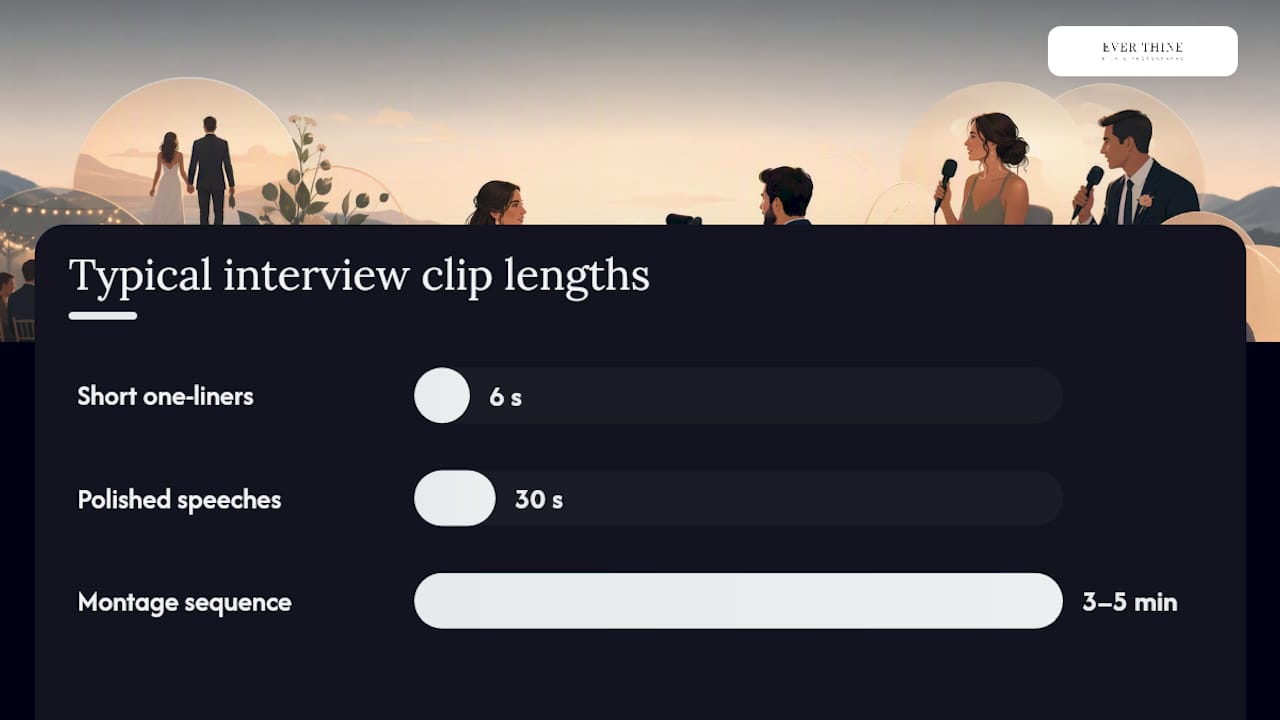
Not every clip needs to survive the edit, and that’s the point. Wedcuts advises keeping interview footage short and favouring raw, spontaneous lines over anything over-rehearsed, since a genuine six-second laugh often lands harder than a polished thirty-second speech.
Typical use across the finished film:
Short one-liners cut between ceremony and reception footage
A dedicated montage sequence, often three to five minutes, played during dinner
A single standout line used to close the entire film
Deliverables worth expecting from your videographer:
Labelled individual clips, not just one long raw file
A separate audio export for anyone wanting to use quotes elsewhere
Optional short social clips sized for sharing
A full, unedited interview reel if you want to keep everything
Ask how removal requests are handled too. A guest who says something private on camera should be able to ask for that line to be cut before the final version is locked.
Pro Tip: Request your full interview reel as a separate file from the main film. You’ll likely rewatch a two-minute highlight far more often than the full ninety-minute cinematic cut.
What to ask your videographer and what it costs
Guest interviews are usually priced as an add-on rather than folded silently into a package, since they demand extra staff hours during the event and extra editing time afterwards, a point echoed in practitioner pricing discussions.
Questions worth putting to any videographer before you sign anything:
Is a second shooter included for roving interviews, or is that an extra fee?
Who reviews and approves clips before they’re used, and can guests request removal?
Will I receive raw audio files as well as the edited film?
How long is the recording window built into the day’s schedule?
What happens to clips shared on social media, do you handle uploads or do I?
What tends to push the price up: added staff time, an extra camera for a second angle, a dedicated audio kit, and the editing hours needed to sort through raw footage for the best material. Our guide to questions every couple should ask a wedding videographer covers the wider briefing conversation in more depth.
Before booking, confirm the contract covers usage rights for clips, the approval and removal process, delivery timelines, and that the studio carries proper insurance for the day.
Risks that spoil guest interviews and simple fixes
Most problems here are entirely preventable if you flag them early with whoever’s filming.
Noisy background: Move the setup away from speakers, even ten feet helps significantly.
Poor lighting: Eventoly notes that bad lighting alone can make roughly 20% of clips unusable, so a small on-camera light is worth insisting on.
Reluctant guests: Recruit a known face to go first and break the ice.
Clip overload: Set a rough time limit per guest so editing doesn’t become unmanageable.
Late arrivals or missed guests: Offer a QR code that stays live after the wedding for anyone who couldn’t make the recording window.
A short pre-event checklist with your planner or videographer, confirming location, lighting, and backup recording options, catches most of this before it becomes a problem on the day.
Pro Tip: Always have a QR-based backup ready. If the live recording window gets swallowed by a running-late timeline, guests can still leave a message from their phones later that evening.
Why we build guest interviews into every film we can
There’s a couple we filmed where the bride’s grandmother, too frail to make the speeches, sat with us quietly for two minutes before dinner and told a story nobody else in the room had heard in years. That clip became the heart of the entire film, not the vows, not the first dance.
We treat guest interviews the same way we treat the rest of the day: unobtrusive, never staged to the point of feeling fake, curated afterwards into something that earns a rewatch. You can see how that plays out across our portfolio and client stories before deciding if it’s right for your own day.
How Ever Thine Film & Photography handles guest interviews
Booking a videographer purely on price often means guest interviews get bolted on as an afterthought, rushed setup, one microphone, no real editing plan. Ever Thine Film & Photography builds them into the day’s schedule properly: wireless mic kit, a dedicated interview window during cocktail hour or dinner, and an editing process that turns raw clips into a genuine narrative thread through your film, not a bonus reel nobody watches twice.
[
What’s included typically covers the crew time for a controlled setup or roving pass, on-camera lighting so clips actually look good, and an edited montage woven into your final film alongside a separate full interview reel if you want it. Package details, sample films and client feedback are all available on our Staffordshire wedding photography page, and couples further south can check our Worcestershire service page for local availability. If you’re planning a wedding and want guest interviews done properly rather than tacked on, get in touch through our Derbyshire wedding photography page to check your date and talk through add-on options.
Sources
FAQ
Do guest interviews add much to the cost of a wedding film?
Yes, typically as a separate add-on, since it needs extra staff time during the day and additional editing afterwards rather than being folded into a standard package.
How long does filming guest interviews usually take?
A recording window of thirty to forty minutes during cocktail hour or dinner is common, plus roughly fifteen minutes for setup and a short wrap-up.
What’s the best method for getting shy guests to open up?
Using a friend or family member the guest already knows to ask the questions works better than a stranger holding a microphone.
Can guests who aren’t at the wedding still leave a message?
Yes, QR-based recording links can stay active after the event so remote or missed guests can still contribute.
Does Weddingfilmphotography include guest interviews as standard?
Weddingfilmphotography offers guest interviews as a planned add-on with dedicated crew time and editing, available across its Staffordshire, Derbyshire and Worcestershire packages.
Recommended

Comments