
100 g rule and 120 m ceiling: drone rules for UK weddings
Yes, you can legally fly a drone at a UK wedding, but only within strict Civil Aviation Authority rules. You need a Flyer ID once your drone weighs 100 g or more, an Operator ID for most cameras, and you must never fly over a crowd. There’s also a 120 m altitude ceiling, and anyone shooting for payment needs proper insurance. The detail on IDs, distances, venue permissions, and hiring a pilot follows below.
TL;DR:
Drone pilots at UK weddings need both Flyer and Operator IDs, especially for drones over 100 g with cameras, and they must be displayed on the aircraft.
Flying over crowds is strictly prohibited, with a 50-metre horizontal buffer, regardless of drone weight, and the flight altitude cannot exceed 120 meters.
Consent from guests is implied through notices and briefing, but filming identifiable faces still counts as personal data under UK GDPR, requiring privacy considerations.
Venue permission must be obtained in writing, with a designated takeoff spot, site reconnaissance, and liability clauses incorporated before flight.
Commercial drone operators must carry valid insurance coverage, with policies explicitly confirming coverage for the specific venue and planned flight conditions.
Table of Contents
What are the drone wedding regulations UK couples need to follow?
Every drone flight in the UK sits under the Civil Aviation Authority’s registration scheme, and weddings get no special exemption. The two IDs that matter are the Flyer ID and the Operator ID, and they cover different things.
Flyer ID proves the pilot has passed a free CAA theory test. From 1 January 2026, you need one for any drone weighing 100 g or more, a significant drop from the old 250 g threshold that now catches many lightweight consumer models previously flown without a licence.
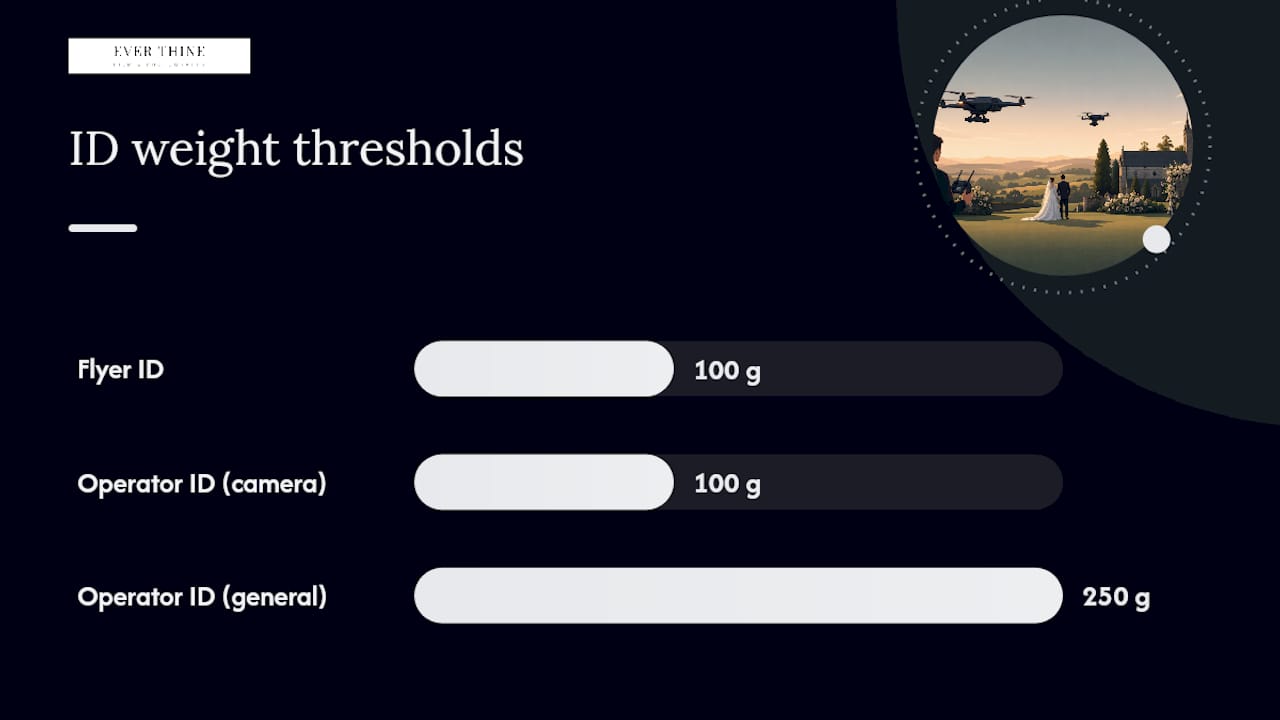
Operator ID is the registration for whoever owns or is responsible for the drone. You need it for drones of 250 g or more, or for anything 100 g and above fitted with a camera, which covers virtually every model used for wedding footage. The Operator ID number must be displayed on the aircraft itself, and if a company owns the drone, the business registers rather than the individual pilot.
A few other points trip people up:
Drone class matters. UK0, UK1, and higher classes determine which open sub-category (A1, A2, or A3) a drone can legally fly in, and that governs how close it can get to people and buildings.
Age rules apply. You typically need to be old enough to sit the theory test yourself, though a parent or guardian can register the drone on a minor’s behalf in some cases.
Overseas credentials don’t transfer. A pilot’s licence or drone registration from another country isn’t valid for flights within UK airspace, no matter how experienced they are elsewhere.
If you’re hiring a professional for wedding coverage, ask to see both IDs before booking. It takes thirty seconds and rules out an entire category of legal headaches later.
How close can a drone fly to wedding guests?
The Drone and Model Aircraft Code sets three limits that matter most on a wedding day: a 120 metre (400 ft) altitude ceiling, a requirement to keep the drone within visual line of sight at all times, and an absolute ban on flying over crowds.
That crowd ban is the one couples and suppliers most often misunderstand.
The rule that catches people out: the crowd ban applies to every drone regardless of size or weight. A featherweight 50 g toy drone breaks the same law as a 20 kg cinema rig if it flies over an assembled group of people who can’t disperse.
The standard horizontal buffer is 50 metres from uninvolved people, though the smallest drones in sub-category A1 get some relaxation and can fly closer to individuals who haven’t consented to being nearby. That relaxation never extends to crowds. A wedding ceremony, with rows of seated guests who can’t easily move, is treated as a crowd under CAA guidance on where you can fly. A dispersed reception, where people are milling about a garden or terrace with room to move, is a different matter entirely.
For operations that need to step outside these baseline rules, such as flying genuinely close to a static, uninvolved audience, the legal route is PDRA01 or a bespoke Specific Category authorisation built on the UK SORA framework. Neither is designed for casual wedding use, and both require planning well in advance of the day.
Altitude: 120 m maximum, always within sight of the pilot.
Horizontal buffer: 50 m from uninvolved people as a baseline.
Crowds: an outright ban, with no weight-based exception.
Do you need consent to film wedding guests with a drone?
Drone footage that shows identifiable faces counts as personal data under UK GDPR, and that brings the same obligations that apply to any photographer or videographer working a wedding, just with a wider field of view and less control over who ends up in frame.
The practical answer isn’t complicated. Most couples and suppliers handle it through clear notice rather than individual sign-off from every guest, since chasing signatures from eighty people mid-reception isn’t realistic.
Put a simple notice on the wedding invitation or order of service mentioning that drone footage will be captured.
Brief the venue and any other suppliers so nobody is caught off guard mid-shot.
Avoid flying over private areas such as changing rooms, guest accommodation, or anywhere people have a reasonable expectation of privacy.
Give an easy way for anyone uncomfortable being filmed to say so before the drone goes up, not after.
Pro Tip: Keep raw footage only as long as you need it for editing, then archive or delete it. A clear retention policy, even a one line note in your contract, makes it far easier to respond if a guest later asks what happened to footage they appeared in.
What venue checks do you need before flying a drone at a wedding?
Venue permission is not optional, and it needs to be in writing well before the wedding day. Many venues have their own drone policies, particularly listed buildings, National Trust properties, and anywhere near livestock or protected wildlife.
Ask the venue directly whether drones are permitted, and get the answer confirmed by email rather than a verbal nod from a wedding coordinator.
Agree a take off and landing spot that’s away from guest areas, with a backup emergency landing zone identified in case of a sudden battery or control issue.
Identify “involved people” such as the couple, the wedding party, and key suppliers who understand the operation and have consented to being nearby during flight, since this group can legally be approached more closely than uninvolved bystanders.
Walk the site in advance to check for power lines, tall trees, narrow sightlines, and likely spectator routes that could bring uninvolved people into the flight path unexpectedly.
Put drone terms in the supplier contract, covering who is liable for the aircraft, what happens if weather forces a cancellation, and who owns the footage rights afterwards.
A proper site recce, ideally weeks before the wedding rather than on the morning itself, turns most of this into routine admin instead of a last minute scramble.
What insurance does a wedding drone operator need?
Any paid drone work is commercial activity in the eyes of UK law, and that means third-party liability insurance isn’t a nice extra, it’s expected practice for any pilot taking money for the job. This holds true whether the drone weighs 200 g or 2 kg. A smaller aircraft doesn’t reduce the commercial obligation just because it’s lighter and cheaper.
Before booking anyone to fly at your wedding, ask for:
Their Flyer ID and Operator ID numbers.
A current insurance certificate showing the policy level, territorial coverage, and indemnity sum.
Written confirmation from the insurer, or the operator, that cover extends to the specific venue and type of operation planned that day.
A short operations summary covering how they’ll handle crowd avoidance and altitude limits on site.
Pro Tip: Insurance policies often carry territorial or activity exclusions that aren’t obvious from a policy summary alone. Ask the operator to confirm, in writing, that the policy covers commercial wedding filming at your exact venue, not just “UK drone operations” in general.
Flying outside the Drone Code, whether that’s over a crowd or beyond the 120 m ceiling, can invalidate insurance entirely and leaves the pilot personally liable for any damage or injury. That’s a risk no couple wants attached to their wedding day.
How do you plan safe drone coverage for a wedding day?
Getting aerial footage without legal risk comes down to timing and preparation rather than luck. Most experienced operators build the drone slot around the reception, not the ceremony, precisely because a room full of seated guests is exactly the crowd scenario the Drone Code prohibits.
Schedule the flight for the reception or golden hour, when guests are naturally more dispersed across a garden, terrace, or car park rather than seated in rows.
Check the airspace for the venue postcode ahead of time, particularly if you’re near an airport, helicopter route, or military zone, since local restrictions can apply on top of the national rules.
Check the weather forecast the morning of, and have a clear cut off point (wind speed, visibility) beyond which the flight simply doesn’t happen.
Assign roles clearly: one person as pilot in command, ideally a second as a spotter watching for guests wandering into the flight path, and a point of contact liaising with the venue.
Agree a stop signal in advance so anyone on site can flag a problem and the pilot brings the drone down immediately, no discussion needed.
For the paperwork, a single line in the supplier agreement covering drone use and footage rights saves confusion later: something like “aerial footage will be captured subject to weather and safety conditions on the day, with usage rights assigned as per the main photography and videography agreement.” Couples who want to see what this looks like in practice can browse examples of drone wedding videography in action before deciding whether it suits their venue.
Pro Tip: Always have a plan B shot list that doesn’t need the drone. Weather, venue restrictions, or a packed guest list can rule out aerial footage at short notice, and a couple who never expected to miss it won’t mind if the ground-level coverage was strong enough to carry the film anyway.
What experienced wedding suppliers actually see on site
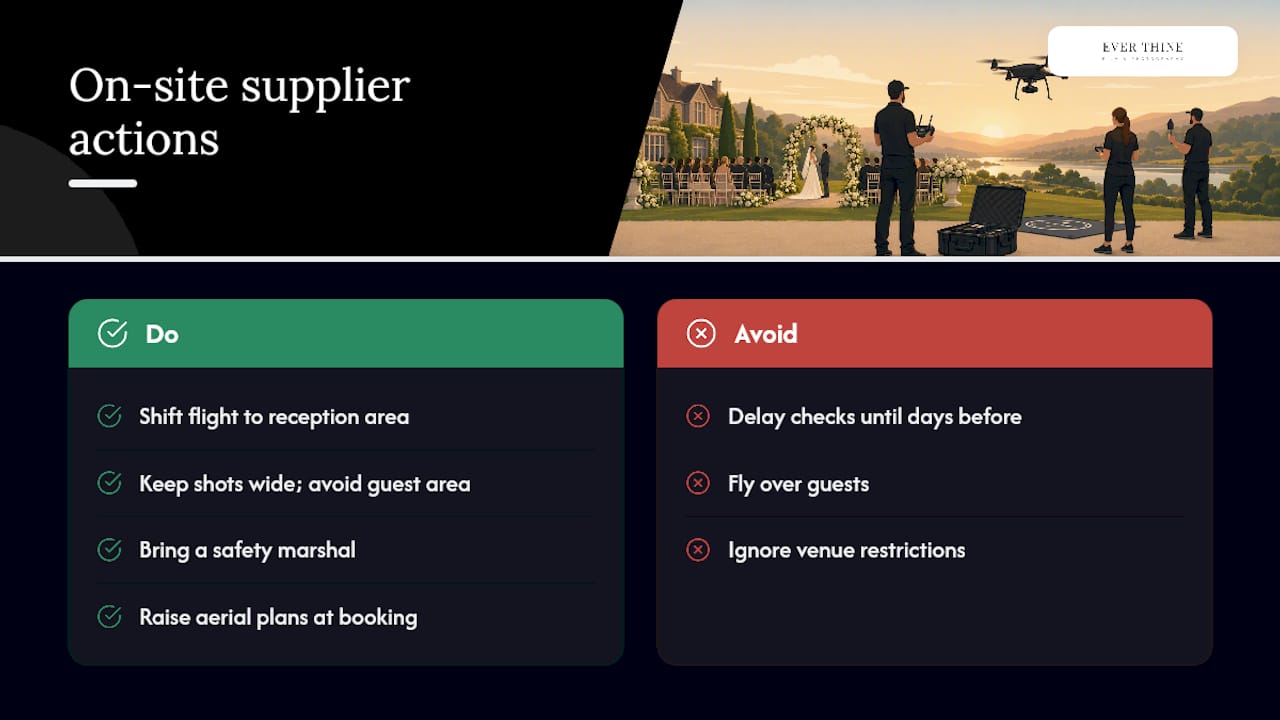
Venue restrictions are rarely about the law itself, they’re about liability and nervous venue managers who’d rather say no than research the rules. The workaround is usually straightforward: shift the flight to the reception, keep the shot wide rather than over the guest area, and bring a safety marshal so the venue sees you’ve thought it through.
Couples planning aerial footage for their wedding film get the smoothest results by raising it early with their photographer and videographer, ideally at booking stage, so venue checks and airspace clearance happen with weeks to spare rather than days.
— Dawn & Carl
Get compliant drone coverage without the legwork
Chasing Flyer IDs, insurance certificates, and venue sign-off yourself adds weeks of admin most couples don’t have time for. Some wedding photography businesses handle groundwork such as venue liaison, proof of insurance, and a pre-flight safety plan as part of their approach to weddings that include aerial coverage, so clients may not need to verify paperwork themselves during the final week.
[
When you book with us, we agree the shot list and airspace checks during planning, not on the morning itself, and we brief every venue on take off points, timing, and crowd avoidance before we arrive. Our wedding videography packages can include drone footage where the venue and conditions allow it, alongside documentary-style coverage of the day itself. If you’d rather have same-day highlights alongside your film, our wedding content creation service starts from £600. Get in touch through our wedding photography and videography page to check drone availability for your date and venue.
Where to check the current rules yourself
Rules change, and the CAA is the only source worth trusting for the current position. Bookmark these before your wedding:
The Drone and Model Aircraft Code, the primary regulator document covering altitude, distance, and crowd rules.
CAA registration pages for Flyer ID and Operator ID applications.
Guidance on where you can fly, covering sub-category distances and the crowd definition in detail.
Sources
FAQ
Can I fly my drone at a wedding?
Yes, provided you hold the correct IDs, stay within the 120 m altitude ceiling, and never fly over guests gathered as a crowd. Ceremonies with seated guests are usually off-limits for overflight, while a dispersed reception often allows lawful aerial shots.
What are the new drone rules in the UK for 2026?
From 1 January 2026, the Flyer ID threshold dropped to drones weighing 100 g or more, down from the previous 250 g mark. The CAA has said this change could affect up to 500,000 existing flyers, so it’s worth reconfirming your registration even if you passed the test previously.
How much does a wedding drone show cost in the UK?
Pricing varies by operator, drone type, and whether it’s a single flypast or a full drone light show, and isn’t standardised across the industry. Weddingfilmphotography includes drone coverage as part of tailored videography packages, with pricing available on request through our wedding videography page.
Can you fly a 249 gram drone anywhere in the UK?
No. A drone under 250 g still needs an Operator ID if it carries a camera once it’s 100 g or heavier, and the crowd ban applies regardless of weight. Being under 250 g gives some flexibility in how close you can fly to individuals, but it never permits flying over an assembled group of people.
Recommended


Comments