
Inside a videographer's toolkit: essentials for UK weddings
TL;DR:
A professional wedding videographer’s kit includes multiple cameras, lenses, audio recorders, stabilizers, lighting, and drones.
Equipment choices are tailored to venues, weather, and wedding schedule to ensure reliable coverage.
The quality of a wedding film depends more on the videographer’s skill and storytelling than on their gear.
Most couples assume their wedding videographer will simply turn up with a camera and press record. The reality is strikingly different. A professional toolkit for a UK wedding spans multiple camera bodies, specialist lenses, dedicated audio recorders, stabilising equipment, lighting gear, and potentially a drone with its own regulatory paperwork. Understanding what goes into that kit bag helps you ask the right questions, set realistic expectations, and ultimately choose the videographer who will give you a film worth watching on every anniversary for the rest of your lives.
Table of Contents
Key Takeaways
Point | Details |
More than a camera | A videographer’s toolkit includes cameras, audio, accessories, and backups for all wedding moments. |
Legal and venue ready | UK professionals must comply with drone laws and have portable gear for multi-location events. |
Audio matters most | Clear audio equipment is as vital as video gear for recording vows and speeches. |
Preparation beats equipment | Experience and adaptability make a bigger impact than simply having the latest kit. |
Understanding the modern videographer’s toolkit
The role of a wedding videographer is far more complex than it might appear from the other side of the ceremony aisle. Rather than a single camera operator, a professional arrives as a one-person production unit, or ideally as part of a small, discreet team, carrying everything needed to capture your day beautifully regardless of what the weather, the venue, or the schedule throws at them.
A modern toolkit divides neatly into two categories. Core equipment covers the essentials without which no great film is possible: cameras, lenses, audio recorders, and microphones. Bonus tools are the creative extras that separate competent coverage from something genuinely cinematic: drones, gimbals (motorised stabilisers that keep footage silky smooth), and portable lighting. Both categories matter, but their priority and relevance shift depending on your venue, your day structure, and the style of film you want.
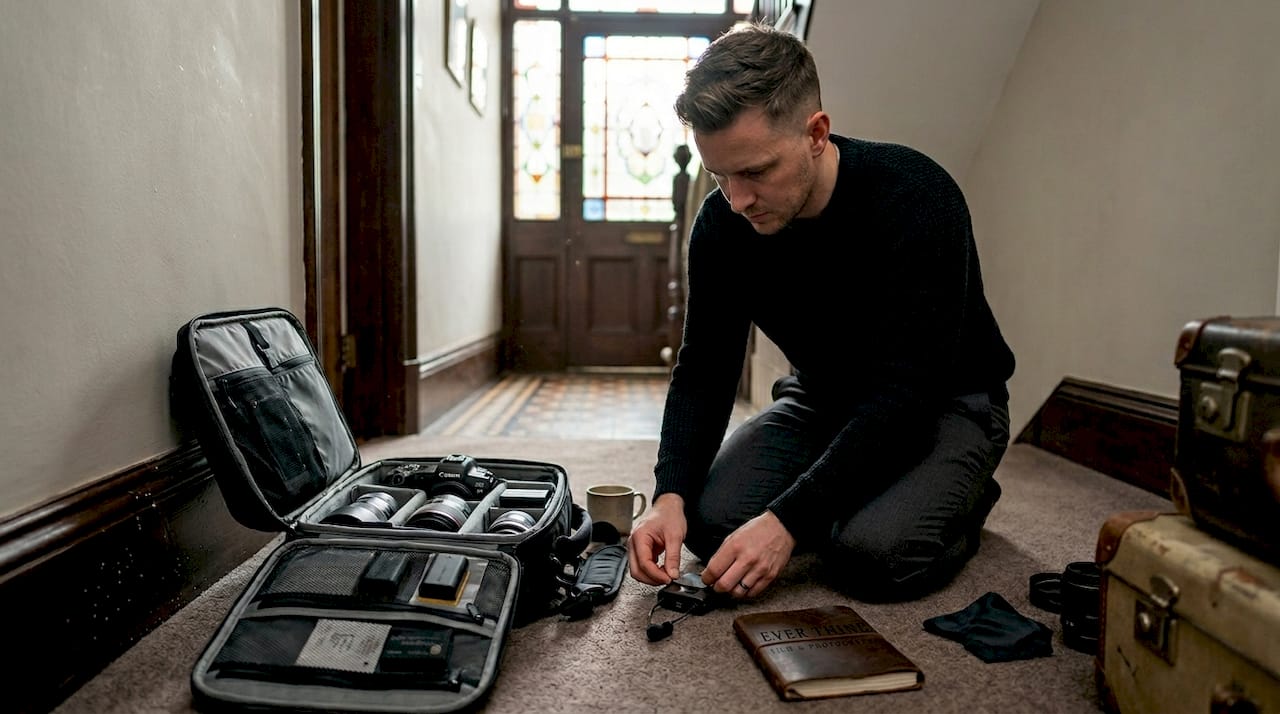
Portability is an underappreciated factor. UK weddings frequently span several locations, moving from a registry office to a church, then on to a country estate for the reception. Gear must be portable for multi-location days, and any professional worth hiring will have a system for moving efficiently without missing a single moment. Here is a quick overview of what a fully stocked wedding videography toolkit typically contains:
Primary camera body (mirrorless or cinema camera)
Backup camera body (same or compatible system)
Range of lenses (wide, standard, telephoto)
Lapel microphones (also known as lavalier or clip-on mics)
Dedicated audio recorder (records separately from the camera)
Shotgun microphone (directional mic mounted on the camera)
Gimbal stabiliser (for smooth, moving shots)
Drone with CAA (Civil Aviation Authority) compliance documents
Portable LED lighting panels
Multiple memory cards and batteries
Weatherproof cases and rain covers
Toolkit category | Items | Primary benefit |
Core camera gear | Bodies, lenses | Story and coverage |
Audio equipment | Lapel mics, recorders | Clear, emotional sound |
Stabilisation | Gimbal, tripods | Smooth, professional movement |
Creative extras | Drone, lighting | Cinematic variety |
Backup supplies | Cards, batteries, covers | Reliability on the day |
Knowing why hiring a professional videographer matters so much comes down to precisely this level of preparation. The kit is extensive because every wedding is unpredictable.
Cameras, lenses and capturing the wedding story
The heart of any great wedding film is the camera system. Modern professional videographers at UK weddings most commonly use mirrorless cameras, though cinema cameras are increasingly popular for couples wanting that ultra-cinematic look. DSLRs (Digital Single-Lens Reflex cameras) are the older generation of interchangeable-lens cameras, and while technically capable, most professionals have moved on to mirrorless systems that offer superior autofocus, lighter bodies, and better low-light performance.
Mirrorless cameras, such as those from Sony, Canon, or Panasonic, produce exceptional 4K footage, handle the dim lighting of a candlelit church beautifully, and are quiet enough to be virtually undetectable during vows. Cinema cameras offer even richer colour science and greater dynamic range (the ability to capture detail in both bright windows and shadowy corners simultaneously), but they tend to be bulkier and require more setup time.
Carrying multiple cameras on the day is not a vanity exercise. During the ceremony, one camera might be locked on a wide shot from the back of the room, capturing the full scene, while a second is operated handheld for close, intimate moments. A third body, if available, might be positioned at the altar, all without anyone needing to physically move a camera mid-ceremony. The result is a film that feels dynamic and complete rather than limited to a single vantage point.
Lenses are equally important. A fast prime lens (a fixed focal length lens with a wide aperture) at around 35mm or 50mm is ideal for capturing candid moments up close without invading personal space. A telephoto lens, typically in the 70 to 200mm range, allows the videographer to zoom in on emotional expressions from the back of the room without disrupting the atmosphere. Wide-angle lenses work beautifully for establishing shots of venues, giving viewers a sense of place and grandeur.
Pro Tip: For indoor venues with low lighting, such as Victorian church interiors common across the UK, a lens with an aperture of f/1.8 or wider makes an enormous difference. It allows more light in without needing to raise the ISO (the camera’s sensitivity to light) to a level that introduces visual noise or grain into the footage.
Current wedding videography trends show a strong preference for that natural, filmic look, which is achieved precisely through thoughtful lens choice and camera settings rather than relying on heavy post-production editing.
Camera type | Best use | Key advantage |
Mirrorless | Ceremonies, receptions | Light, fast, quiet |
Cinema camera | Stylised coverage | Rich colour and dynamic range |
DSLR | Budget-friendly backup | Versatile and widely available |
Audio essentials: capturing vows and atmosphere
Visuals alone do not tell the full story. Ask any couple who has watched their wedding film back and the moments that make them cry are almost always the spoken ones: the trembling voice during vows, the laughter during the best man’s speech, the quiet words exchanged during the first dance. Crystal-clear audio is what makes those moments land with full emotional weight.
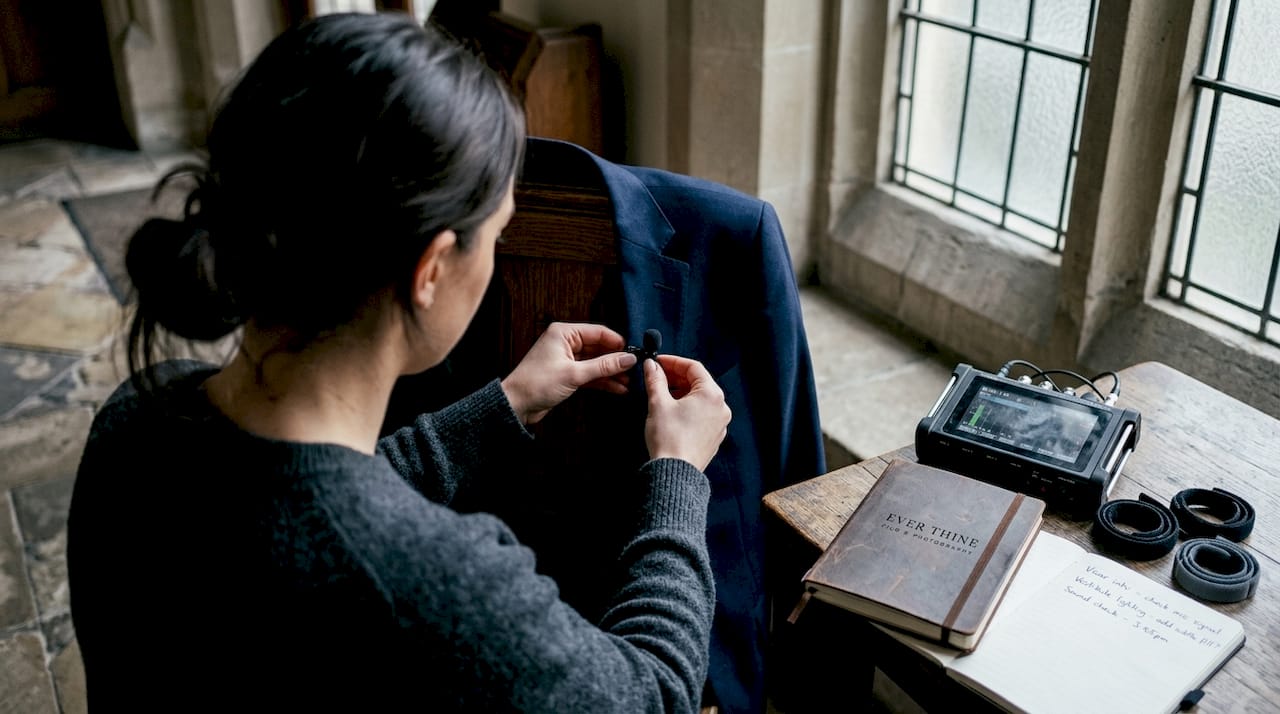
In-camera microphones, the built-in ones found on every camera body, are essentially useless for professional wedding recording. They pick up handling noise, camera clicks, the hum of air conditioning, and distant conversations rather than the specific voices that matter. Professional videographers rely on dedicated audio equipment to solve this problem.
A lapel microphone, also called a lavalier or radio mic, is a tiny clip-on device that attaches discreetly to the groom’s jacket. It transmits audio wirelessly to a receiver clipped onto the camera or, better still, to a dedicated audio recorder that captures an entirely separate, high-quality sound file. Some videographers also place a small recorder near the officiant or on the lectern, providing multiple independent audio sources for the edit. For UK wedding audio logistics, gear portability and quick deployment between venues is critical.
Here is how a thorough videographer prepares and monitors audio on the day:
Fit the lapel microphone to the groom well before the ceremony begins, testing levels and checking for clothing rustle.
Place a backup recorder near the ceremony space, such as on the officiant’s table, as an independent safety net.
Monitor levels in real time using headphones or a small monitor during the ceremony.
Record separately on a dedicated audio recorder so that even if camera audio fails, the sound is protected.
Check and pack all audio gear between venues to ensure nothing is left behind during transitions.
Pro Tip: Ask your videographer whether they use a dual-system audio setup. This means audio is recorded simultaneously on the camera and on a separate device. If one fails, the other saves the day. It is a simple question that tells you a great deal about a videographer’s level of professionalism and how seriously they take the craft of wedding storytelling.
A shotgun microphone mounted on the camera itself is also a standard inclusion, picking up ambient sound and natural atmosphere. This layer of background noise, from the rustle of dresses to guests laughing softly, is what makes a wedding film feel real and immersive rather than clinical.
Drones, gimbals, and creative accessories
For couples wanting sweeping aerial shots of their country house venue or a bird’s eye view of guests gathering on the lawn, a drone is a genuinely exciting addition to the toolkit. However, the conversation about drones cannot start with visuals alone. In the UK, all commercial drone operators must comply with CAA drone regulations, including holding appropriate operator registration and flying within strict airspace rules.
“Any professional using a drone for commercial wedding videography in the UK must hold a valid GVC (General Visual Line of Sight Certificate) or equivalent qualification, and the operator must be registered with the Civil Aviation Authority. Always ask to see these credentials before confirming drone coverage.”
Beyond legal compliance, venue permission is a separate layer of consideration. Many heritage properties, National Trust venues, and urban locations have blanket restrictions on drone use. A prepared videographer will have already contacted your venue to confirm access weeks before your wedding day. This is not optional admin. It is the difference between a legal, beautifully executed aerial sequence and a costly, stressful situation on one of the most important days of your life.
Gimbals are the other major creative tool. A gimbal is a motorised, three-axis stabilising device that the videographer holds while the camera is mounted on top. Even while walking quickly or navigating a crowd, the gimbal produces footage that glides as smoothly as if it were on a dolly track. The effect is immediately cinematic and works particularly well for first dances, grand entrances, and coverage of stunning venue interiors.
Additional creative accessories that complete the professional toolkit include:
Slider rigs for slow, horizontal tracking shots across tablescapes or detail shots
LED lighting panels with adjustable warmth for dim reception rooms
Lens filters to manage bright outdoor light without overexposing the footage
Reflectors for softening harsh sunlight during outdoor portraits
You can explore drone wedding videography in more detail to understand when it genuinely adds value to a film rather than simply being a technical novelty.
Adapting to the UK wedding calendar and venues
All the finest gear in the world means nothing if a videographer cannot adapt swiftly to the realities of a British wedding day. UK weddings are famously unpredictable. A June morning might start with bright sunshine and shift to horizontal rain by noon. A ceremony that was planned for an outdoor terrace may migrate inside with twenty minutes’ notice. The gear must be portable and weatherproofed for exactly these scenarios.
A thorough wedding videography planning guide will address these contingencies well in advance, but here is a practical breakdown of common UK challenges and the toolkit solutions that address them:
Unpredictable rain: Weatherproof camera covers, sealed cases for audio equipment, and microphone windshields prevent damage and maintain sound quality.
Moving between venues: Pre-packed, labelled kit bags with a clear inventory mean nothing is left behind during the rush between the ceremony and reception.
Low-light receptions: Fast lenses, high-performance cameras with strong low-light capability, and portable LED panels ensure beautiful footage regardless of candle-only venue restrictions.
Restricted drone zones: Always have a land-based alternative plan, such as a gimbal walk or elevated tripod shot, so aerial limitations do not create gaps in coverage.
Heritage venue restrictions on equipment: Some listed buildings do not allow tripods on historic flooring. Monopods or handheld shooting methods provide a quick, respectful alternative.
Tight scheduling: A streamlined, well-organised kit bag means a professional can be fully set up and rolling within minutes of arriving at a new location.
What most couples miss about a videographer’s toolkit
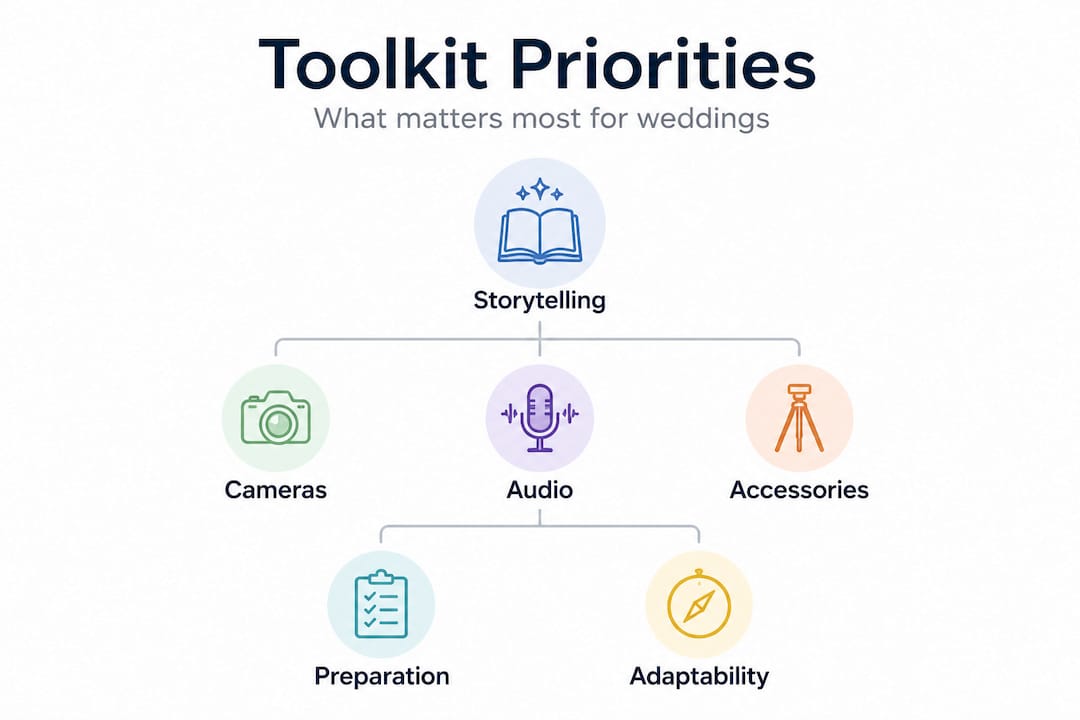
Here is something that experience teaches quickly: the couples who get the most extraordinary wedding films are rarely the ones who hired the videographer with the most expensive gear. They are the ones who hired someone with the best instincts, the deepest understanding of storytelling, and the adaptability to work within the real, messy, emotional rhythm of a wedding day.
There is a genuine risk in being dazzled by flashy kit. A drone, a cinema camera, and a full lighting rig in the hands of someone who lacks the emotional intelligence to stay unobtrusive will produce technically competent footage that feels hollow. Conversely, a skilled videographer with a compact mirrorless system and two prime lenses will often produce something far more moving, because they are free to be present, to anticipate moments, and to follow the story rather than the equipment requirements.
The toolkit serves the story. It does not replace the storyteller. When you are assessing a videographer, watch their films before you even glance at their gear list. Does the film feel like your wedding could feel? Does it capture the small, unexpected moments, the grandmother dabbing her eyes, the flower girl losing interest halfway down the aisle? That is the work of someone whose toolkit is in service of their craft, not the other way around.
Understanding the value of a videography team also matters here. Two people with well-matched, portable equipment will capture more of your day than one person with double the gear and only two hands. The toolkit conversation is inseparable from the team conversation.
Find your ideal wedding videographer
Now that you understand what sits inside a professional’s kit bag, the next step is finding the team that knows how to use it all in a way that is right for your wedding. Reviewing a videographer’s portfolio alongside their equipment list gives you a complete picture: the gear tells you they are prepared, the films tell you they are talented.
[
We work across the Midlands and beyond, tailoring our approach to your specific venue, schedule, and the story you want told. Whether you are looking for Derbyshire wedding photographers, Staffordshire wedding photographers, or Worcestershire wedding photographers, we would love to chat about your day. Get in touch to discuss your vision, ask about our kit, our approach, and how we make sure your wedding film is everything you hoped it would be.
Frequently asked questions
Why is a videographer’s toolkit different for UK weddings?
UK weddings require portable, versatile gear because they frequently span multiple locations, and drone operators must comply with CAA regulations alongside individual venue permission requirements.
Should we check if our videographer owns their equipment?
Yes, absolutely. Knowing your videographer owns and regularly maintains their kit confirms they understand its capabilities and can handle any technical issues independently on your wedding day.
What is the most important item in a videographer’s toolkit?
The primary camera body and dedicated audio recording equipment are both essential, as they safeguard the visual and spoken moments that make your wedding film genuinely emotional and memorable.
Can all wedding venues allow drone footage?
No. Many UK venues, particularly listed buildings, heritage sites, and urban locations, prohibit drone use outright, and all commercial drone operators must hold valid CAA registration regardless of venue permission.
Why do some videographers carry so much gear?
A well-stocked kit ensures they can adapt to the unpredictable conditions of UK wedding days, from sudden rain and low lighting to venue changes and restricted equipment access, without missing a single meaningful moment.
Recommended
Comments