
What is a wedding trailer? Your guide to stunning films
TL;DR:
A wedding trailer is a short, emotionally impactful film capturing the most powerful moments of your day, typically one to three minutes long. It serves as a quick, heartfelt highlight reel designed for easy sharing and rewatching, often delivered before the full wedding film. To create an authentic trailer, personalized storytelling and genuine moments are essential, moving beyond formulaic templates to reflect your unique celebration.
There is a moment, usually a few weeks after the wedding, when a short film lands in your inbox and you watch it three times before breakfast. That is a wedding trailer. Yet so many couples book their videography without quite knowing what a trailer is, how it differs from a highlight film, or whether they actually need one. This guide explains the difference between all three main wedding film formats, shows you how trailers are made, and gives you practical tools to ensure yours genuinely captures the spirit of your day rather than looking like every other wedding on the internet.
Table of Contents
Key Takeaways
Point | Details |
Wedding trailer definition | A wedding trailer is a concise, cinematic preview of your wedding day’s best moments. |
Trailer vs. other films | Trailers are shorter and more shareable than highlight films or full videos. |
Creation process | Expert planning and editing are key to crafting a meaningful trailer. |
Personalisation | Tailoring your trailer makes it more memorable and emotionally powerful. |
Benefits for couples | Wedding trailers let you relive and share your favourite moments instantly. |
What is a wedding trailer?
A wedding trailer is a short, cinematic film, typically one to three minutes long, that distils the most emotionally powerful moments of your wedding day into a single watchable piece. Think of it the way a film studio trailer works: it is not trying to tell the whole story. It is trying to make you feel something, fast.
As described in our wedding highlight film guide, “wedding trailers condense the best moments of your day into a short, emotive film.” The format is built around emotional peaks rather than chronological storytelling.
A well-crafted trailer will typically include:
The look on your partner’s face as you walk down the aisle
Candid laughter between you and your guests
A line or two from the vows, chosen for impact
Key ceremony and reception moments
Atmospheric shots of the venue, details, and setting
“A wedding trailer is not a summary of your day. It is a feeling captured on screen. When it is done right, watching it should give you the same sensation as being there.”
Couples choose trailers for several reasons. They are quick to share, emotionally resonant, and easy to rewatch. They also arrive faster than a full film, meaning you can relive the experience within weeks rather than months. For many couples, the trailer becomes the film they watch most often, precisely because it is short enough to fit into an ordinary evening.

Wedding trailer vs. highlight film vs. full wedding film
Confusion between these three formats is extremely common, and understandably so. The terminology varies between videographers, and some use “trailer” and “highlight film” interchangeably when they are actually distinct products. Understanding the difference will help you ask the right questions when booking.
As our cinematic wedding video guide makes clear, “highlight films and trailers serve different roles in documenting your wedding day.” Here is how each one breaks down:
Wedding trailer: One to three minutes. Pure emotional impact. Designed for sharing and rewatching. Uses music-driven editing and strong visual pacing. Often delivered first.
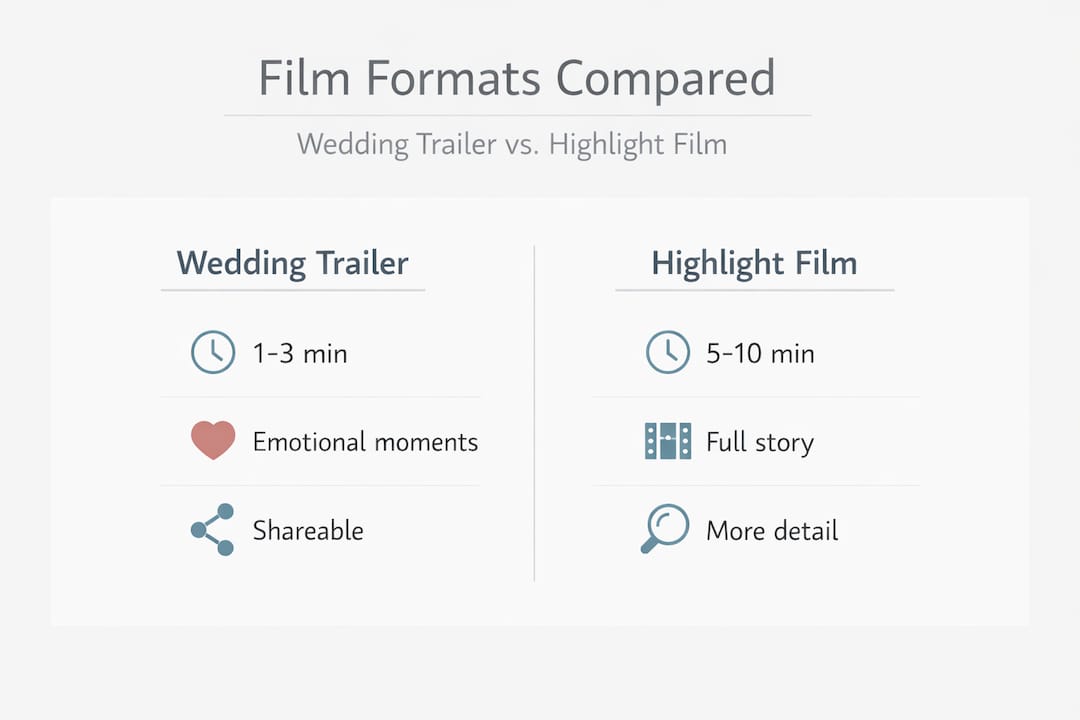
Highlight film: Typically five to ten minutes. Tells more of the story from start to finish. Includes more of the ceremony, speeches, and reception. Provides context alongside emotion.
Full wedding film: Usually 60 to 90 minutes or longer. A near-complete documentary record of the day. Captures full speeches, full ceremony, and extended footage. More for preserving memory than casual sharing.
Film type | Typical length | Main focus | Best for | Turnaround |
Wedding trailer | 1 to 3 minutes | Emotional highlights | Sharing online, reliving quickly | 2 to 4 weeks |
Highlight film | 5 to 10 minutes | Story and atmosphere | Showing family, rewatching with depth | 6 to 12 weeks |
Full wedding film | 60 to 90+ minutes | Complete documentation | Archiving, deep memory keeping | 12 to 20 weeks |
Many couples opt for a package combining a trailer and a highlight film. The trailer is the thing you share immediately; the highlight film is the one you sit down and watch properly. You might want to explore why a wedding film matters before deciding which formats suit you best.
When choosing between formats, think honestly about how you plan to watch and share the footage. If you love the idea of showing your wedding to friends over dinner, a highlight film works beautifully. If you want something to post online that captures your day in under three minutes without losing emotional impact, the trailer is the one.
How wedding trailers are created: the process behind the magic
Understanding how a trailer is made helps you appreciate why it costs what it costs, and more importantly, how to get the best possible result from the process.
Professional wedding videography “combines documentary moments with cinematic editing for a compelling trailer.” The process generally follows these stages:
Pre-wedding planning: Your videographer discusses the shape of your day, key moments you want captured, and your visual and musical preferences. This is where personalisation begins, not in the edit suite.
Shooting on the day: A skilled videographer works unobtrusively, capturing both planned moments (the first look, the first dance) and spontaneous ones (a grandmother wiping away a tear, two friends laughing during the speeches).
Story selection in the edit: From hours of footage, the editor identifies scenes with the strongest emotional resonance. Not just visually impressive shots, but moments that carry genuine feeling.
Music choice and pacing: Music drives the emotional arc of a trailer more than almost any other single element. The editor matches pace, cuts, and mood to the chosen track, building and releasing tension in a way that mirrors how the day actually felt.
Colour grading: This is the visual finishing step that gives a trailer its cinematic quality. Colour grading unifies the look of footage shot across different lighting conditions throughout the day, creating a consistent, beautiful aesthetic.
Delivery and revisions: The finished trailer is shared with you for feedback, with revisions made before the final version is delivered.
The wedding storytelling guide covers in detail how narrative structure shapes a film that actually moves people rather than simply documenting events.
Pro Tip: Before your wedding, write a short list of three to five “must-have” moments for your trailer. These might include a specific speech moment, the look your partner gives you during vows, or a shot of your pet walking down the aisle. Share this list with your videographer in advance so they know exactly where to be and when.
Why choose a wedding trailer? Benefits for modern couples
A wedding trailer is not just a nice extra. For many couples, it becomes the most-used piece of their entire videography investment. Here is why the format has become so popular.
Couples today value content that is easy to share and emotionally immediate. As noted in our guide, “couples value trailers as social-friendly, heartfelt snapshots of their wedding story.” A three-minute trailer is the perfect length for a private Instagram post, a WhatsApp share with grandparents who could not attend, or a simple evening rewatch on the sofa.
The key benefits include:
Instant shareability: Most social platforms and messaging apps handle short video content far more easily than hour-long films. A trailer simply works better for sharing.
Emotional clarity: Because it is edited to the highlights, the trailer contains the very best of your day. Every second has been chosen deliberately, which means every second lands harder.
Faster delivery: Trailers are typically available weeks before the full film, giving you something beautiful to watch while the longer edit is completed.
Social media compatibility: A one to three-minute film fits naturally into the way people consume video content on Instagram Reels, YouTube, and even Facebook. It is the right format for the right platform.
Works as a teaser: If you also have a highlight film or full wedding film being made, the trailer builds genuine anticipation for the longer version.
Research consistently shows that short-form video content receives significantly higher engagement than long-form video across social platforms. Your wedding trailer is designed precisely for this format, which is why couples who share theirs often find the response from friends and family is immediate and deeply positive.
There is also a practical memory benefit worth mentioning. A full wedding film is wonderful, but most couples do not rewatch it regularly. The trailer, by contrast, is short enough to watch on a Tuesday afternoon when you want to feel something good. Over time, it becomes the quick emotional shortcut back to one of the best days of your life.
Making the most of your trailer: personalisation tips
The difference between a trailer that makes you cry and one that feels a bit generic often comes down to preparation rather than budget. These practical steps will help you get a trailer that genuinely reflects your relationship and your day.
Personalising your trailer with meaningful moments increases its impact significantly, which is why the conversation you have with your videographer before the day matters as much as anything that happens during the edit.
Key tips for a truly personal trailer:
Brief your videographer on your story. Where did you meet? What are the moments that define your relationship? A good videographer will weave this into the visual narrative.
Choose music you actually love. Generic orchestral swells work, but a piece of music with personal meaning transforms a trailer into something profoundly yours.
Include the bridal preparations. Filming bridal preparations captures intimate, unguarded moments that often become the most emotionally resonant footage in the final edit.
Discuss voiceovers. Some couples choose to include a line from the vows or a speech as audio over the visuals. Even a single sentence of your own words can completely change how personal the trailer feels.
Avoid over-scripting. The candid, unplanned moments are usually the best ones. Trust your videographer to capture them.
Common mistakes couples make include not telling their videographer about key people or moments in advance, choosing music purely by popularity rather than by personal resonance, and expecting a trailer to cover absolutely everything. A trailer is a curated poem about your day, not a report.
Pro Tip: Ask to see examples of trailers your videographer has made for similar wedding styles and venues. This gives you a realistic sense of their editing approach and helps you articulate what you do and do not want before a single frame is shot.
Why the conventional approach to wedding trailers needs rethinking
Most wedding trailers follow a predictable formula: sweeping drone shot of the venue, slow-motion confetti, emotional music swelling at the kiss, quick cuts of dancing. It is effective. It is also everywhere.
The honest truth is that many trailers look interchangeable, not because the weddings were similar, but because the videographer applied the same template rather than interrogating the unique spirit of each couple. A formula can produce a beautiful film. It rarely produces a true film.
What actually separates a memorable trailer from a forgettable one is the commitment to genuine storytelling over visual spectacle. The wedding storytelling process is fundamentally about understanding what is specific and irreplaceable about this particular couple on this particular day, and making sure the camera is pointed at that.
We have found that the trailers couples return to, the ones they share repeatedly and watch years later, are almost always built around one or two moments of unexpected, unscripted humanity. A nervous laugh. A whispered word. The way a father looks at his daughter before she walks away. These moments cannot be manufactured or formulaically captured. They require a videographer who is genuinely present, genuinely curious about the couple, and genuinely committed to finding the truth of the day rather than recreating a template.
Our strong recommendation: when you meet your videographer, pay less attention to the gear they carry and more attention to whether they ask about you. The questions they ask before the wedding are the clearest signal of the trailer you will receive after it.
Capture your wedding story with expert film and photography
If this guide has helped you understand what a wedding trailer truly is, the next step is finding the right team to bring yours to life with care, skill, and genuine personalisation.
[
At Wedding Film Photography, we specialise in documentary-style wedding films and photography that put your real story at the centre of every frame. Whether you are looking for a wedding photographer in Staffordshire or planning a celebration in the Peak District with a trusted Derbyshire wedding photographer, we would love to hear about your day. Get in touch to discuss your vision and explore our packages. Your story deserves more than a template.
Frequently asked questions
How long is a wedding trailer usually?
Most wedding trailers last between 1 and 3 minutes and focus on the day’s emotional highlights rather than providing a complete record of events.
What is included in a wedding trailer?
A wedding trailer features the day’s most emotional moments, typically including vows, candid laughter, key ceremony scenes, and celebrations, all expertly edited for maximum impact.
Do I still need a full-length wedding film if I have a trailer?
A trailer gives a beautifully short overview, but many couples choose both formats to ensure they have a quick share-friendly film and a complete documentary record of their day.
How quickly will I get my wedding trailer?
Trailers are usually delivered ahead of the full film, with a fast turnaround for sharing typically meaning you receive yours within two to four weeks of the wedding.
Recommended


Comments