
What is an unplugged wedding? Your 2026 guide

TL;DR:
An unplugged wedding requires guests to put away phones and devices during the ceremony to be fully present. This approach enhances emotional connection, improves professional photography, and maintains privacy while allowing device use at the reception. Clear, kind communication across multiple touchpoints encourages relaxed compliance and creates a more meaningful, unobstructed wedding experience.
An unplugged wedding is a ceremony where guests are asked to put away phones, cameras, and all devices to be fully present in the moment. The concept has moved from niche request to mainstream wedding planning, and for good reason. When every guest is watching through a screen, the couple sees a sea of glowing rectangles instead of the faces of the people they love most. This guide covers the unplugged wedding meaning, the real benefits, how to communicate the policy clearly, and a step-by-step plan to make it work on your day.
What is an unplugged wedding ceremony?
An unplugged ceremony is a phone-free, device-free exchange of vows where guests experience the moment directly rather than through a lens. The term “unplugged” borrows from the music world, where acoustic performances strip away amplification to reveal something raw and genuine. Applied to weddings, it does the same thing: it removes the digital layer between your guests and the emotion of your ceremony.
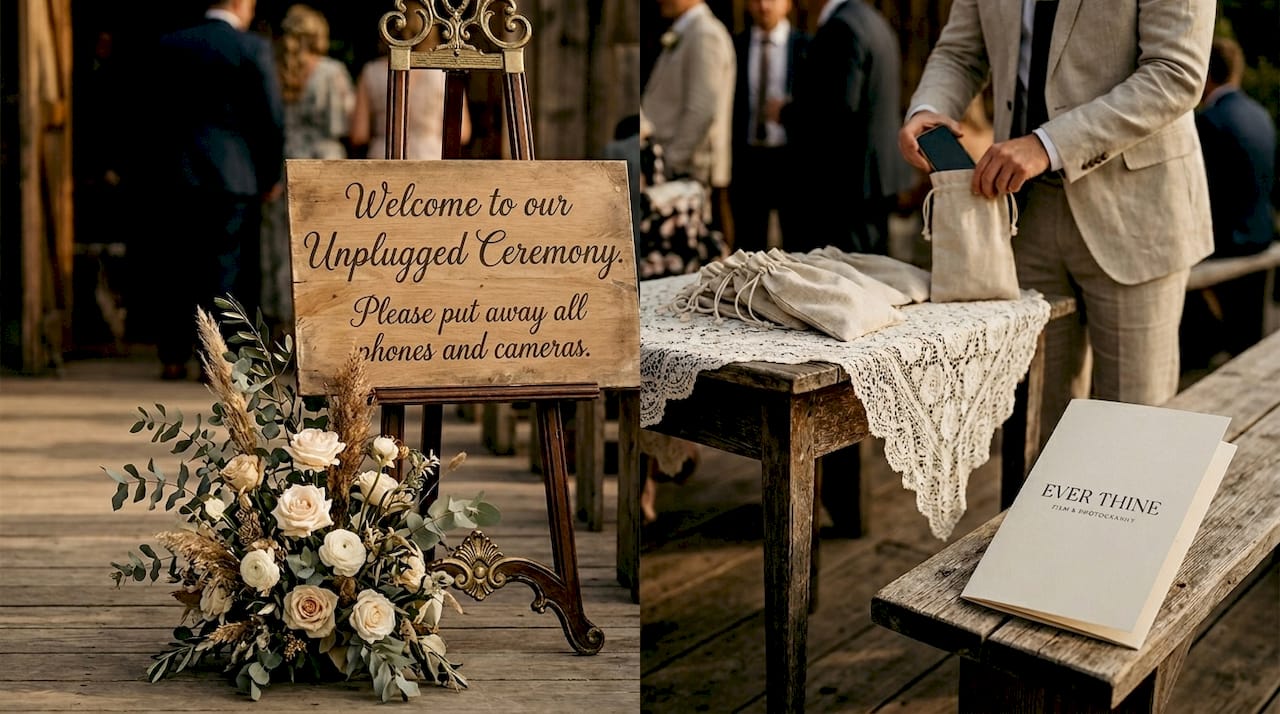
The policy typically covers the ceremony itself, from the processional to the recessional. Many couples then balance device use at the cocktail hour or reception, giving guests the freedom to photograph and share once the formal vows are complete. This distinction matters because it reassures guests that they are not being banned from capturing any memories at all. They simply need to wait.
The unplugged wedding definition is straightforward, but the motivation behind it runs deeper than etiquette. Couples choose it to protect intimacy, improve professional photography, and control their own narrative on social media before they are ready to share it.
What are the main benefits of an unplugged wedding?
The benefits of unplugged weddings fall into three clear categories: emotional, visual, and practical. Each one is worth understanding before you decide whether this approach is right for you.
Emotional presence. When guests put their phones away, they fully experience the moment without the distraction of framing a shot or worrying about battery life. They see your smile, hear your voice crack, and feel the weight of the moment. You look out and see their faces, not their screens. That exchange is irreplaceable.
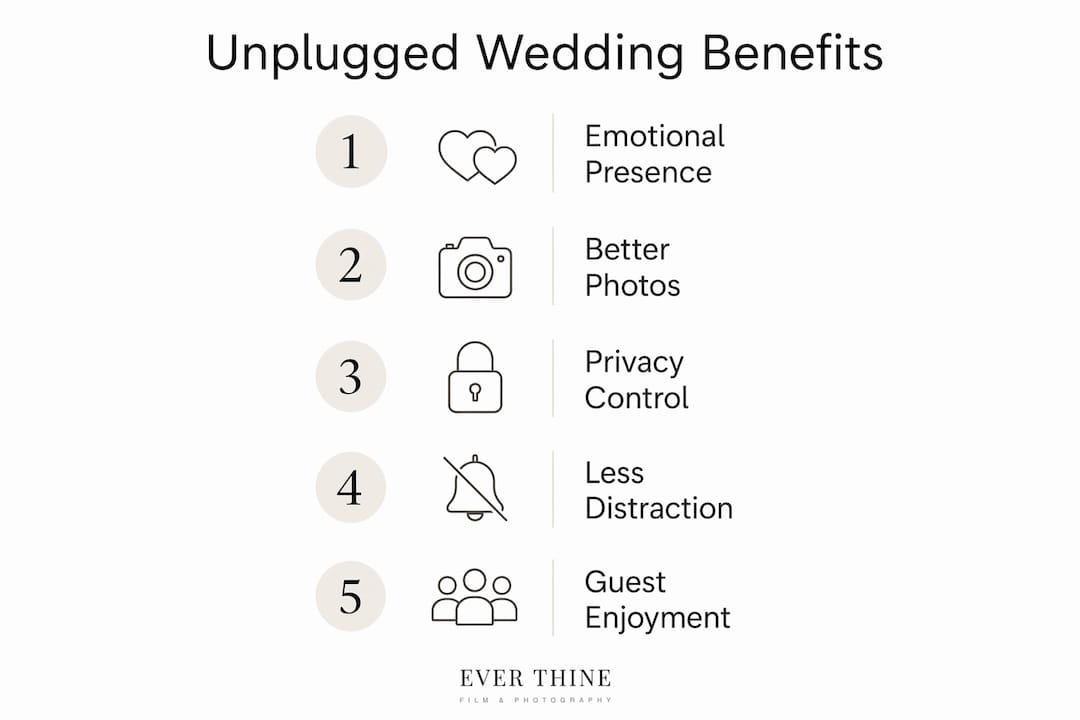
Better professional photography. Professional photographers report significantly better results at unplugged ceremonies. A 30-minute unplugged window during the ceremony gives your photographer unobstructed aisle views and clean sightlines to every key moment. A guest leaning into the aisle with an iPad can ruin a once-in-a-lifetime shot that no amount of editing can recover.
Privacy and narrative control. Social media privacy is a genuine motivator for many couples. An unplugged ceremony reduces the risk of blurry, unflattering images appearing online before your professional gallery is ready. You get to choose the first images the world sees of your wedding day.
Reduced noise and distraction. Notification sounds, camera shutter clicks, and whispered instructions to a partner about camera settings all interrupt the atmosphere your florist, venue, and musicians worked hard to create. Removing devices removes that layer of background noise entirely.
Pro Tip: Brief your wedding party about the unplugged policy before the day. When your bridesmaids and groomsmen model the behaviour, guests follow their lead naturally.
How to communicate your unplugged policy to guests
The most common reason unplugged policies fail is not that guests are rude. It is that they were not told clearly enough, or the message felt like a telling-off. Kind, inviting language rather than prohibitive commands makes all the difference. Think “we invite you to be fully present” rather than “no phones allowed.”
Where to communicate the policy
Use multiple touchpoints so no guest is surprised on the day:
Wedding invitations. A short line in the invitation or on the RSVP card sets expectations early. Something like: “We’re having an unplugged ceremony. Please put your devices away so you can be fully with us.”
Wedding website. A dedicated section explaining the why behind your decision builds goodwill. Guests who understand the reasoning comply far more readily.
Printed programme. A note at the top of the order of service is visible to every guest as they sit down.
Venue signage. Unplugged wedding signs at the entrance and on chairs or pews serve as a final reminder before the ceremony begins. Handwritten signs on chalkboards or printed cards tied with ribbon feel warm rather than clinical.
Officiant announcement. Ask your officiant or emcee to make a brief, warm announcement just before the processional. This is the single most effective enforcement tool available to you.
Wording that works
The tone of your request shapes how guests receive it. Framing the request as an invitation to connect rather than a restriction on behaviour produces far better results. Here are three examples you can adapt:
“As a gift to us, please put your phones away and simply be here with us.”
“We have a wonderful photographer capturing every moment. Please give us the gift of your full attention.”
“Phones away, hearts open. We want to see your faces, not your screens.”
Pro Tip: Ask your officiant to frame the announcement with warmth and a touch of humour. A line like “your photographer has this covered, so sit back and enjoy the show” puts guests at ease immediately.
After the ceremony, announce when phones can be used again, such as during the cocktail hour or immediately after the recessional. This prevents guests from sneaking shots in the final moments and gives them something to look forward to.
Common misconceptions about unplugged weddings
The most persistent misconception is that an unplugged wedding is about control. Couples worry that guests will feel restricted or judged. In practice, the opposite tends to be true. Unplugged ceremonies focus on connection, not restriction, and most guests appreciate the permission to simply sit and enjoy without feeling obligated to document anything.
A second misconception is that guests will resist or forget. Some will. A guest who raises a phone during the vows is almost never being deliberately disrespectful. They are acting on habit. Gentle reminders from the officiant handle this without confrontation, and etiquette guidance consistently advises against any punitive response. The goal is harmony, not compliance at all costs.
There is also confusion about scope. An unplugged wedding does not mean a phone-free day. It means a phone-free ceremony. Guests who know they can photograph freely at the reception are far more relaxed about putting devices away for thirty minutes during the vows. Clarifying this distinction in your communications removes the biggest source of resistance before it starts.
Finally, some couples assume professional photography makes an unplugged policy unnecessary. The reality is the opposite. Professional photos from an unplugged ceremony are consistently cleaner, more emotional, and more technically sound because the photographer has unobstructed access to every moment. The two things work together, not against each other.
How to plan an unplugged wedding ceremony
Planning an unplugged ceremony is straightforward when you work through it methodically. Here is a step-by-step approach that covers every stage from decision to day-of execution.
Decide the scope. Confirm whether your unplugged policy covers the ceremony only, or extends to the cocktail hour and parts of the reception. Most couples limit it to the ceremony for practical reasons.
Draft your messaging. Write the wording you will use across all touchpoints: invitation insert, website copy, programme note, and officiant script. Keep the tone warm and consistent across all of them.
Design your signage. Order or create unplugged wedding signs for the venue entrance and seating areas. Handwritten signs on kraft paper or chalkboards photograph beautifully and feel personal rather than corporate.
Brief your officiant. Give your officiant the exact wording you want them to use. A rehearsed, confident announcement lands far better than an improvised one.
Coordinate with your photographer. Share your unplugged plan with your photographer so they can position themselves to take full advantage of the clear sightlines. At Weddingfilmphotography, we always discuss this during the planning consultation because it directly affects how we approach the ceremony coverage. Understanding why professional photos matter helps couples commit to the policy with confidence.
Plan your photo allowance moment. Decide exactly when guests can resume taking photographs and build that announcement into the ceremony close or the recessional. A clear signal removes ambiguity and prevents the awkward last-second scramble for phones.
Prepare your wedding party. Ask bridesmaids, groomsmen, and close family to model the behaviour. When the people closest to you are visibly present and device-free, the rest of the room follows.
Pro Tip: Consider providing a small basket or pouch at the entrance where guests can voluntarily store phones during the ceremony. It removes the temptation entirely and signals that you have thought about their comfort, not just your own preference.
Key takeaways
An unplugged wedding ceremony produces better photographs, deeper emotional presence, and greater privacy control when couples communicate the policy clearly and kindly across multiple touchpoints.
Point | Details |
Core definition | Guests put away all devices during the ceremony to be fully present. |
Scope matters | Limit the policy to the ceremony; allow device use at the reception to reduce resistance. |
Communication is everything | Use invitations, signage, and an officiant announcement together for best compliance. |
Tone shapes response | Inviting language (“be fully present”) works far better than prohibitive language (“no phones”). |
Photography benefits directly | Unobstructed sightlines give professional photographers access to every emotional moment. |
Why I think the framing matters more than the rule itself
After working at hundreds of ceremonies, the unplugged weddings that go smoothly share one thing: the couple framed it as a gift, not a rule. The ones that create friction are almost always those where the signage felt stern or the officiant announcement sounded like a warning.
Guests are not adversaries. They are people who love you and arrived with the best intentions. When you ask them to put their phones away in the same tone you would use to invite them to the dance floor, they respond in kind. I have seen guests at unplugged ceremonies visibly relax when the officiant says “sit back, breathe, and just be here.” The permission to not perform for social media is something many people quietly crave.
The other thing I would say is this: do not underestimate what your photographer sees from the front of the room. At an unplugged ceremony, the aisle is clear, faces are turned toward you rather than toward screens, and the emotional reactions in the room are genuine and unguarded. Those are the photographs you will still be looking at in thirty years.
One pitfall to avoid is announcing the policy and then never reinforcing it. A single line on a sign is not enough. The officiant announcement is non-negotiable. Without it, at least a handful of guests will have their phones out before the first reading is finished.
— Ever
Capture every moment with professional wedding photography
[
An unplugged ceremony gives your photographer the conditions they need to do their best work. No phones blocking the aisle, no screens between you and your guests, and no distractions during the moments that matter most. At Weddingfilmphotography, we specialise in documentary-style coverage that captures the real emotion of your day, from the first look to the final dance.
We work across Derbyshire, Staffordshire, and Worcestershire, and we would love to be part of your unplugged ceremony. Explore our wedding photography in Derbyshire or our award-winning Staffordshire packages to find the right fit for your day.
FAQ
What does unplugged wedding mean?
An unplugged wedding is a ceremony where guests are asked to put away phones, cameras, and devices so they can be fully present. The policy typically applies to the ceremony only, with normal device use resuming at the reception.
Does an unplugged ceremony mean no photos at all?
No. An unplugged ceremony means no guest photography during the vows and formal ceremony. Guests are free to take photographs at the cocktail hour, reception, and any other part of the day outside the ceremony itself.
How do I tell guests about an unplugged ceremony?
Communicate the policy through your invitations, wedding website, printed programme, venue signage, and an officiant announcement on the day. Using kind, inclusive phrasing rather than strict prohibitions produces the best guest response.
Will guests be upset about an unplugged wedding policy?
Most guests appreciate the clarity and the permission to simply enjoy the ceremony without feeling obligated to document it. Gentle reminders and a warm tone from the officiant handle any hesitation without creating conflict.
Does an unplugged ceremony really improve wedding photos?
Yes. Professional photographers consistently produce better results when guest devices are not blocking sightlines or creating distractions. A clear aisle and unguarded emotional reactions from guests produce the authentic, unobstructed images that define great wedding photography.
Recommended
Comments