
Why archive wedding footage? Preserving memories for life

Your wedding film is one of the few things that can genuinely transport you back to the most emotional moments of your life. Yet over 50% of people lose precious footage simply because they never set up a proper backup. Digital files feel permanent, but without active archiving, they are far more fragile than you might expect. This article walks you through why archiving matters, which myths to ignore, and exactly what steps to take to protect your wedding memories for decades to come.
Table of Contents
Key Takeaways
Point | Details |
Backups are essential | Relying on a single copy puts cherished memories at risk; follow proven backup strategies. |
Archiving ensures longevity | Proper archiving helps wedding footage outlast technological changes, preserving memories for generations. |
Couples bear responsibility | You must actively receive and archive your footage as videographers may not keep raw files. |
Expert help matters | Professionals with archiving know-how make a genuine difference in protecting your family’s legacy. |
The emotional and practical value of wedding footage
A wedding film is not just a highlight reel for Instagram. It captures the tremor in your partner’s voice during their vows, the laughter that erupted during the best man’s speech, and the quiet glance you shared before walking down the aisle. These are moments that photographs simply cannot hold in the same way. Sound, movement, and emotion combine to create something genuinely irreplaceable.
Over 80% of UK couples now opt for professional wedding films, recognising their value as family heirlooms rather than throwaway social media content. That shift in thinking is significant. Couples are no longer treating their film as a bonus extra. They are treating it as a document of their family’s history.
Consider what your footage actually contains:
Speeches from grandparents who may no longer be with you in ten years
The voices and laughter of children who will grow up fast
Candid moments between guests that nobody planned or staged
The atmosphere of your venue, your flowers, your music
These details fade from memory. A well-made emotional wedding film brings them back with startling clarity. The lasting value of wedding films extends far beyond the wedding day itself, and the preservation of wedding speeches alone is reason enough to invest in professional coverage.
“Your wedding film is the one gift you give your future self. Watch it on your tenth anniversary and you will understand exactly why archiving it properly matters.”
With that emotional significance established, it becomes clear why losing this footage would be devastating. And the risk is far more real than most couples realise.
Common myths about digital wedding footage safety
The biggest misconception couples carry is this: once the file is on my laptop, it is safe. It is not. Digital files do not wear out the way a VHS tape does, but they are still vulnerable to a surprising range of threats.
General surveys note that more than half of people experience data loss at some point without proper backups in place. For wedding footage, that statistic carries enormous emotional weight.
Here are the most common risks couples overlook:
Hardware failure: Hard drives have a finite lifespan, often five to seven years. If your footage lives on one drive, a single failure wipes everything.
Accidental deletion: One wrong click, one corrupted folder, and the file is gone.
Format obsolescence: The file format your footage was delivered in today may not be playable on devices in fifteen years.
Theft or fire: Physical devices can be lost, stolen, or destroyed in a house fire.
Cloud service closure: Free cloud storage services can shut down or change their terms without warning.
The 3-2-1 backup rule is the gold standard recommended by archiving professionals: three copies of your footage, stored across two different media types, with one copy kept off-site. This is not overcautious. It is the minimum sensible approach for files you genuinely cannot replace.
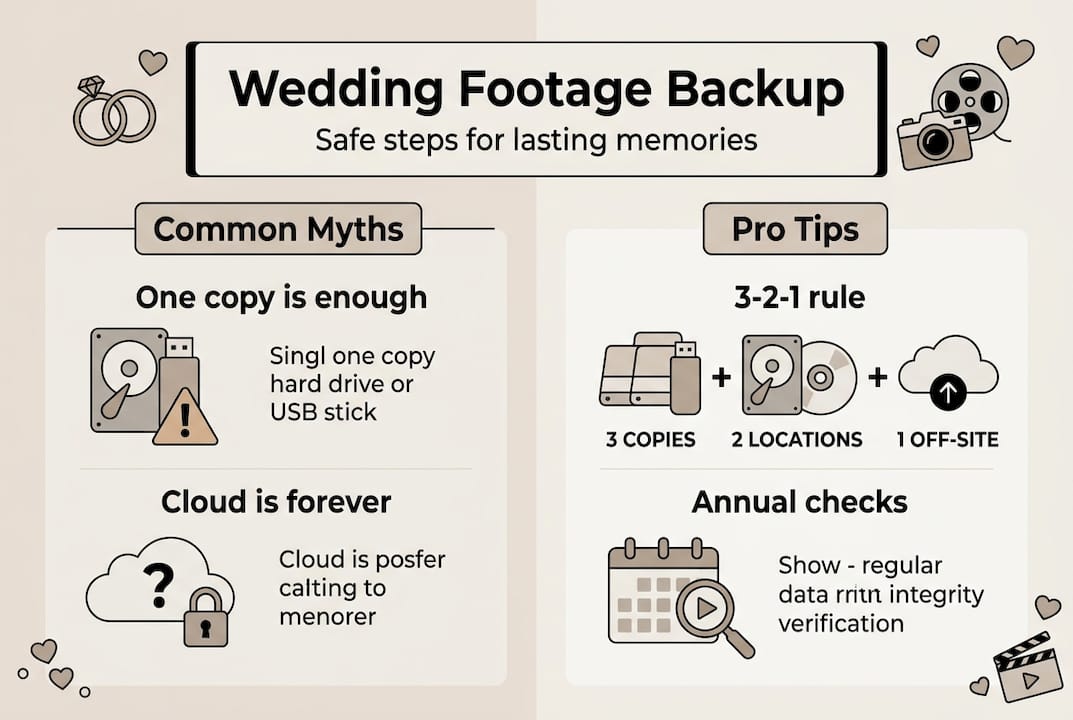
A solid wedding photo backup guide applies the same logic to your photographs, and the principles translate directly to video files. Having debunked the safety myth, the next step is understanding what an effective archival process actually looks like in practice.
Essential strategies: how to archive your wedding footage
Archiving does not need to be complicated, but it does need to be deliberate. Here is a clear, numbered process to follow as soon as your footage arrives.
Download and verify immediately. As soon as your videographer delivers your files, download them and check every file opens correctly before assuming delivery is complete.
Apply the 3-2-1 rule. Create three copies: one on an external hard drive, one on a second drive or USB, and one in cloud storage such as Google Drive, Dropbox, or a dedicated service like Backblaze.
Add metadata. Rename your files clearly (for example, “Smith-Jones-Wedding-2026-Ceremony-Edit.mp4”) and add tags including the date, venue, and names of people featured. This makes searching for specific moments far easier in twenty years.
Choose widely supported formats. MP4 with H.264 encoding is currently the most universally compatible format for long-term playback. Avoid proprietary formats that may not be supported by future devices.
Schedule annual audits. Set a reminder each year to check your files still open, your drives are functioning, and your cloud storage subscription is active.
Regular audits, metadata addition, and format compatibility checks are essential to ensure long-term accessibility as technology evolves.
Pro Tip: Store one copy of your footage with a trusted family member in a different location. If your home is affected by fire or flood, that off-site copy becomes invaluable.
Here is a quick comparison of the most common archival methods:
Method | Cost | Reliability | Accessibility | Best for |
External hard drive | Low upfront | Moderate (5-7 yr lifespan) | Immediate | Primary local backup |
USB/flash drive | Very low | Lower (prone to failure) | Immediate | Secondary short-term copy |
Cloud storage | Ongoing subscription | High (redundant servers) | Anywhere with internet | Off-site backup |
NAS (home server) | Medium upfront | High | Home network | Tech-savvy couples |
Archival Blu-ray disc | Low per disc | Very high (100+ yr rated) | Requires disc drive | Long-term physical archive |
For videography backup strategies that go beyond the basics, combining cloud and physical storage gives you the strongest possible safety net.
Who is responsible? Videographer policies and your rights
Many couples assume their videographer holds a permanent copy of their footage. This is a dangerous assumption. Most professional videographers delete raw files within a set period after delivery, often six to twelve months. Once that window closes, there is no recovery option.
In more extreme cases, vendor disputes or personal circumstances such as divorce have led to videographers deleting footage entirely, leaving couples with no recourse. This is not common, but it does happen, and it underlines why you must treat your own archived copy as the only copy that truly matters.
“Never assume your videographer is your backup. The moment your footage is delivered, archiving it becomes your responsibility entirely.”
Here is a summary of key responsibilities to clarify before and after your wedding:
Stage | Couple’s responsibility | Videographer’s responsibility |
Before booking | Ask about delivery format and raw file policy | Clarify retention period and delivery method |
On delivery | Download and verify all files immediately | Deliver complete, high-quality edited files |
Within first week | Apply 3-2-1 backup rule | Confirm delivery is complete |
Ongoing | Annual file audits and format checks | None (post-delivery) |
Knowing the right questions to ask your videographer before you book can save enormous heartache later. Understanding the role of a wedding videographer also helps you set realistic expectations about what is and is not included in your package.
Pro Tip: Ask your videographer in writing what format your files will be delivered in, how long they retain raw footage, and whether they offer any extended storage options. Get the answers before you sign any contract.
Find trusted experts for archiving and unforgettable films
Understanding archiving is one thing. Choosing a videographer who delivers your footage in a format that is easy to archive, and who communicates clearly about delivery and retention, is equally important. The right professional makes the entire process straightforward from the moment you book.
[
At Wedding Film Photography, we work with couples across the Midlands and beyond to create cinematic, documentary-style films that genuinely capture the emotion of your day. Whether you are searching for a Derbyshire wedding photographer or a Staffordshire wedding photographer, we prioritise clear communication about file delivery so you can archive your memories with confidence. Get in touch to find out how we can help you protect your wedding story for generations.
Frequently asked questions
What is the best backup strategy for wedding footage?
The 3-2-1 rule is the recommended approach: three copies of your footage, stored across two different media types, with one copy kept off-site for maximum security.
How soon should couples archive their wedding footage after delivery?
Archiving should happen immediately upon receipt. Vendor issues or personal disputes can result in raw footage being deleted, so your own archived copy is the only one you can truly rely on.
Can wedding footage be lost even after delivery?
Yes. Keeping files on a single device without backups puts you at serious risk, and over half of people experience data loss at some point due to failed or absent archiving.
Are there differences between archiving photos and videos?
The core backup principles are the same, but videos require significantly more storage space and need careful attention to format compatibility to ensure they remain playable on future devices.
Recommended

Comments