
Why consider photo privacy for your wedding

TL;DR:
Wedding photos contain sensitive personal data, including biometric, location, and timestamp information. Couples should proactively manage privacy through clear contracts, platform choices, and obtaining legal consent. UK laws require photographers and platforms to adhere to data protection standards and enable early action against misuse.
Photo privacy is defined as your right to control who views, shares, and uses images in which you appear. Wedding photography sits at the heart of this issue. A single wedding gallery can contain hundreds of identifiable faces, GPS-tagged locations, timestamps, and deeply personal moments. Under UK GDPR, images are classified as personal data, which means the same legal protections that apply to your name and address apply to your wedding photos. Most couples do not realise this until something goes wrong.
Why consider photo privacy at your wedding
Photo privacy concerns at weddings go far beyond worrying about an unflattering angle. Your wedding album is, in data terms, one of the richest personal records you will ever create. It contains biometric data in the form of faces, location data embedded in file metadata, and images of children and guests who never consented to being photographed for public use.

The National Crime Agency has warned that publicly shared children’s photos risk being used to generate AI abuse imagery. That warning applies directly to wedding galleries posted openly on social media, where images of young relatives are visible to anyone. The risk is not theoretical. It is a documented and growing concern.
Wedding photos are also valuable for data mining and AI training. Platforms that host your gallery may use broad licensing terms to process your images in ways you did not agree to. Understanding the importance of photo privacy means recognising that your wedding day produces data, not just memories.
What personal data do wedding photos contain?
Wedding photos contain far more than smiling faces. Every digital image carries metadata, including the exact time it was taken, the device used, and often the GPS coordinates of the location. That information travels with the file unless it is deliberately stripped out.
The table below shows the types of personal data typically found in wedding photos and the associated privacy risks.
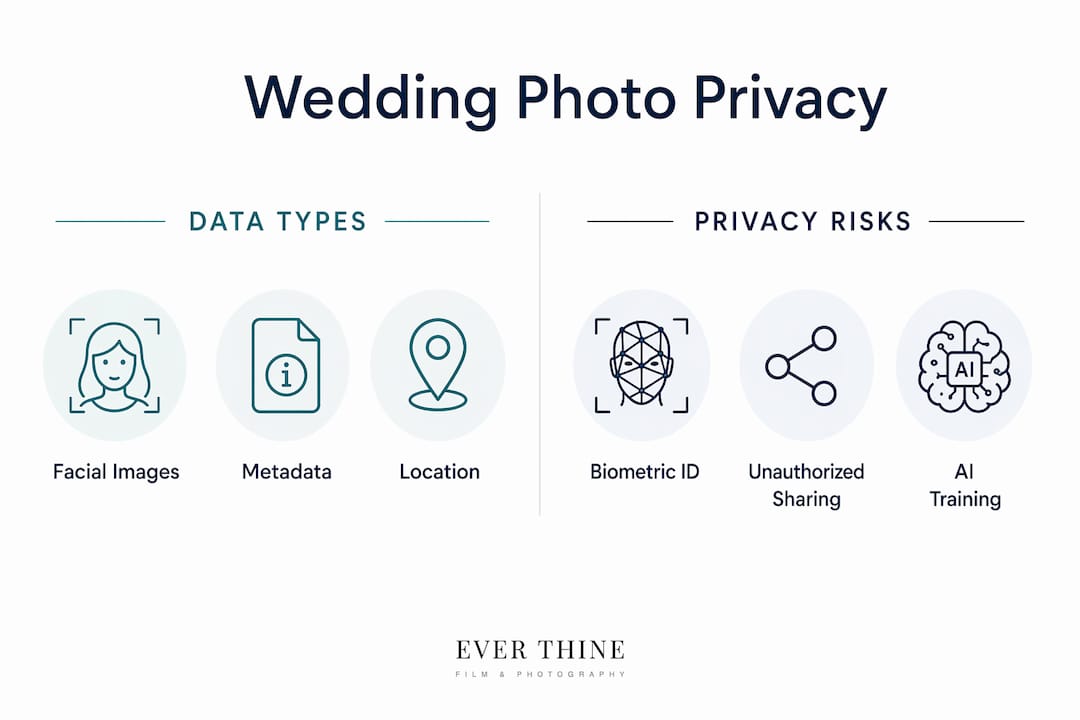
Type of data | Example | Privacy risk |
Facial images | Guests, children, couple | Biometric identification, AI misuse |
GPS metadata | Venue location, home address | Location tracking, stalking |
Timestamps | Ceremony time, reception end | Routine mapping, security risk |
Private moments | First kiss, emotional exchanges | Reputational harm if shared without consent |
Children’s images | Young relatives, flower girls | AI-generated abuse imagery |
Under UK GDPR, every identifiable person in a photograph is a data subject. That means photographing a guest without their knowledge and then sharing that image publicly may breach data protection law. Wedding photographers who process personal data must pay annual ICO fees starting at £52, with fines reaching £4,000 for non-compliance. That legal structure exists precisely because wedding images carry real data risk.
Key photo privacy concerns also include the use of facial recognition by third-party providers embedded within photo-sharing platforms. Most couples are unaware that uploading their gallery to a popular app may trigger automated facial tagging by a company they have never heard of.
What UK laws protect wedding photo privacy?
UK law provides a meaningful framework for protecting photo privacy, though it requires couples to be proactive rather than passive.
The key legal protections include:
UK GDPR: Classifies identifiable images as personal data. Anyone processing such images for commercial purposes must have a lawful basis and a clear privacy policy.
The Online Safety Act: Designates non-consensual sharing of intimate images as a priority offence. Platforms must act swiftly to remove flagged content.
2026 mandatory takedown rules: Tech platforms must remove non-consensual intimate images within 48 hours of being flagged, facing fines of up to 10% of worldwide revenue for failure to comply.
ICO registration: Wedding businesses handling personal data must register with the Information Commissioner’s Office and pay the relevant annual fee.
These laws set a floor, not a ceiling. They tell you the minimum standard platforms and photographers must meet. They do not guarantee that your images will never be misused. The 48-hour takedown rule, for example, only applies once you have identified and flagged the content. By that point, the image may already have been downloaded and shared elsewhere.
Pro Tip: Ask your photographer directly whether they are registered with the ICO. A professional who handles personal data and is not registered is operating outside UK law. You can verify ICO registration on the ICO’s public register at ico.org.uk.
How can couples and guests manage photo privacy?
Managing photo privacy at a wedding requires planning before the day, not damage control after it. The most effective approach combines clear contracts, proactive guest communication, and careful platform choices.
Include privacy clauses in your photography contract. Your contract should specify whether the photographer can use images for their portfolio, social media, or marketing. A clear ‘Marketing & Social Media’ clause gives you control from the outset. Ask for a clause that requires your written approval before any image is published.
Communicate your photo policy to guests before the day. Send a short note with your invitations explaining your wishes. Some couples request an unplugged ceremony, where guests put phones away entirely. Others simply ask guests not to post images until the couple has shared their own. Pre-wedding communication templates that offer guests an opt-out option are a practical and respectful approach.
Choose your sharing platform carefully. Not all photo-sharing platforms offer the same level of privacy. Look for platforms that store data on UK or EU servers, do not use third-party facial recognition, and give you genuine control over who can view and download images. Privacy-conscious platforms avoid overseas data storage and third-party processing, which keeps your images within a more controlled environment.
Use a ‘Bring Your Own Storage’ model. Routing your wedding gallery directly to a personal encrypted cloud folder, such as a private Google Drive or similar service, gives you ownership and longevity that server-hosted galleries cannot match. You control access, you control deletion, and you are not dependent on a third-party platform’s retention policy.
Request approval rights over image use. Professional photographers offer privacy options including total privacy or selective sharing. Ask explicitly for the right to approve any image before it appears publicly, including on the photographer’s own website or social media.
Pro Tip: Review your photography contract before signing and look specifically for clauses about data retention, portfolio use, and third-party sharing. If a clause is vague, ask for it to be rewritten in plain language before you sign.
What are the privacy risks of popular photo-sharing platforms?
Most couples assume that uploading their wedding gallery to a popular photo app is safe. The reality is more complicated. Wedding photo-sharing apps often store images on US or EU cloud servers and may use third-party facial recognition, spreading data across multiple companies beyond your control.
The terms of service for many popular platforms include broad licensing language. This can allow the platform to use your images for purposes including AI model training or promotional material, without seeking further consent. Most people do not read these terms before uploading.
Retention policies present another risk. Many event photo apps permanently delete galleries 6–12 months after the event, despite users expecting long-term access. That means couples may lose their images entirely if they do not download and back them up independently. The platform’s convenience comes at the cost of your control.
The table below outlines typical platform features and their privacy implications.
Feature | Common platform practice | Privacy implication |
Server location | US or international cloud | Data outside UK GDPR jurisdiction |
Facial recognition | Third-party providers | Biometric data shared beyond your control |
Licensing terms | Broad, AI training permitted | Images used without further consent |
Deletion policy | Gallery deleted after 6–12 months | Permanent loss of access |
Download controls | Often unrestricted | Guests can save and reshare images |
What should you look for in a wedding photographer regarding privacy?
Choosing a photographer who takes privacy seriously is one of the most effective tips for photo privacy you can act on. Not all photographers approach data handling in the same way, and the difference matters.
When meeting potential photographers, ask these questions directly:
Are you registered with the ICO? If so, what is your registration number?
Where are client images stored, and for how long?
Do you use any third-party platforms or apps to share galleries?
Can I request that my images are kept completely private?
What is your policy on using client images for your portfolio or social media?
A photographer who cannot answer these questions clearly is a risk. A professionally insured and ICO-registered photographer operates within a defined legal framework that protects you as a client. That registration is not just a formality. It signals that the photographer understands their data protection obligations.
Weddingfilmphotography recommends reviewing the questions to ask your photographer before any consultation. Having a prepared list ensures you cover privacy, data handling, and contract terms before you commit.
Pro Tip: Ask your photographer to show you their ICO registration certificate, not just confirm they are registered. Verification takes 30 seconds on the ICO public register and gives you genuine peace of mind.
Key takeaways
Photo privacy at weddings requires active management because UK GDPR classifies wedding images as personal data, and most sharing platforms operate outside the protections couples assume are in place.
Point | Details |
Wedding photos are personal data | UK GDPR applies to identifiable images, including guests and children. |
Legal protections have limits | The 48-hour takedown rule only activates after you flag content. |
Contracts are your first defence | Insist on clear clauses covering portfolio use, social media, and data retention. |
Platform choice affects control | Many apps store data internationally and delete galleries within 12 months. |
Verify your photographer’s ICO status | Registered photographers operate within a legal data protection framework. |
Why photo privacy reflects something deeper
The couples I have worked with who care most about photo privacy are not being precious. They are being clear-eyed. A wedding is one of the most documented days of your life, and the images produced carry real weight, legally, emotionally, and socially.
What I have noticed over time is that photo privacy can act as a litmus test for how a couple navigates boundaries together. When one partner wants images kept private and the other wants to share everything publicly, that tension rarely stays contained to the photos. It surfaces in other decisions too. Talking about your photo policy before the wedding is not pedantic. It is useful.
The shift I would encourage is away from reactive thinking. Most couples only think about photo privacy after a guest posts something they did not want shared. A proactive approach to privacy management reduces conflict and respects everyone present. It also means you are in control of your own story, which is exactly what your wedding day should be.
The misconception I encounter most often is that once a photo is taken, it belongs to whoever took it. That is not how UK law works, and it is not how most thoughtful photographers work either. Your images are your data. Treat them accordingly.
— Ever
Privacy-conscious wedding photography with Weddingfilmphotography
Couples who care about how their images are handled deserve a photographer who shares that commitment. Weddingfilmphotography works with a clear respect for client privacy, handling images with care and operating within UK data protection standards.
[
Whether you are planning a ceremony in Derbyshire, Staffordshire, or further afield, the team at Weddingfilmphotography prioritises your right to control how your images are used and shared. For couples who want professional wedding photography in Derbyshire with a photographer who takes data handling seriously, this is a natural starting point. You can also explore how Weddingfilmphotography approaches digital wedding albums to understand the options available for protecting and preserving your memories on your own terms.
FAQ
What does photo privacy mean for wedding couples?
Photo privacy means your right to control who can view, share, and use images taken at your wedding. Under UK GDPR, identifiable wedding photos are classified as personal data, giving you legal standing to manage how they are used.
Are wedding photographers required to register with the ICO?
Yes. Wedding photographers who process personal data, which includes identifiable images of clients and guests, must register with the Information Commissioner’s Office and pay an annual fee starting at £52.
Can guests legally share wedding photos on social media?
Guests sharing images of other identifiable people without consent may breach UK GDPR, particularly if those images include children or sensitive private moments. A clear guest communication policy before the wedding reduces this risk significantly.
How long do photo-sharing platforms keep wedding galleries?
Many event photo apps permanently delete galleries 6–12 months after the event. Couples should download and back up images independently rather than relying on platform storage for long-term access.
What is the fastest legal protection if a wedding photo is shared without consent?
Under 2026 UK legislation, tech platforms must remove non-consensual intimate images within 48 hours of being flagged. For other images, UK GDPR provides a right to erasure, which you can exercise by contacting the platform directly.
Recommended


Comments