
The role of detail shots in wedding storytelling

TL;DR:
Detail shots serve as structural elements that connect high-emotion moments and enhance storytelling. They guide viewer focus, prevent pacing issues, and support emotional beats through careful sequencing and selection. Captured during natural downtime, these shots bridge lighting gaps and add narrative depth to wedding films and photography.
Detail shots are defined as close-up images or footage of specific objects, textures, or environmental elements that serve as narrative anchors within a visual story. In wedding and event photography and filmmaking, the role of detail shots extends far beyond decoration. They connect high-intensity moments, guide viewer focus, and give audiences the emotional space to absorb what they have just witnessed. Three out of four successful story-driven wedding films incorporate these in-between shots deliberately. That figure reflects a professional consensus: detail shots are structural, not supplementary.
How do detail shots contribute to emotional rhythm and narrative flow?
Detail shots function as visual punctuation within a sequence, giving viewers a moment to breathe after an emotionally charged scene. Without them, a wedding film or photo album moves from ceremony to reception to speeches with no pause. The result feels rushed and emotionally flat, even when the individual moments are powerful.
Sequencing is the mechanism that makes this work. The standard practice moves from wide environmental shots to medium frames, then into tight close-ups. This progression guides the viewer’s eye and signals a shift in emotional register. A wide shot of a ceremony space tells you where you are. A close-up of a bride’s hands holding a letter tells you how she feels.
Detail shots also prevent pacing from becoming disjointed. When a filmmaker cuts directly from a tearful vow exchange to a wide reception shot, the tonal gap jars the viewer. Inserting a close-up of the rings, the flowers, or a candle flame bridges that gap naturally. Visual grammar and shot sequencing are as important as the shots themselves. Detail shots act as the commas and full stops of visual language.
The importance of detail shots lies not in volume but in selection. Every detail shot must earn its place by supporting a specific emotional or narrative beat.
Choose details that reflect the couple’s personality: handwritten vows, a grandmother’s brooch, a child’s shoes.
Sequence detail shots after high-emotion moments to allow the viewer to process what they have seen.
Avoid repeating the same type of detail shot (e.g., three floral close-ups in a row) as this dilutes narrative impact.
Match the mood of the detail to the scene it follows: soft and warm after a tender moment, sharp and graphic after a dramatic one.
Pro Tip: Before the wedding day, ask the couple which objects carry personal meaning. A detail shot of a meaningful item lands far harder than a beautiful but generic one.
What techniques ensure detail shots effectively establish setting and mood?
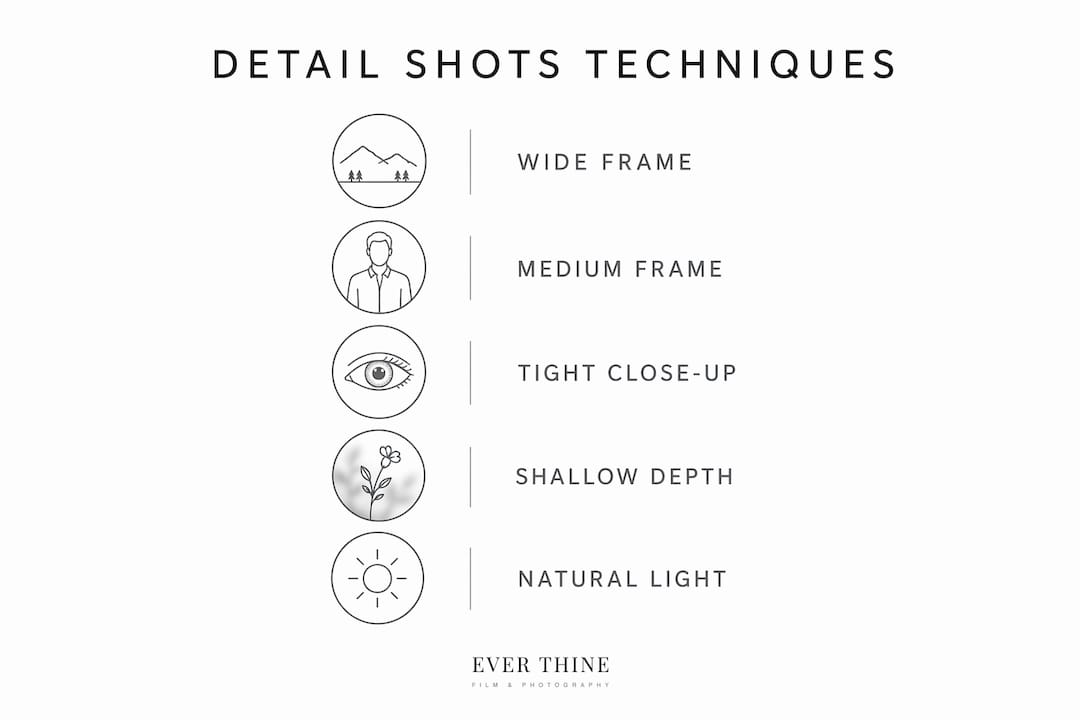
Industry guidance advises sequencing detail shots from wide environmental frames to tight close-ups to establish setting and guide viewer focus. This is not arbitrary. The wide shot anchors the viewer in a physical space. The close-up then draws attention to what matters within that space. Together, they build atmosphere efficiently.
Depth of field is the most powerful compositional tool for detail shots. A shallow depth of field isolates a subject, such as a ring on a velvet cushion, and blurs the background into soft colour. This directs the viewer’s attention completely. A deeper depth of field, by contrast, places the detail within its environment, showing context as well as content.
Lighting is equally critical. Natural window light during morning preparations creates a soft, intimate quality that suits detail shots of invitations, jewellery, and florals. Candlelight during an evening reception produces warmth and shadow that give texture shots genuine atmosphere. The challenge arises when lighting conditions shift between scenes. Detail shots help bridge visual gaps in footage by acting as transitional buffers between scenes with mismatched lighting qualities.
Technique | Narrative effect |
Shallow depth of field | Isolates subject, creates emotional intimacy |
Wide-to-close sequencing | Establishes setting, then draws focus inward |
Natural window light | Produces soft, authentic atmosphere for morning details |
Candlelight or ambient light | Adds warmth and texture for evening sequences |
Tight framing on texture | Conveys tactile quality and sensory detail |
Common detail elements worth capturing include embossed invitations, floral arrangements, fabric textures, ambient light through stained glass, and table settings. Each of these carries environmental information that wider shots cannot convey alone.
Pro Tip: Shoot detail shots at the same colour temperature as the surrounding scene. Mismatched white balance between a detail shot and the footage it bridges will create a visible, distracting inconsistency in the edit.
When and how should photographers capture detail shots during wedding events?
Experienced photographers recommend capturing detail shots during natural in-between moments rather than dedicated, disruptive sessions. Stopping a wedding to photograph the table settings while guests are waiting to be seated creates tension and breaks the documentary flow that makes candid storytelling work.

The most productive windows for detail capture are the margins of the day. Morning preparations offer quiet time with good light and meaningful objects close at hand. The cocktail hour, when guests are socialising and the couple is often occupied with portraits, provides another natural gap. These pockets of downtime yield authentic narrative texture without imposing on the emotional flow of the event.
Focused detail photography typically requires only 5–10 minutes when planned well. The key is knowing in advance which details matter most and where they will be located. A photographer who arrives knowing the ceremony space layout can capture architectural details, floral arrangements, and order-of-service cards before guests arrive, without any disruption at all.
Optimal time windows for detail capture:
Morning preparations: Jewellery, shoes, invitations, and personal items in natural light before the day accelerates.
Pre-ceremony: Venue details, floral arrangements, and table settings while the space is still empty.
Cocktail hour: Drinks, food styling, guest interactions, and ambient environmental details.
Between speeches: Table details, candles, and room atmosphere during natural pauses in the programme.
End of evening: Cake, lighting, and decor details as the reception winds down and the space empties slightly.
Cooperation with the event timeline is non-negotiable. A photographer who understands the schedule can anticipate these windows and move through them efficiently. Disrupting an emotional moment to capture a detail shot defeats the purpose entirely.
How do filmmakers use detail shots in cinematic wedding films?
Detail shots serve as technical cutaways that bridge lighting and pacing inconsistencies between scenes in cinematic wedding films. When a filmmaker cuts from a brightly lit outdoor ceremony to a dimly lit indoor reception, the tonal shift can feel abrupt. A close-up of a candle, a floral centrepiece, or a wine glass in the transitional light gives the viewer’s eye time to adjust.
Two cameras minimum is the industry standard for dynamic, complete wedding film coverage. Detail shots complement this multi-camera approach by providing additional angles and textures that neither camera may have captured in the moment. They fill narrative gaps and add depth to sequences that might otherwise feel thin.
Audio design also benefits from detail shots. When a filmmaker needs to extend a piece of music or allow a voiceover to breathe, a sequence of detail shots provides the visual space to do so without cutting away from the story. Cinematic wedding films create emotional resonance through deliberate editing rhythm, and detail shots are the primary tool for controlling that rhythm.
Pro Tip: Capture detail shots at a higher frame rate than your primary footage. Slowing them down in post-production adds a cinematic quality that reinforces emotional weight without requiring additional shooting time.
Integrating detail shots effectively in post-production follows a clear sequence:
Identify pacing gaps in the rough cut where transitions feel abrupt or scenes feel rushed.
Select detail shots that match the emotional tone of the surrounding footage, not just the visual content.
Insert transitional details at lighting or colour mismatches to smooth the visual continuity.
Layer audio beneath detail shot sequences to allow music or ambient sound to carry the emotional weight.
Review the rhythm of the full sequence to confirm that detail shots are adding pace variation, not interrupting it.
The role of b-roll in films overlaps with detail shots but is not identical. Generic b-roll fills time. Intentional detail shots carry narrative meaning. That distinction defines the difference between a competent wedding film and a genuinely moving one.
Key takeaways
Detail shots are structural narrative tools, not decorative additions, and their placement, timing, and selection determine the emotional coherence of any wedding or event visual story.
Point | Details |
Narrative function | Every detail shot must support a specific emotional or story beat, not simply fill time. |
Sequencing principle | Move from wide environmental frames to tight close-ups to guide viewer focus and establish mood. |
Optimal capture timing | Shoot details during natural downtime windows such as morning preparations and cocktail hour. |
Technical editing role | Detail shots bridge lighting mismatches and pacing gaps between scenes in post-production. |
Selection over volume | Fewer, well-chosen detail shots carry more narrative weight than a large number of generic ones. |
Why detail shots are the most underestimated tool in wedding storytelling
Most photographers and filmmakers understand that detail shots matter. Fewer understand why they matter, and that gap shows up in the final edit. I have reviewed wedding films where detail shots were plentiful but purposeless. Beautiful images of flowers and rings, shot with care, placed randomly between scenes. The result was a film that looked polished but felt hollow.
The shift happens when you stop asking “what looks good?” and start asking “what does this moment need?” A detail shot of a bride’s mother adjusting her veil carries entirely different narrative weight than a detail shot of a floral arrangement. Both might be beautiful. Only one is doing narrative work.
The misconception that more detail equals better storytelling is genuinely common, and it leads photographers to over-shoot details at the expense of candid moments. The discipline is in restraint. Capture the details that carry personal meaning, place them where the story needs breathing room, and cut everything else.
Collaboration with clients before the wedding day is the practical foundation of this approach. Understanding which objects carry emotional significance, which family heirlooms will be present, and which moments the couple most wants preserved shapes every detail shot decision. That conversation is as important as any technical skill. The wedding detail photography workflow at Weddingfilmphotography is built around exactly this kind of pre-event dialogue.
Visual grammar is not a concept reserved for film school. It is the practical logic of how images communicate. Detail shots are the punctuation of that language. Use them well, and the story reads clearly. Use them carelessly, and the story loses its shape entirely.
— Ever
Wedding photography and filmmaking with genuine narrative depth
Weddingfilmphotography specialises in documentary-style wedding coverage across Derbyshire and Staffordshire, with detail shot expertise woven into every stage of the process, from the morning preparations through to the final edit.
[
Every couple has objects, textures, and moments that carry personal meaning. The team at Weddingfilmphotography works with you before the day to understand which details matter most, then captures them at the right moment without disrupting the natural flow of your wedding. If you are looking for a wedding photographer in Derbyshire who treats detail shots as narrative tools rather than filler, get in touch to discuss your day. You can also explore the full range of award-winning services in Staffordshire to find the right fit for your story.
FAQ
What is the role of detail shots in wedding photography?
Detail shots serve as narrative anchors that connect high-intensity moments and give viewers emotional breathing space. They are structural elements of visual storytelling, not decorative additions.
How many detail shots should a wedding film include?
There is no fixed number. Selection matters more than volume. Each detail shot should support a specific emotional or narrative beat, and purposeless detail shots weaken rather than strengthen a film.
When is the best time to capture detail shots at a wedding?
Natural downtime windows such as morning preparations, the pre-ceremony period, and cocktail hour provide the best opportunities. Focused detail capture typically requires only 5–10 minutes when planned in advance.
How do detail shots help in the editing process?
Detail shots bridge lighting and pacing gaps between scenes, acting as transitional buffers that smooth visual continuity. They also provide space for music and audio to develop without cutting away from the main story.
What makes a detail shot narratively effective?
A detail shot is narratively effective when it reflects the couple’s personality, supports the emotional tone of the surrounding footage, and is placed where the story needs a pause. Every detail shot must serve character psychology or thematic development rather than being purely decorative.
Recommended


Comments