
The role of b-roll in films: a filmmaker's guide
- Jun 14
- 8 min read

TL;DR:
B-roll serves as supplementary footage that connects, enhances, and shapes the narrative in filmmaking. It is essential for preventing jump cuts, restructuring scenes, and controlling emotional pacing, making the story more engaging. Successful use of intentional, varied, and well-planned b-roll elevates overall production quality and viewer trust.
B-roll is defined as supplementary footage intercut with the main narrative footage, known as A-roll, to provide context, smooth transitions, and emotional depth throughout a film. The role of b-roll in films extends far beyond simple visual padding. It is the connective tissue that holds a story together, controls pacing, and shapes how an audience feels during every scene. From documentary interviews to cinematic wedding films, b-roll as connective tissue is what separates polished, professional productions from footage that feels raw and unfinished. Understanding its functions gives filmmakers and videographers a genuine creative advantage.
How does b-roll shape narrative flow and prevent jump cuts?
The most immediate technical function of b-roll is eliminating jump cuts. A jump cut occurs when two shots of the same subject are edited together without a visual break, creating a jarring, disorienting effect for the viewer. In interview-heavy productions, this is a constant challenge. B-roll masks surgical cuts in conversational footage, allowing editors to trim repetitive sentences, reorder answers, or remove hesitations without the audience ever noticing.
Beyond hiding edits, b-roll gives editors genuine freedom to restructure a scene. If an interview subject makes their strongest point at the end of a ten-minute take, the editor can move it to the opening without any visible seam, provided there is sufficient b-roll to cover the transition. This flexibility is one of the most underappreciated functions of b-roll in film production.
B-roll also controls emotional pacing. A close-up of clasped hands during a tense interview, or a slow pan across a quiet landscape between two dramatic scenes, gives the audience a moment to absorb what they have just seen. These micro-pauses are not wasted time. They are deliberate editorial choices that deepen emotional impact.
Hiding edits: Cut to b-roll during any trim point in an interview to remove unwanted content invisibly.
Reordering content: Use b-roll transitions to restructure the sequence of a subject’s responses without continuity errors.
Controlling rhythm: Insert b-roll at moments of emotional weight to slow the pace and let the audience breathe.
Adding context: Show the environment, objects, or actions being described to reinforce the spoken narrative.
Pro Tip: Shoot at least three to four distinct b-roll clips for every minute of interview footage you plan to use. This gives you enough coverage to restructure the edit freely without scrambling for cutaways in post-production.
What types of b-roll shots are used and why?
Common b-roll shot types include establishing shots, cutaways, close-ups, and action shots, each serving a distinct narrative purpose. Knowing which type to reach for is what separates purposeful filmmaking from random coverage.

Shot Type | Primary Purpose | Typical Use Case |
Establishing shot | Sets location and scale | Opening a scene or new sequence |
Cutaway | Redirects attention, hides edits | Interview transitions, reaction moments |
Close-up / detail shot | Adds texture and emotional intimacy | Hands, objects, facial expressions |
Action / process shot | Shows activity in real time | Craft, cooking, ceremony preparations |
Reaction shot | Captures emotional response | Audience, bystanders, interview subjects |
Establishing shots tell the viewer where they are before the story begins. A wide shot of a church exterior before a wedding ceremony, or a skyline before a city-based documentary, grounds the audience in place and time. Without this context, scenes can feel disconnected and disorienting.
Close-up and detail shots carry significant emotional weight. A shot of a bride’s hands trembling slightly as she holds her bouquet communicates far more than a wide shot of the same moment. These shots direct the audience’s attention to the specific detail the filmmaker wants them to notice, reinforcing the emotional subtext of the scene.
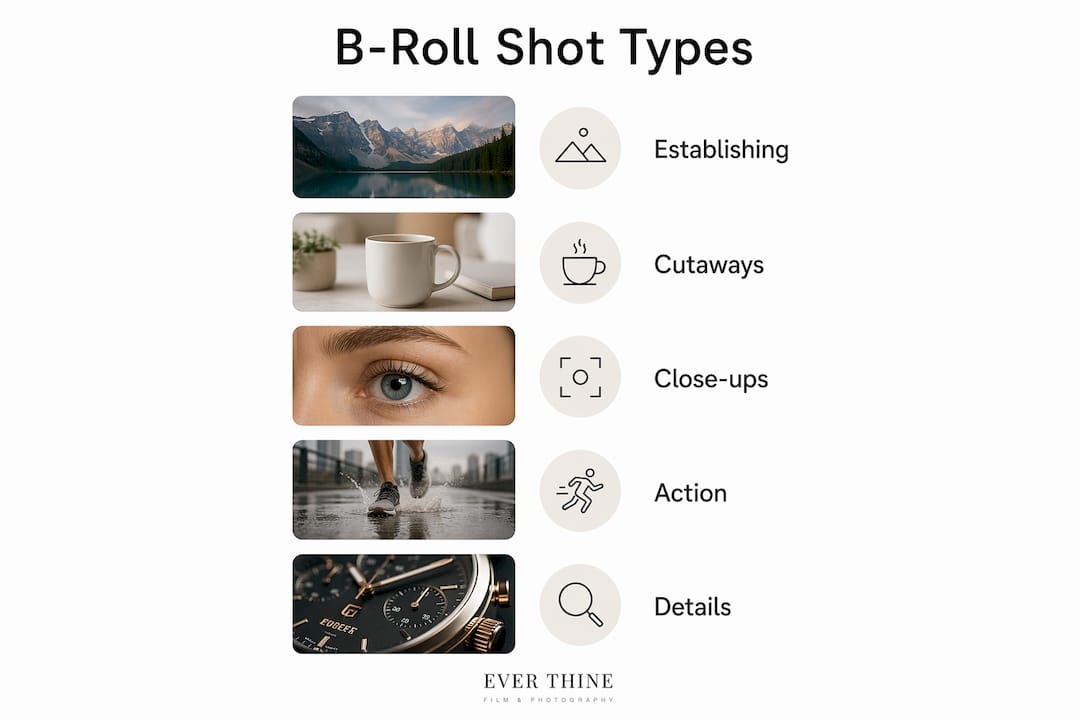
Action and process shots are particularly powerful in documentaries and corporate films. Showing a craftsman at work, a chef preparing a dish, or a team collaborating in an office provides visual proof of claims that a talking head simply cannot deliver. The viewer sees the evidence rather than just hearing it described.
Pro Tip: When shooting b-roll for a documentary or corporate video, capture each type of shot for every key location or subject. A complete set of establishing, detail, and action shots gives your edit genuine visual variety and prevents you from relying on the same cutaway repeatedly.
How much b-roll should you shoot and how do you integrate it?
The practical answer is: more than you think you need, but used with discipline. Most b-roll clips run 3–7 seconds in the final timeline, but the shots themselves should be held for approximately ten seconds during filming. That extra length is what professionals call “editorial runway.” It gives the editor a clean in-point and out-point without being forced to use an awkward moment at the start or end of a clip.
Shooting b-roll as sequences rather than isolated clips is one of the most effective techniques in professional film production. Planned b-roll sequences use multiple focal lengths to cover a single subject or action, moving from wide to medium to tight. This approach creates micro-narratives within the edit and produces smoother, more believable transitions between shots.
Here is a practical framework for b-roll planning on any shoot:
Wide shot: Establishes the environment and spatial relationships.
Medium shot: Shows the subject in context, neither too close nor too distant.
Close-up: Isolates a specific detail, object, or expression.
Over-the-shoulder or POV shot: Places the viewer inside the action.
Reaction or ambient shot: Captures the atmosphere or response to the main action.
Capturing this sequence for each key moment on a shoot gives the editor a complete visual vocabulary to work with. The edit becomes a matter of selection rather than improvisation.
Overusing b-roll to fill time is a common mistake that dilutes viewer impact. When every sentence of an interview is covered by b-roll, the audience loses connection with the speaker. The most effective edits alternate between A-roll and b-roll deliberately, using supplementary footage to punctuate and support the main narrative rather than replace it. Capturing longer takes gives editors the freedom to make these choices without feeling forced into covering everything.
For managing b-roll in post-production, tools like Adobe Premiere Pro and DaVinci Resolve both offer bin structures and metadata tagging that allow editors to categorise footage by shot type, location, and emotional tone before the edit begins. This preparation pays dividends when working under deadline pressure.
What impact does b-roll have on viewer engagement?
Visual variation through b-roll prevents viewer boredom by refreshing attention at strategic moments in a video narrative. A static talking-head interview, however compelling the content, will lose audience attention within minutes without visual relief. B-roll footage effects on engagement are measurable in corporate video production, where the difference between a polished film and a raw recording often comes down entirely to the quality and quantity of supplementary footage.
Authentic, real-environment b-roll builds credibility in a way that stock footage cannot replicate. Overlay footage as authenticity infrastructure provides real-world proof that enhances message credibility, particularly in corporate and documentary contexts. When a company claims to prioritise craftsmanship, showing actual hands at work is more persuasive than any spoken statement.
The emotional rhythm created by alternating A-roll and b-roll is one of the most sophisticated tools available to a filmmaker. Consider how b-roll enhances storytelling in documentary films like those produced by the BBC Natural History Unit. A narrator describes a predator’s patience, and the edit cuts to a tight close-up of the animal’s eye, then to the distant prey, then back to the narrator. Each cut adds a layer of tension that the words alone cannot create.
Using b-roll in documentaries also builds trust with the audience. When a subject describes an event and the edit immediately shows footage of that event, the viewer’s confidence in the narrative increases. The footage becomes evidence, not illustration. This distinction matters enormously in journalism, documentary filmmaking, and any production where credibility is central to the message.
Key takeaways
B-roll is the single most flexible tool in a filmmaker’s editing arsenal, and its deliberate use is what separates a coherent cinematic story from disconnected footage.
Point | Details |
B-roll prevents jump cuts | Cut to supplementary footage during any interview trim to maintain seamless visual flow. |
Shot variety is non-negotiable | Capture establishing, detail, action, and reaction shots for every key scene to give editors genuine choice. |
Hold shots for ten seconds | Film each b-roll clip for approximately ten seconds to allow clean in and out points during editing. |
Sequence shooting beats isolated clips | Shooting wide to tight sequences creates micro-narratives and produces smoother, more believable edits. |
Overuse reduces impact | Reserve b-roll for purposeful moments; excessive cutting away from A-roll weakens the audience’s connection to the speaker. |
Why b-roll is the most misunderstood tool in filmmaking
Most filmmakers understand b-roll as coverage. I think that framing is the root cause of weak edits. Coverage implies you are filling space. What you are actually doing is composing a second layer of storytelling that runs beneath the spoken or acted narrative.
The pitfall I see most often is b-roll shot without intention. A filmmaker grabs twenty clips of a location, drops them over an interview, and considers the job done. The result is footage that looks busy but feels empty. The viewer senses the disconnect even if they cannot name it. Every b-roll shot should answer a specific question: what does this add to what the audience already knows or feels at this moment?
The other mistake is saving b-roll planning for the shoot day itself. The filmmakers who produce the strongest edits plan their b-roll sequences during pre-production, treating them with the same seriousness as the A-roll. They arrive on set knowing exactly which details, actions, and environments they need to capture. That preparation is what makes the edit feel inevitable rather than assembled.
Audience expectations have shifted considerably. Viewers in 2026 are accustomed to the visual language of high-end documentary and streaming content. They notice when b-roll is generic, repetitive, or disconnected from the emotional tone of the scene. Shooting with genuine narrative purpose, and understanding the cinematic storytelling principles behind each cut, is no longer optional for anyone serious about their craft.
— Ever
How Weddingfilmphotography uses b-roll to tell your story
Understanding b-roll transforms how a wedding film feels to watch. At Weddingfilmphotography, every cinematic wedding film is built on a foundation of purposefully captured supplementary footage, from the quiet detail of a buttonhole being pinned to the wide sweep of a reception venue filling with guests.
[
Based in Staffordshire and covering Derbyshire, Worcestershire, and beyond, Weddingfilmphotography applies the same sequence-based b-roll approach used in professional documentary filmmaking to every wedding. The result is a film that feels cohesive, emotional, and genuinely yours. If you are planning your wedding and want a film built on real storytelling craft, explore our wedding videography in Derbyshire or our Staffordshire wedding films to see the approach in action.
FAQ
What is b-roll in film production?
B-roll is supplementary footage intercut with the main footage, called A-roll, to provide context, hide edits, and add visual variety. It is the connective tissue that gives editors flexibility and enriches the storytelling.
Why is b-roll important in documentary filmmaking?
Using b-roll in documentaries prevents jump cuts, provides visual evidence for spoken claims, and builds audience trust by showing real environments and actions rather than relying solely on interview footage.
How long should b-roll clips be when filming?
Shoot each b-roll clip for approximately ten seconds to allow editorial flexibility, even though most clips will only appear for 3–7 seconds in the final edit.
Can you use too much b-roll in a film?
Yes. Excessive b-roll use dilutes viewer impact and weakens the audience’s connection to the main subject. B-roll should punctuate and support the narrative, not replace it.
What is the difference between b-roll and stock footage?
B-roll is original footage captured specifically for the production, while stock footage is pre-existing material licensed from a library. Authentic b-roll builds far greater credibility and emotional connection than generic stock alternatives.
Recommended

Comments