
The role of composition in photography explained
- Jun 13
- 8 min read

TL;DR:
Composition in photography involves deliberately arranging visual elements within the frame to guide viewer attention and evoke emotion. Mastery of principles like the Rule of Thirds, leading lines, and negative space allows photographers to create purposeful, compelling images that communicate stories beyond technical skill. Internalizing these rules and practicing intentional framing accelerates artistic growth, enabling deliberate rule-breaking for powerful creative expression.
Composition in photography is the intentional arrangement of visual elements within the frame to guide viewer attention, create emotional tone, and convey a story. Known formally as visual composition, it is the single greatest determinant of whether a photograph communicates or merely records. Studies show composition has greater influence on viewer engagement than expensive camera gear or megapixel counts. That finding should reshape how you invest your time as a photographer. Lines, shapes, negative space, and colour are not decorative choices. They are the vocabulary of a visual language that every serious photographer must learn to speak fluently.
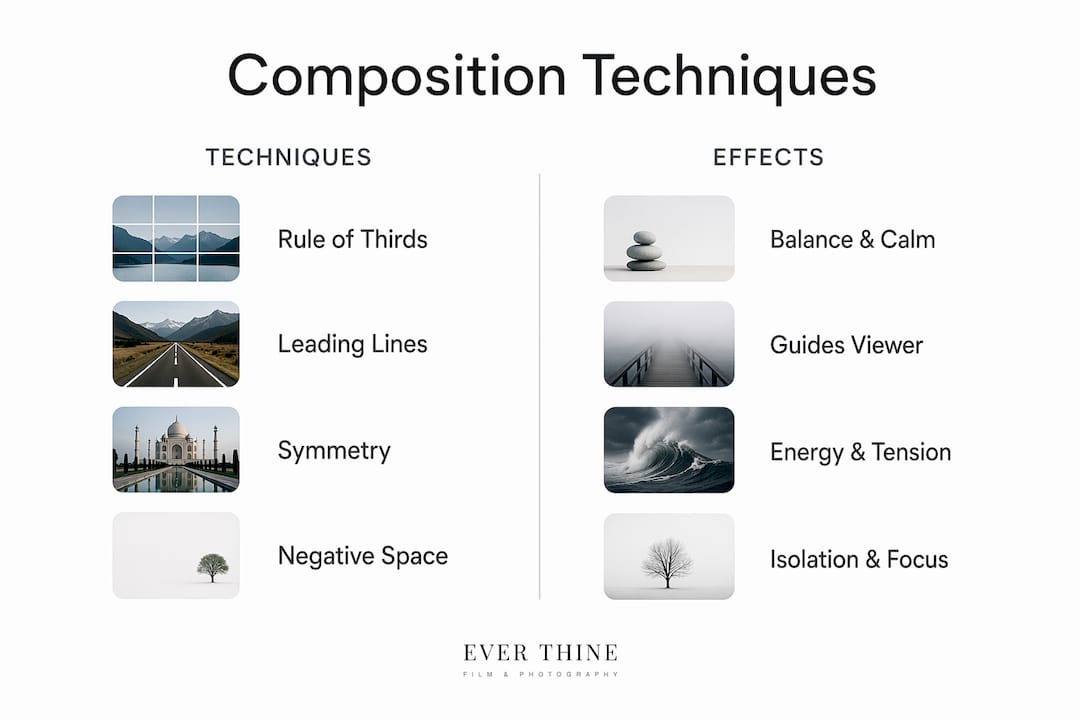
What are the fundamental principles of composition in photography?
Composition is defined as the intentional arrangement of visual elements, including lines, shapes, space, colour, and texture, within the frame. These elements do not work in isolation. They interact through foundational principles: balance, visual weight, harmony, and proportion. Understanding how these principles operate gives you a repeatable framework for producing photographs that feel considered rather than accidental.
The most widely taught compositional guidelines include:
Rule of Thirds: Divide your frame into a three-by-three grid and place your subject along the grid lines or at their intersections. This creates natural tension and visual interest that a centred subject rarely achieves.
Leading lines: Roads, fences, rivers, and architectural edges draw the viewer’s eye through the frame toward your subject. They add depth and a sense of movement.
Negative space: The empty area around your subject is not wasted space. It isolates the subject and shifts the mood from busy to contemplative.
Framing: Use natural elements such as doorways, archways, or tree branches to frame your subject within the frame. This adds layers and directs attention precisely.
Golden ratio: A more sophisticated version of the Rule of Thirds, the golden ratio creates a spiral that guides the eye through the image in a mathematically harmonious path.
Modern cameras often provide grid overlays to help photographers apply these techniques in real time. This is particularly useful when you are still training your eye.
Pro Tip: Enable the grid overlay on your camera or smartphone viewfinder before every shoot. Practise placing subjects on the intersecting points until it becomes instinctive. This one habit accelerates compositional learning faster than any textbook.
How does composition affect the viewer’s perception and emotional response?
Composition directs where the viewer looks first, second, and last within a photograph. This sequence is called visual hierarchy, and it is entirely within your control as the photographer. Visual weight determines how strongly an element draws the viewer’s eye via contrast, saturation, and placement, which in turn shapes the emotional tone of the image.

Consider the difference between a portrait with the subject centred against a cluttered background versus the same subject placed off-centre against open sky. The first image feels static and noisy. The second feels expansive, perhaps even lonely or free, depending on the context. Neither is technically superior. The composition determines the emotional reading entirely.
Symmetry brings calm and balance; asymmetry adds tension and energy. A wedding photograph of two people reflected in still water communicates serenity. The same couple photographed mid-laugh with one partner slightly out of frame communicates spontaneity and joy. Both are valid. Both are intentional. The photographer chooses the emotional register through compositional decisions.
The table below summarises how common compositional techniques influence viewer perception:
Technique | Emotional or perceptual effect |
Negative space | Creates calm, isolation, or contemplation |
Symmetrical balance | Conveys order, elegance, and stability |
Asymmetrical balance | Suggests energy, movement, and tension |
Leading lines | Builds anticipation and draws the eye to a focal point |
Tight framing | Increases intimacy and emotional intensity |
Negative space isolates subjects, shifting mood from chaotic to contemplative regardless of camera equipment quality. This is why two photographers with identical gear can produce images that feel worlds apart.
What practical photographic composition techniques can photographers apply consistently?
Practical composition begins before you press the shutter. Making compositional choices before pressing the shutter is considered best practice in professional photography, and for good reason. Post-processing tools like Adobe Lightroom and Capture One allow you to crop and reframe after the fact, but front-loading your compositional decisions produces more authentic, higher-quality images with greater tonal and detail integrity.
Here is a consistent process you can apply to any shoot:
Assess the scene before raising your camera. Walk the location. Identify natural lines, light sources, and potential foreground elements. The best composition often reveals itself on foot, not through the viewfinder.
Use your camera’s live view or grid overlay. Enable the Rule of Thirds grid and consciously place your subject at an intersection point before shooting.
Build depth through layers. Foreground, midground, and background layers restore depth to photographs and enhance immersive visual storytelling. A wedding portrait gains dimension when a blurred floral arrangement occupies the foreground and a softly lit venue fills the background.
Practise subtractive framing. Ask yourself what you can remove from the frame, not what you can add. Move closer, change your angle, or shift your position to exclude distracting elements. Cleaner frames tell clearer stories.
Crop with intention in post-processing. Cropping in post-processing refines composition by removing distractions and enhancing visual hierarchy. Use it as a final refinement, not a substitute for thoughtful framing at capture.
Pro Tip: Spend 15 minutes each week analysing photographs you admire, whether from photographers like Henri Cartier-Bresson, Annie Leibovitz, or wedding photographers whose work resonates with you. Identify the compositional choices at work. This critical analysis trains your eye faster than shooting alone.
Combining multiple composition techniques amplifies image impact. A leading line that guides the eye to a subject placed at a Rule of Thirds intersection, framed by an archway, is not over-engineered. It is deliberate visual storytelling.
How do experienced photographers balance rules and creative freedom?
Technical settings can be learned in weeks; a compositional eye takes years to develop. That gap is where creative freedom lives. Experienced photographers do not abandon compositional rules. They internalise them so thoroughly that breaking them becomes a conscious, purposeful act rather than an accident.
The most common beginner pitfall is visual clutter. When everything in the frame competes for attention, nothing wins. Composition is a decision-making process focused on excluding elements to avoid visual clutter, and this subtractive mindset is what separates technically competent photographers from genuinely compelling ones.
Once you have internalised the foundational rules, deliberate rule-breaking becomes a creative tool:
Centring a subject can create powerful symmetry or confrontational directness, particularly in portraiture where eye contact is the entire point.
Leaving a subject at the very edge of the frame creates unease or a sense of departure, useful in documentary and editorial photography.
Filling the entire frame with a subject, eliminating all negative space, creates intensity and claustrophobia that can serve a narrative purpose.
Using an empty frame where the subject has just left or is about to enter builds anticipation and invites the viewer to complete the story.
Rules like the Rule of Thirds and the Golden Ratio are guides to train the eye. Once internalised, photographers can intentionally break them for artistic expression. Rule-breaking creates tension, shock, or emotional responses that mark an advanced personal style. The goal is not to follow rules or break them. The goal is to make every compositional choice with full awareness of its effect.
Photography shares design principles with art and graphic design, and studying these disciplines alongside photography accelerates compositional development. Reading about gestalt theory, studying graphic design layouts, or analysing film cinematography all feed directly into your photographic eye. Understanding visual storytelling in wedding photography offers a practical example of how these design principles translate into emotionally resonant images.
Key takeaways
Composition is the most learnable and highest-impact skill in photography, outweighing gear, settings, and post-processing in its effect on viewer engagement and emotional storytelling.
Point | Details |
Composition outweighs gear | Intentional visual arrangement influences viewer engagement more than camera equipment quality. |
Core techniques are learnable | Rule of Thirds, leading lines, negative space, and layering are skills built through deliberate practise. |
Emotional tone is compositional | Symmetry, asymmetry, and negative space each produce distinct emotional responses in the viewer. |
Front-load your decisions | Making compositional choices before pressing the shutter produces more authentic, higher-quality images. |
Rules exist to be broken intentionally | Internalising compositional rules allows deliberate rule-breaking for specific artistic and emotional effects. |
Why composition changed how I see every photograph I take
I spent my first two years as a photographer obsessing over lenses and camera bodies. I upgraded twice before I realised the images were not improving in the ways that mattered. The turning point came when I started studying the work of photographers whose images stopped me mid-scroll, and I began asking not what they photographed but how they arranged what was in the frame.
The honest truth is that composition is uncomfortable to learn because it requires you to slow down. You have to resist the instinct to raise the camera the moment something interesting appears. Walking a scene, assessing lines, considering what to exclude, these habits feel slow at first. Over time, they become the fastest route to a photograph worth keeping.
What I find most photographers underestimate is the power of subtraction. The urge to include everything, the venue, the guests, the details, produces images that communicate nothing clearly. The photographs that consistently move people are the ones where a single decision was made about what matters most in this frame, right now.
Studying cinematic wedding storytelling taught me that the same compositional logic applies whether you are working with a still camera or a video frame. The principles of visual weight, balance, and hierarchy are not photographic rules. They are human perceptual truths. Once you understand that, composition stops feeling like a constraint and starts feeling like a superpower.
— Ever
How Weddingfilmphotography uses composition to tell your love story
Every wedding photograph Weddingfilmphotography creates begins with a compositional decision, not a camera setting. The team’s documentary approach means reading a scene in real time, identifying the lines, light, and layers that will make a fleeting moment feel permanent. That is composition working at its highest level.
[
If you are planning a wedding in the Midlands and want photography that does more than document, that genuinely tells the story of your day through considered, emotionally resonant framing, explore the wedding photography in Derbyshire services from Weddingfilmphotography. Every image is built on the principles covered in this article, applied by photographers who have spent years developing their compositional eye. Your story deserves that level of intention.
FAQ
What is the role of composition in photography?
Composition is the intentional arrangement of visual elements within the frame to guide viewer attention, create emotional tone, and tell a story. It has greater influence on image quality and engagement than camera gear or technical settings.
Which compositional technique is best for beginners?
The Rule of Thirds is the most accessible starting point. Place your subject along the grid lines or at their intersections rather than dead centre, and the improvement in visual interest is immediate.
How does composition affect the mood of a photograph?
Compositional choices directly control emotional tone. Negative space creates calm or contemplation, symmetry conveys order and elegance, and asymmetry produces tension and energy, all independent of subject matter.
Can you fix poor composition in post-processing?
Cropping and reframing in tools like Adobe Lightroom can refine composition after the fact, but they cannot fully replace intentional framing at capture. Front-loading compositional decisions at the point of shooting produces stronger, more authentic results.
How long does it take to develop a strong compositional eye?
Technical camera skills can be learned in weeks, but developing a compositional eye takes years of deliberate practise and critical analysis of images. Studying design principles alongside photography accelerates the process considerably.
Recommended

Comments