
Cinematic wedding storytelling: what every couple should know

TL;DR:
Cinematic storytelling in weddings creates emotionally immersive films by applying film directing techniques, emphasizing storytelling structure and emotional arcs. It blends intentional composition with documentary authenticity, balancing direction and observation to capture genuine moments and feelings. This approach helps couples preserve their memories as vivid, heartfelt experiences that transcend simple event documentation.
Most couples assume their wedding film will be one of two things: a staged performance where you’re directed like actors, or a flat chronological record that captures what happened without capturing how it felt. Neither option sounds particularly appealing. What you actually want is something far more powerful, a film and a set of photographs that transport you straight back into the emotion of your day every single time you watch or look at them. Cinematic storytelling makes that possible, and understanding how it works will help you choose the right team and get the most from your coverage.
Table of Contents
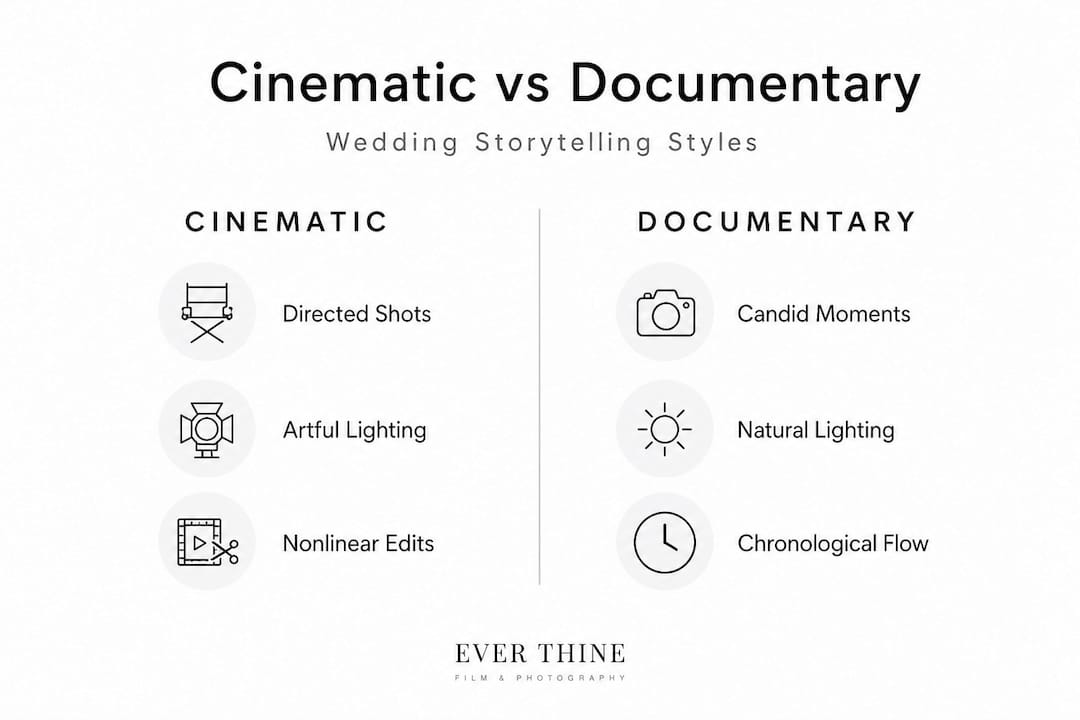
Cinematic vs documentary: how do they differ in wedding films and photography?
Blending cinematic storytelling with documentary style: the best of both worlds
Planning your own cinematic wedding story: practical tips for couples
Why cinematic storytelling matters more than ever in 2026 weddings
Start planning your cinematic wedding story with an expert team
Key Takeaways
Point | Details |
Cinematic storytelling defined | It’s a blend of real moments and film-inspired techniques that make your wedding story emotionally compelling. |
Cinematic vs documentary | Cinematic style uses direction and editing, while documentary captures authentic, unscripted moments as they happen. |
Blended approach benefits | Combining both styles ensures you get true-to-life emotion and creative polish in your wedding memories. |
Practical planning | Clear communication with your team helps tailor the balance of cinematic and documentary styles to your vision. |
What is cinematic storytelling in a wedding context?
The term “cinematic” gets thrown around a lot in the wedding industry, so let’s be precise about what it actually means when applied to your wedding day. Cinematic storytelling borrows its language directly from film directing. Think about the films that have moved you most deeply. They work because of careful composition, deliberate pacing, music that amplifies feeling, and a structure that builds emotional momentum. Those same principles, applied to your wedding coverage, are what separate an extraordinary film from a forgettable slideshow.
In wedding contexts, “cinematic” typically borrows techniques from film direction including scene composition, movement, rhythm, and emotional arc, while documentary style emphasises observing real moments and letting the day unfold more naturally. The origins of this approach trace back to the 1990s and early 2000s, when a new generation of wedding filmmakers began rejecting the static, tripod-locked camcorder footage that defined the industry. Inspired by the Dogme 95 movement in cinema and the rise of digital filmmaking, they started shooting handheld, using natural light, and editing to music with genuine intention.
For your wedding, this means your videographer is thinking in terms of story structure. There is a beginning, a middle, and an end. There are scenes that establish atmosphere, moments that build tension (will the ring fit?), and payoffs that release emotion (the first kiss, the father’s speech). This is why a cinematic wedding video guide is so different from a traditional wedding recording. Rather than delivering a complete record of every moment, it curates and shapes experience.
Here is the emotional arc a well-crafted cinematic wedding story typically follows:
Establishment — quiet, intimate preparation scenes that introduce mood and character
Rising tension — the ceremony approach, the anticipation before the first look
Emotional peak — vows, the kiss, tears from loved ones
Release and joy — celebrations, dancing, candid laughter
Reflection — quieter closing moments that let the emotion settle
“The goal is not to document an event but to tell a story that makes the viewer feel they were there — and feel it deeply.”
This is the distinction that matters most for couples choosing their wedding team. You are not commissioning a record. You are commissioning a memory, shaped and crafted with artistic intention.
Cinematic vs documentary: how do they differ in wedding films and photography?
Understanding the difference between cinematic and documentary approaches will help you communicate your preferences clearly to any photographer or videographer you speak with. Both styles have genuine merit, and the best professionals draw on both, but they start from very different places.
Documentary wedding photography is framed around authentic, unscripted moments with narrative flow rooted in photojournalism; cinematic wedding films are story-driven, with intentional composition and non-linear editing based on feeling. In practical terms, a documentary photographer is thinking like a journalist. They are patient, unobtrusive, and reactive. They wait for the moment and capture it as it unfolds.
A cinematic filmmaker, by contrast, thinks like a director. They might position you near a window for beautiful side lighting during preparation. They might ask your best man to walk through a doorway twice so they can capture it properly. They are shaping the raw material of your day into something more visually coherent.

Feature | Cinematic style | Documentary style |
Approach | Intentional, directed | Observational, reactive |
Composition | Carefully framed and lit | Spontaneous and candid |
Editing structure | Non-linear, emotionally driven | Chronological or narrative flow |
Viewer experience | Polished, immersive film | Organic, authentic memory |
Couple involvement | Some gentle direction | Minimal interaction |
Best for | Emotional impact and artistry | Candid, unscripted authenticity |
Here is what each style uniquely offers your wedding story:
Cinematic delivers a film you will want to share. It is beautiful, polished, and emotionally compelling for viewers who were not at your wedding.
Documentary delivers a record that feels deeply personal. It captures the real texture of your day, the nervous laugh, the tearful hug that nobody planned.
Combined gives you both: the shareability of a cinematic film and the authenticity of real, unguarded moments.
Pro Tip: When you meet with potential videographers, ask to see a full-length edit rather than just a highlights reel. Highlights are always polished; a full edit shows you whether they can sustain emotional momentum over time and handle the quieter, less dramatic moments of your day with the same skill.
If you want to explore how professional filmmakers approach this creative balance, reading about cinematic wedding videographers and their methods will give you a clearer picture of what to look for.
Blending cinematic storytelling with documentary style: the best of both worlds
Many professionals position the best result as a blend of documentary authenticity and cinematic technique. This is not a compromise; it is actually the most sophisticated approach available to you. And it is increasingly the standard that UK couples are requesting, because they want coverage that is both honest and beautiful.
So how does blending work in practice? Here is a typical workflow showing when direction and observation each come into play:
Preparation — primarily observational; the nervous energy, the shared laughter, the quiet moments before everything begins
First look or pre-ceremony portraits — gently directed; positioning for light, suggesting a slow walk, a whispered word
Ceremony — almost entirely documentary; nothing is staged, everything is real
Couple portraits — directed but relaxed; guiding you through movement rather than poses
Reception and dancing — purely documentary; chaos, joy, and authenticity
Moment | Dominant style | Why it works this way |
Getting ready | Documentary | Real nerves and emotion need no direction |
First look | Blend | Lighting matters, but the reaction must be genuine |
Ceremony | Documentary | Authenticity is everything in this moment |
Couple portraits | Cinematic | Intentional composition elevates the images |
Speeches | Documentary | Unscripted emotion is the whole point |
First dance | Blend | Beautiful framing around unrehearsed movement |
Understanding emotional wedding films is partly about recognising that the best emotional impact comes from the unguarded moments, not the scripted ones. A well-timed zoom onto a mother’s face during the vows. The groom’s breath catching as the doors open. These are not directed. They are witnessed.
The cinematic craft comes in knowing how to witness and capture them: the lens choice, the angle, the decision to hold on a moment rather than cut away. That is where narrative videography expertise becomes invaluable. It is not about controlling your day. It is about reading it with the trained eye of a filmmaker.
Planning your own cinematic wedding story: practical tips for couples
Knowing your options is one thing. Translating that knowledge into a productive conversation with your wedding team is another. Here is how to approach it practically.
Cinematic storytelling in weddings can be tailored to individual couples by communicating their priorities, preferred balance of direction versus observation, and emotional tone. This means your input genuinely shapes the final film. You are not a passive subject; you are a collaborator in the story.
Start by reflecting on these questions before your consultation:
What do you most want to remember about your day? Is it the emotion of the ceremony, the chaos of the reception, the quiet moments between just the two of you?
How comfortable are you with gentle direction? Some couples find it reassuring; others find it distracting.
What films or visual styles do you find most moving? Sharing references is enormously helpful.
Are there specific people or moments that absolutely must be captured, regardless of style?
Once you have clarity on these points, use this communication checklist with your team:
Share two or three wedding films you love and explain specifically what you love about them
Discuss which parts of your day feel most emotionally significant to you
Ask how they handle the moments they cannot predict, such as a surprise speech or a spontaneous dance
Clarify the ratio of directed to documentary coverage they typically use
Review their wedding video storytelling process from initial consultation through to final edit
Understanding how creative wedding editing works will also help you set realistic expectations for timelines and outputs. Editing a cinematic wedding film is not quick work. A well-crafted highlight film of eight to twelve minutes may take forty or more hours of editing, colour grading, and sound design.
Pro Tip: Ask to see storytelling wedding video examples from your specific venue or a similar setting. Light conditions, architecture, and space all affect how a filmmaker works, and seeing their approach in a comparable environment gives you a far more accurate sense of what to expect from your own film.
Finally, trust matters enormously in this process. The more comfortable you are with your team, the more naturally you will behave on the day, and naturalness is the foundation of every great cinematic story.
Why cinematic storytelling matters more than ever in 2026 weddings
Here is an opinion you will not hear very often: the rise of cinematic wedding storytelling is not really about aesthetics. It is about memory.
We are saturated with visual content. You have watched thousands of beautifully produced videos. Your wedding film needs to cut through that noise and do something different: it needs to make you feel something specific, your own wedding, your own love, your own day. Generic video montages with upbeat music and sweeping drone shots no longer satisfy modern couples because they all start to look the same. They show what happened. They do not show what it meant.
The best wedding memories are a blend of authenticity and intentional artistry. This is not just an aesthetic preference. It reflects a deeper truth about how human memory works. We do not remember events neutrally. We remember how they felt. A well-made cinematic film recreates that feeling rather than simply replaying the event.
There is also a widespread misconception worth addressing directly: cinematic does not mean scripted. It does not mean your day becomes a film set where everyone is performing. In practice, the best cinematic wedding teams spend the majority of their time simply watching, waiting, and being present. The direction is subtle and brief. The observation is constant. What makes the result feel cinematic is not how much was directed, but the skill and intentionality brought to every frame.
What you are really asking for, when you request cinematic storytelling, is a team with both the technical skill of a filmmaker and the emotional intelligence of a documentary artist. That combination is rarer than the industry sometimes suggests, and it is worth taking time to find it. Understanding what a wedding highlight film genuinely involves, and how it differs from a simple video edit, is the first step toward making an informed choice.
The couples who revisit their wedding films most often are not the ones who had the most elaborate productions. They are the ones whose films captured something true.
Start planning your cinematic wedding story with an expert team
If this guide has sparked a clearer sense of what you want from your wedding coverage, the natural next step is finding a team whose portfolio reflects that vision.
[
We are based in Staffordshire and work across the Midlands and beyond, specialising in exactly this blend of cinematic storytelling and documentary authenticity. Whether you are looking for a wedding photographer in Derbyshire, a wedding photographer in Staffordshire, or a wedding photographer in Worcestershire, we would love to show you our portfolio, talk through your vision, and help you understand how we approach every couple’s unique story. Get in touch to start the conversation.
Frequently asked questions
Is cinematic wedding storytelling the same as traditional videography?
No; cinematic storytelling uses intentional film-inspired direction and non-linear editing, while traditional videography typically records your day in a straightforward, chronological fashion without the same artistic shaping of narrative or emotion.
Can you have a cinematic story without posed shots or acting on your wedding day?
Yes; cinematic storytelling focuses on narrative arc and emotional resonance, not staging, and the best results come from authentic, unscripted moments elevated by skilled framing, lighting, and editing rather than rehearsed performance.
How do I choose between cinematic and documentary styles for my wedding?
Consider whether you prioritise a polished, emotionally driven film or purely candid authenticity, though most couples find that a blend of both delivers the most satisfying result by preserving real moments within a beautifully crafted narrative structure.
Does a cinematic approach mean my photographer will direct everything?
Not at all; cinematic teams offer gentle, minimal direction for key scenes such as portraits or the first look, but the majority of their time is spent observing and waiting for genuine, unscripted emotion to unfold naturally.
Recommended


Comments