
Why natural poses work best for authentic photos

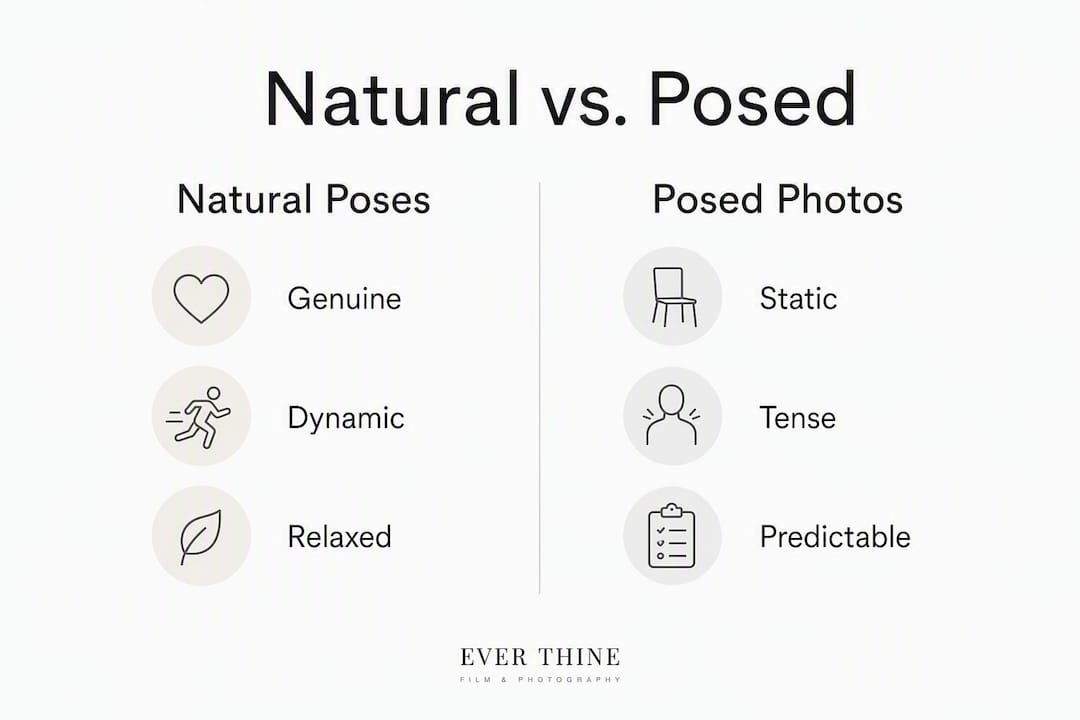
Natural poses outperform rigid posing because they reduce physical tension, create dynamic compositional lines, and signal genuine emotion to anyone looking at the image. When a subject is stiff, the camera captures exactly that: a body braced for the shot rather than a person living in a moment. Research confirms that candid-style photos produce higher ratings of connectedness and liking, with the benefit traced directly to perceived genuineness.
Here are five things you can do right now to get more natural results:
Shift your weight onto one foot so your hips and shoulders sit at slightly different angles.
Create a small gap between your arm and your torso rather than pressing them together.
Soften your jaw by parting your lips slightly or breathing out slowly before the shutter fires.
Angle your shoulders roughly 30–45 degrees away from the camera instead of squaring up to it.
Ask the subject to take one small step or turn their head slowly, then capture the moment mid-movement.
Table of Contents
What pose adjustments actually make a difference?
The gap between a stiff portrait and a relaxed one usually comes down to a handful of micro-corrections, not a complete rethink of the setup.
Weight shift (contrapposto). Ask the subject to put their weight on their back foot and let the front knee bend slightly. This single adjustment shifts the hips, waist, and shoulders onto different vertical axes, breaking the flat, parallel lines that make a pose read as rigid. The front leg appears slightly larger because it is closer to the lens, while the waist and hips recede, creating a naturally slimming effect. Photographer cue: “Lean onto your back leg and let the front one go soft.”
Shoulder angle. Turn the body roughly 30–45 degrees from the camera. Squared-up shoulders create a wide, static shape; angled shoulders introduce a diagonal that draws the eye through the frame. Cue: “Turn your body away from me a little, then look back.”
Forward lean. A slight lean from the hips towards the camera brings the face closer to the lens, slims the body, and conveys engagement. Cue: “Lean towards me just a touch, like you’re about to tell me something.”
Space between arm and torso. An arm pressed flat against the body looks wider and stiffer than it is. Ask the subject to rest a hand on their hip, hold something, or simply let the arm hang slightly away from the body. Cue: “Give yourself a little air — just let that arm breathe.”
Neck elongation. Ask the subject to push their chin very slightly forward and down, rather than pulling it back. It sounds counterintuitive, but it defines the jaw and removes the appearance of a compressed neck. Cue: “Chin forward and down just a fraction — like a slow nod.”
Pro Tip: Try a 3–5 second micro-move: ask the subject to walk slowly towards you, turn in a half-circle, or shake out their hands, then stop. Capture the two or three seconds after they stop moving. The body settles into a natural resting position that no amount of deliberate posing can replicate.
Why do natural poses look better? The psychology and science
The preference for natural-looking images is not just aesthetic instinct. There is a measurable perceptual and psychological basis for it.
What the research says about candid versus posed photos
A multi-study paper published in SAGE Journals found that observers feel more connected to people shown in candid photographs and are more likely to want to befriend or date them, with the advantage rooted in perceived genuineness. Separately, field data from online platforms show that posed photos dominate profiles despite this preference: Most OKCupid and Facebook profile photos in sampled data were posed. The gap between what people post and what observers respond to is striking.
Context matters too. Research discussed by Wharton notes that candids tend to work better for social connection and dating contexts, while more controlled, posed shots still serve professional settings such as LinkedIn headshots. For wedding photography, the social-connection context is exactly the one that counts.
How composition explains the visual preference
Asymmetry and diagonal lines hold attention longer than symmetrical, parallel ones. When every person in a group stands with feet parallel and shoulders squared, the eye has nowhere to travel. Introduce a weight shift, a turned shoulder, or a hand on a hip, and the frame gains triangular shapes and diagonal lines that pull the viewer through the image.
Studies on the contrapposto pose show it increases observer dwell time and attractiveness ratings, with neurophysiological research identifying the middle temporal gyrus and angular gyrus as the brain regions activated during attractiveness judgement of bodies in this pose. The contrapposto also creates what researchers describe as a “supernormal stimuli” effect: it exaggerates the waist-to-hip ratio beyond its natural value, which the brain reads as more attractive. For male subjects, the effect is less pronounced and the pose can read as less masculine, so a wider stance with squared shoulders tends to work better.
Expectancy-violation theory adds another layer: shapes that deviate from what we expect, such as the triangle formed by a bent elbow pointing outward, demand more cognitive processing and therefore hold attention for longer.
Dimension | Posed photo | Natural / candid photo |
Perceived genuineness | Lower | Higher |
Connectedness rating | Lower | Higher |
Compositional dynamism | Often static | Dynamic lines and asymmetry |
Attractiveness (contrapposto) | Baseline | Elevated (especially female subjects) |
Professional context suitability | Higher | Lower |
Platform | Proportion of posed profile photos (sampled data) |
OKCupid | 93.2% |
Facebook profiles | 87.6% |
The data make a clear case: most people default to posed photos, yet observers consistently respond better to images that look natural. Closing that gap is exactly what good posing technique does.
How do you guide a subject into a natural pose?
The most effective route to authentic expression is reducing a subject’s hyperawareness of the camera. Scripts and warm-up exercises do that faster than any technical adjustment.
Ready-to-use prompt scripts
For a relaxed mood: “Forget I’m here for a moment. Just stand however feels comfortable, look out towards the light, and breathe.” Give it five seconds, then shoot.
For a joyful mood: “Tell me something that made you laugh this week — doesn’t matter what it is.” The genuine reaction that follows is the shot.
For an intimate mood (couples): “Put your foreheads together and just breathe. You don’t need to look at me.” Wait for the small movements — a smile, a squeeze of the hand, a closed eye.
Step-by-step warm-up sequence
Start with movement. Ask the subject to walk towards you slowly, or to walk away and then turn back on your count. Movement breaks the freeze response that comes from standing still in front of a lens.
Use a conversational prompt. Ask a genuine question about the day, the venue, or something personal. A real answer produces a real expression.
Introduce a breathing exercise. Ask the subject to take one slow breath in and let it out completely before you shoot. Shoulders drop, jaw softens, and the body settles.
Give a micro-goal. Instead of “look natural,” say “look at the light just past my shoulder.” A specific focal point removes the self-consciousness of not knowing where to look.
Shoot during the transition. The moment between following an instruction and returning to neutral is often the most honest frame in the sequence.
Pro Tip: Sequence movement before stillness every time. A subject who has just been walking, turning, or laughing cannot hold a stiff pose even if they try. Use that window.
Common posing mistakes and how to fix them quickly
Most posing problems come from the same small set of errors. Spotting them early saves the session.
Rigid straight-on stance. Both feet parallel, shoulders squared, weight evenly distributed. Fix: ask for a weight shift and a shoulder turn immediately. It takes three seconds and transforms the frame.

Arms pressed to the body. This widens the arm visually and signals tension. Fix: hand on hip, fingers in a pocket, or holding something. Any separation works.
Chin tucked back. Subjects often pull their chin back when nervous, compressing the neck and creating the appearance of a double chin. Fix: the “chin forward and down” cue described earlier. Demonstrate it yourself — subjects copy a physical demonstration faster than they follow a verbal instruction.
Forced smiles. A held smile for longer than two or three seconds becomes a grimace. Fix: ask the subject to drop the smile completely, then say something that produces a genuine reaction. Shoot in the first second of the real smile, not the held version.
Ignoring clothing and environment. A tight jacket restricts the shoulder angle. A busy background competes with a subtle pose. Fix: check clothing fit before the shoot begins, and position subjects so the background is clean or deliberately blurred. A subject in comfortable, well-fitted clothing moves more freely and holds poses more naturally.
Flat, uniform group lines. When everyone stands at the same height and distance, the group reads as a row rather than a gathering. Fix: stagger heights by asking some people to sit, lean, or stand slightly forward. Create depth, not a line-up.
A quick pose bank for individuals, couples and small groups
Individual poses
Relaxed contrapposto. Weight on the back foot, front knee soft, shoulders angled 30–45 degrees from camera, one hand resting lightly on the hip. Set it up in three steps: weight shift, shoulder turn, chin forward and down.
Seated lean. Subject sits on a low surface, leans forward with elbows resting on knees, and looks slightly past the camera. Compact, relaxed, and works in almost any environment.
Over-the-shoulder glance. Subject walks away slowly, then turns their head back on your count. Capture the moment the eyes find the lens. The body is in motion; only the face is still.
Couple poses
Walk and talk. Ask the couple to walk together and talk about anything at all. Follow alongside and shoot. The interaction is real because they are genuinely talking, not performing.

Forehead to forehead. Couple stands close, foreheads touching, eyes closed or looking down. Micro-phrase: “Just breathe each other in for a moment.” Wait for the small, unscripted movements.
Simple cradle. One partner stands slightly behind, arms loosely around the other, both looking in the same direction. Cue: “Hold each other like you’re watching something together.”
Small group setups
Position people at staggered heights and depths rather than in a single row. Ask the tallest person to stand slightly back, the shortest to sit or lean forward. Avoid parallel feet across the group; ask at least two people to turn slightly inward. Create triangular shapes by varying arm positions. Spacing matters: too much distance reads as strangers; too little reads as awkward. A natural arm’s-length gap between people who know each other well is usually right.
Practical note: Before a session, prepare a contact sheet of six to eight reference frames covering these setups. Having visual references to hand means you spend less time explaining and more time shooting.
How Weddingfilmphotography creates natural moments on real weddings
The approach at Weddingfilmphotography is built around documentary-style coverage that prioritises observation over direction. The majority of the day is spent anticipating moments rather than staging them, which means the camera is present but unobtrusive for most of the session.
The workflow on a wedding day follows a consistent structure:
Before the day: couples receive a short briefing on what to expect, including the portrait pocket timing and the kinds of prompts that will be used. Familiarity with the process reduces anxiety on the day itself.
The warm-up: the first few minutes of any portrait session are spent in conversation rather than shooting. This is deliberate. A subject who has been talking naturally for two minutes is already less aware of the camera than one who has been standing in position waiting for instructions.
Candid coverage: the majority of frames captured across a wedding day are unposed, taken during genuine moments of connection, laughter, and emotion. Skilled posing is not inherently inauthentic; as academic portraiture research notes, gentle guidance can help camera-shy subjects drop defensive stiffness and reveal their true nature.
Portrait pockets: short, focused portrait sessions of 10–15 minutes are built into the day’s timeline. These use the micro-actions and scripts described in this article to produce relaxed, flattering images without consuming large blocks of time.
Delivery: couples receive a mix of candid documentary frames and guided natural portraits, giving them a complete record of the day rather than a set of either purely staged or purely spontaneous images.
The documentary approach prioritises personality over posing trends, which is why the images hold up over time rather than dating to a particular style era.
Key takeaways
Natural poses work best because they reduce tension, introduce dynamic compositional lines, and signal genuine emotion — three things that rigid posing actively works against.
Point | Details |
Comfort drives authenticity | A relaxed subject stops performing for the camera, which is when genuine expression surfaces. |
Contrapposto changes perception | Shifting weight onto one foot alters the body’s vertical axes, creating a slimming effect and holding viewer attention longer. |
Candids outperform posed shots socially | Research shows observers rate candid-style photos higher for connectedness and liking in social contexts. |
Scripts beat instructions | Specific prompts (“lean towards me like you’re about to say something”) produce natural results faster than generic direction. |
Weddingfilmphotography’s approach | Documentary-led coverage with short portrait pockets and scripted prompts delivers both candid and naturally guided images. |
The thing most photographers get wrong about posing
Most posing advice treats naturalness as the absence of direction. The idea is that if you just stop telling people what to do, authentic moments will appear. In practice, that is rarely how it works. Left entirely to their own devices, most people in front of a camera become more self-conscious, not less. They stand straighter, smile harder, and wait for permission to relax.
The more useful frame is that naturalness is something you create conditions for, not something you wait for. The warm-up conversation, the micro-movement prompt, the specific focal point — these are not tricks to disguise posing. They are the actual mechanism by which a person stops performing and starts being. A subject who has just been laughing at a genuine question cannot hold a stiff pose even if they try. That is the window.
There is also a tendency to treat candid and guided as opposites. They are not. The most resonant wedding images often come from a moment that was gently set up and then left to develop on its own. You position the couple, give them a single prompt, and then step back. What happens in the next thirty seconds is real. The photographer’s job is to be ready for it, not to keep directing it.
Natural wedding photos, captured without the stiffness
Weddingfilmphotography offers documentary-led wedding photography and film across Staffordshire, Derbyshire, Worcestershire, and the wider West Midlands. The approach described throughout this article, warm-up conversations, scripted micro-prompts, short portrait pockets, and predominantly candid coverage, is exactly how every wedding day is covered.
[
Couples who book receive a full day of unobtrusive coverage, a dedicated portrait session using the posing techniques above, and a final gallery that balances genuine documentary moments with relaxed, flattering portraits. There are no awkward line-ups, no forced smiles held for too long, and no poses that will look dated in five years.
Check availability for your date and view the full portfolio for Staffordshire weddings, Derbyshire weddings, or Worcestershire weddings. If you want to see how natural posing looks in practice before you get in touch, the candid moments guide is a good place to start.
Further reading and sources
The claims in this article draw on peer-reviewed research, practitioner analysis, and published editorial sources. The most relevant are listed below.
A candid advantage? The social benefits of candid photos — SAGE Journals multi-study paper on connectedness, liking, and perceived genuineness in candid versus posed photos.
A candid advantage? (Wharton Faculty PDF) — Field data on the prevalence of posed photos across online platforms including OKCupid and Facebook.
So long, selfies: why candid photos make a better impression — Knowledge at Wharton discussion of context-dependent value of candid versus posed imagery.
Body language of the contrapposto pose — Psychology Today overview of contrapposto research, attention effects, and attractiveness ratings.
Becoming sexy: contrapposto pose increases attractiveness ratings — Pazhoohi et al. neurophysiological study (EEG) on body posture, visual attention, and attractiveness judgement.
You can learn to be photogenic — The Atlantic on photogenicity as practised ease rather than innate quality.
Academic research on portraiture and authenticity — Journal of Aesthetics and Art Criticism on posing as an artistic tool for enabling authenticity.
Documentary wedding photography: authentic moments explained — Weddingfilmphotography’s own overview of the documentary approach and on-day workflow.
SEO for photographers — For photographers wanting their natural-posing portfolio to be found online, a resource on search visibility tailored to the photography industry.
FAQ
Why do natural poses look better in photos?
Natural poses reduce physical tension, which allows genuine expression to surface. Research shows that observers rate candid-style images higher for connectedness and liking because they read as authentic rather than performed.
Can you be attractive in real life but not photogenic?
Yes, and the gap is usually about ease in front of the camera rather than appearance. Photogenicity tends to be a practised skill: people who are comfortable with the lens, or who know a few key adjustments such as the chin-forward cue and a weight shift, consistently photograph better than those who are not.
What is the most flattering pose for a woman in photos?
The contrapposto is consistently rated more attractive than a neutral standing pose in published research: weight on the back foot, front knee soft, shoulders angled away from the camera, and one hand resting on the hip. The pose creates diagonal lines, accentuates the waist-to-hip ratio, and holds viewer attention longer than a straight-on stance.
Do candid shots really make a better impression than posed ones?
In social contexts, yes. A multi-study paper found that candid photos produce higher ratings of connectedness and liking than posed equivalents, with the advantage coming from perceived genuineness. Posed photos still perform better in professional contexts such as job applications or LinkedIn profiles.
How does Weddingfilmphotography keep wedding portraits looking natural?
The studio uses short warm-up conversations, scripted micro-prompts, and movement-based exercises before any still portrait is taken, then shoots during the natural settling that follows. The result is a gallery that mixes genuine documentary moments with relaxed, guided portraits rather than stiff, staged shots.
Recommended


Comments