
Plan photos safely: Cold sparks vs fireworks for UK weddings
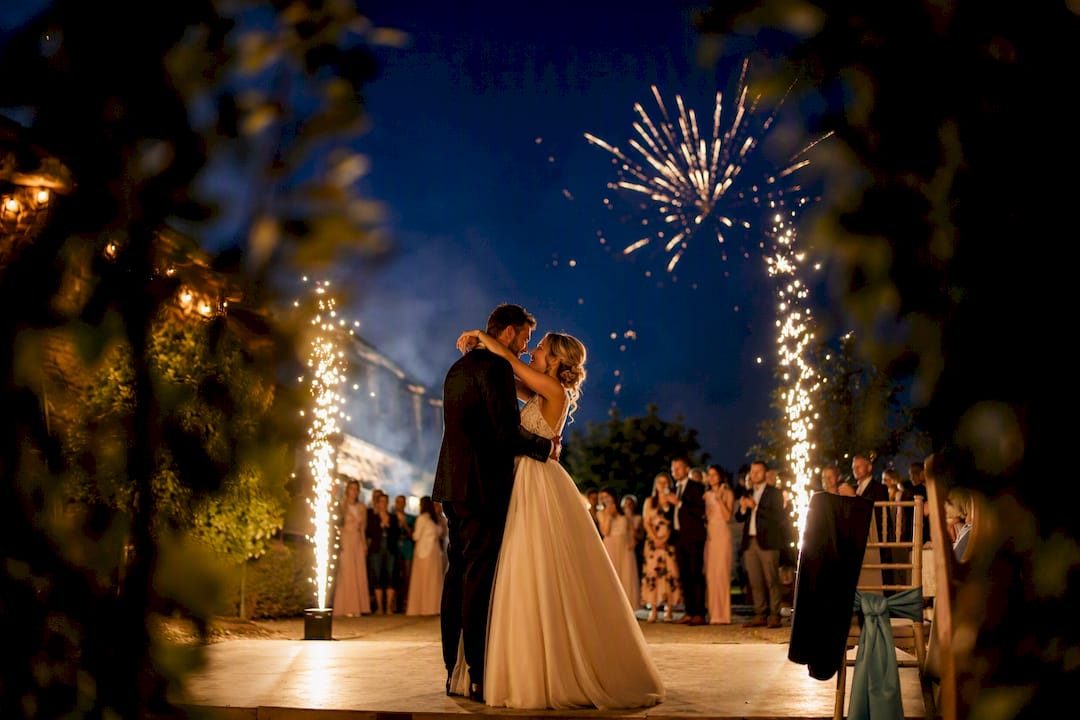
Choose cold sparks for indoor moments and close-proximity drama; choose traditional fireworks for outdoor aerial finales that need real sky and scale. The decision comes down to two things: cold sparks give you tight control and low burn risk, while fireworks give you height and spectacle no indoor effect can match. Venue rules, permits and smoke tolerance usually settle the argument before budget does.
TL;DR:
Cold sparks can be positioned closer to guests indoors because they operate at lower temperatures and produce minimal smoke or debris.
Fireworks require stricter safety zones, permits, and supervision due to their higher combustion temperatures and airborne effects, making them less suitable for indoor use.
Most venues approve cold spark effects more easily than fireworks because they are treated as special effects equipment with lighter paperwork and safety requirements.
Cold sparklers are ideal for intimate moments like first dances or entrances, as they allow precise timing and control without the risk of a fuse misfire.
Budgeting for cold sparks is simpler since equipment hire and minimal maintenance typically cost less than licensed fireworks, with refills lasting several bursts and minimal upkeep.
Table of Contents
Cold sparks vs fireworks: how they actually differ
The difference isn’t just size. It’s temperature, mess and how much control an operator has once the effect starts.
Cold spark machines run at a lower operating temperature than fireworks or even hand sparklers, which is why they can be positioned closer to guests than traditional fireworks typically allow, according to Entertainment Effects. Traditional fireworks burn hotter, throw lit debris, and produce a sulphurous smoke cloud that lingers, especially indoors or under a marquee, making them less suitable for indoor use.
Burn risk: cold sparks cool rapidly on fallout; fireworks carry genuine ignition risk to hair, fabric and dry ground.
Smoke and noise: cold sparks produce minimal smoke and a soft whoosh; fireworks produce dense smoke and loud noise that can be disruptive.
Indoor suitability: cold sparks are built for it; fireworks (beyond the smallest category) generally are not.
Visual scale: fireworks reach heights and colour ranges cold sparks can’t touch.
Permits and insurance: fireworks display categories carry stricter supply and use rules; cold spark hire is usually simpler paperwork.
Cold sparks run cool enough to touch fallout seconds after ignition; category 4 display fireworks reach high combustion temperatures that require strict safety zones and supervision. That single contrast explains most of the venue decisions that follow.
How do cold sparks and fireworks actually work?
A cold spark machine heats a fine metal powder, usually titanium or zirconium, using an internal heating element, then a fan forces the glowing particles out through a nozzle in a controlled column, as Big Shotter Fireworks explains. The particles burn bright but lose heat within a second or two of leaving the nozzle, which is why they’re described as “cold” relative to pyrotechnic sparks.
Traditional fireworks work on entirely different chemistry: a propellant charge lifts the shell, a time fuse triggers a burst charge, and metal salts (strontium for red, copper for blue, and so on) create the colour as they combust midair.
Cold spark components: powder hopper, heating element, fan, directional nozzle, remote trigger.
Fireworks components: propellant, lift charge, burst charge, colour agents, fuse timing.
Stoppability: cold sparks can be switched off instantly; a lit firework fuse cannot be recalled once burning.
Byproducts: cold sparks leave negligible residue; fireworks leave chemical residue and particulate smoke that settles on surfaces.
That last point on stoppability is the one event planners underestimate. A cold spark operator can kill the effect mid-cue if a guest walks too close. Nobody can do that with a firework once the fuse is lit.
What UK rules govern fireworks and cold sparks?
Traditional fireworks in the UK fall under four defined categories, from small garden fireworks (category 1) through to professional display fireworks (category 4), under the Pyrotechnic Articles (Safety) Regulations 2010. Each category carries its own labelling, age-restriction and supply rules, and manufacturers or importers must assign the correct category before the product reaches the market.
Government guidance confirms that placing pyrotechnic articles on the UK market requires conformity assessment and specific labelling tied to category, with category 4 professional fireworks are restricted to competent operators, according to the Department for Business’s guidance. Cold spark machines don’t fall under the same consumer firework categories at all. Most venues and suppliers treat them as special effects equipment rather than fireworks, which is exactly why they clear indoor venue approval more easily.
Venues that flatly refuse category 1–3 fireworks indoors will often approve a cold spark machine on the same night, provided the paperwork is in order. That paperwork rarely changes:
A safety data sheet (SDS) for the spark powder, covering composition and handling.
The equipment datasheet, showing run time, output height and power draw.
Certificate of insurance naming the venue where required.
Operator credentials or experience record, especially for larger venues or corporate bookings.
On-site, expect the operator to check clearances above and around the machine, anchor it securely so it can’t tip, keep a fire extinguisher within reach, and brief the venue on a no-smoke or reduced-smoke expectation for the room. None of this removes the need for permission. It just makes getting it far less painful than a fireworks application.
Where does each effect actually belong?
Match the effect to the moment, not the other way round.
First dance or grand entrance, indoors: cold sparks. Guests can stand close, the machine triggers on a music cue, and there’s no smoke haze ruining the photographs.
Outdoor finale after the last dance: traditional fireworks, provided the venue allows a licensed display and the site has enough clearance.
Marquee or barn with low beams: cold sparks only, run through the ceiling height and flooring materials with the venue first. Timber beams and hay bales are a real fire risk near open flame.
Corporate product reveal indoors: cold sparks, for the same reasons as a first dance. The controllability suits a scripted cue far better than pyrotechnics.
Countryside estate with open sky: either works, but weather becomes the deciding factor outdoors. Wind and rain can delay or cancel a fireworks display; cold sparks are far less weather-sensitive because there’s no aerial trajectory to disrupt.
Always check ventilation, crowd distance and flooring before booking either effect. A stone-floored barn behaves very differently to a marquee over grass.
Setting up cold sparks on the day
Professional setup follows a fairly consistent pattern, and it’s worth knowing the steps even if you’re not the one running the machine.
Site survey first. The operator checks ceiling height, nearby decor, drapes and guest flow before deciding where the machine sits.
Power and cabling. Machines need a stable supply and cabling routed away from walkways, plus a remote trigger synced to the DJ or band for the cue.
Refill and pre-show check. Powder canisters get loaded and tested well before guests arrive, never mid-reception.
Coordination with venue and photographer. The operator confirms timing with venue staff and the photography team so nobody’s caught off guard by the cue.
Pro Tip: Ask the operator for a short dry run during the venue walkthrough, even a five-second test burst, so your photographer can judge exposure and your planner can confirm sightliness before the real moment happens.
What to check before hiring or buying cold spark equipment
Ask suppliers these questions before signing anything, and treat vague answers as a warning sign.
Machine specs: confirm spark height range, run time per canister, footprint and power requirements against your venue.
Safety paperwork: request the SDS, the equipment datasheet, an operator CV or experience summary, and proof of insurance, a combination Brilliant Event Lighting recommends supplying to venues for sign-off.
Refill supply: ask how canisters are sourced, what a refill costs, and turnaround time if you need extras.
Warranty and maintenance: ask who maintains the machine and what happens if it fails on the day.
Hire vs buy: hire suits a single event; buying only makes sense if you’re running effects regularly, given ongoing maintenance and storage.
Getting the shot: photography and videography with cold sparks
Cold sparks change what a camera sees, not just what a guest experiences, and it’s worth briefing your photography team accordingly.
Position the machine slightly behind or beside the couple rather than directly in front, so faces stay lit rather than silhouetted.
Lower shutter speed slightly to let the spark trails read as flowing light rather than frozen dots.
Confirm the cue verbally with the operator beforehand. A missed trigger means a missed shot, with no second take.
Sparks reflect off fabric and skin, so expect richer detail in dress and suit texture than under flat reception lighting.
Pro Tip: If you want the sparks framed behind the couple rather than around them, ask the operator to trigger a beat before the music cue, not exactly on it. Cameras need a fraction of a second to catch up.
What does it cost, and what’s the upkeep?
Budgeting for cold sparks is simpler than budgeting for fireworks, mostly because the paperwork and labour are lighter.
Hiring a cold spark machine with an operator for an evening typically costs less than a licensed outdoor fireworks display of comparable visual impact, since fireworks require a trained pyrotechnician and stricter site clearance.
A single refill canister generally lasts through several short bursts, though exact runtime depends on the model and nozzle setting, so confirm this with your supplier rather than assuming.
Maintenance is minimal: machines need dry storage, occasional nozzle cleaning, and powder kept sealed until use.
Which events actually choose which effect?
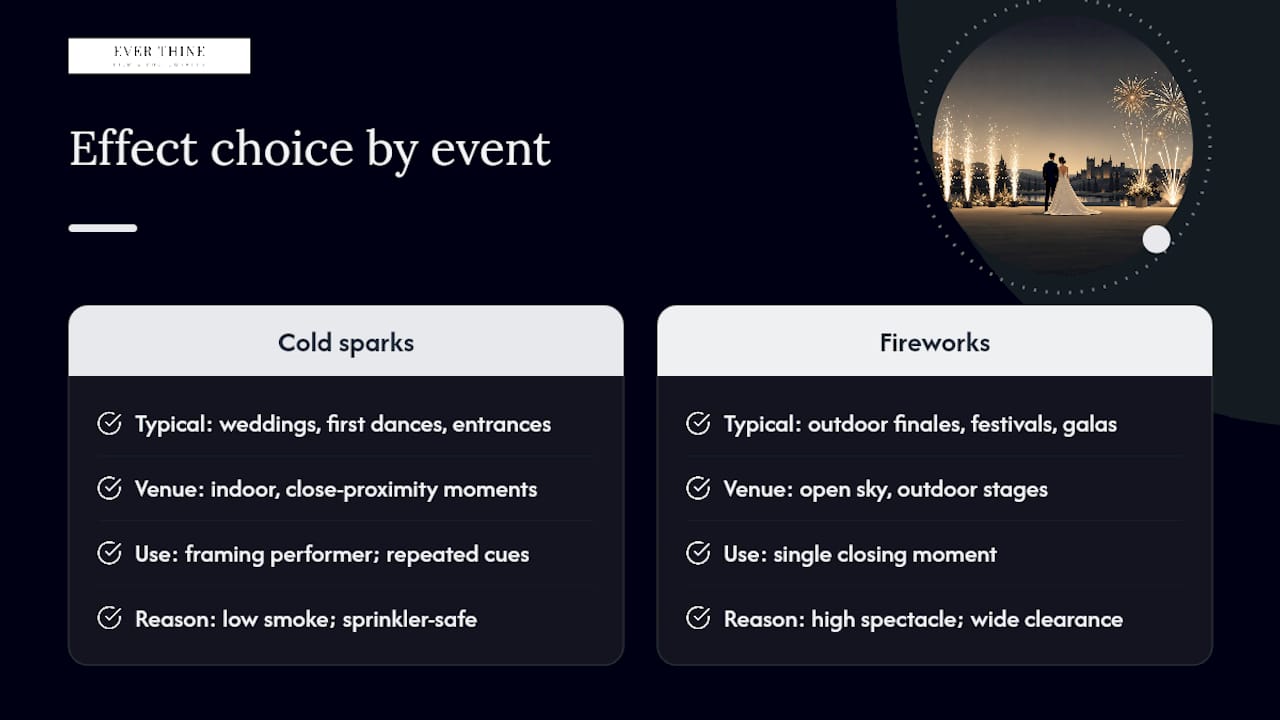
Weddings have driven most of the growth in cold spark bookings, largely because couples want a dramatic entrance or first dance without smoke drifting across the top table or setting off a venue’s fire alarm. Event pages report rising adoption of cold spark machines specifically for first dances, grand entrances and indoor reception moments, a trend The Knot has tracked as venues grow more comfortable approving them.
Concerts and stage shows lean the same way for indoor arenas, where cold sparks frame a performer without triggering sprinkler systems or filling the venue with smoke between songs. Outdoor festival stages sometimes mix both: cold sparks for repeated cues during the set, fireworks reserved for a single closing moment when the crowd has already thinned toward the exits.
Corporate events split by venue type more than by budget. A product launch inside a conference centre almost always uses cold sparks, since most commercial venues won’t permit open pyrotechnics near sprinkler-sensitive ceilings. An outdoor company gala on private grounds, by contrast, can justify a fireworks finale if the site has the clearance and the client wants genuine spectacle over subtlety.
The pattern across all three: indoor and close-proximity moments belong to cold sparks; open-sky finales still belong to fireworks. Few venues are equipped to host both well, so most events pick one and build the moment around it.
Why we lean on cold sparks for the shots that matter
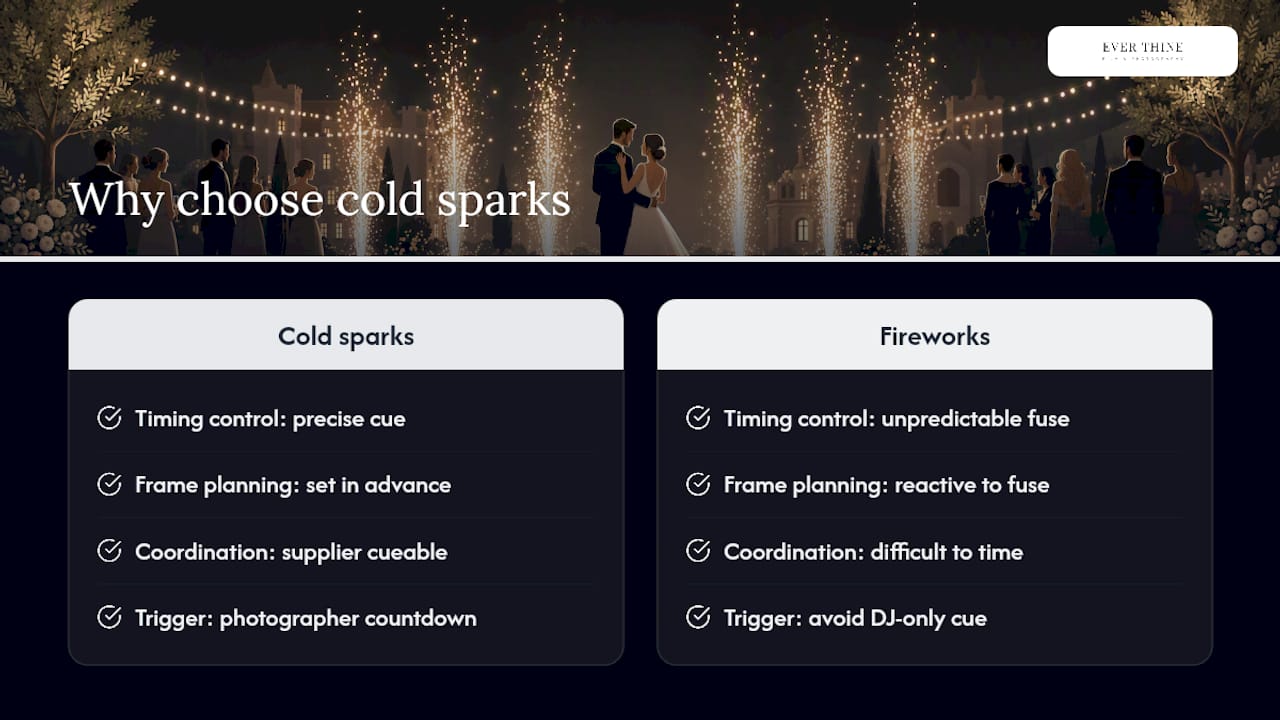
We favour cold sparks for first dances and entrances because the control lets us plan the frame in advance rather than reacting to a fuse we can’t predict. Coordinating timing with the effects supplier beforehand means the cue lands exactly where the couple is standing.
Pro Tip: Always ask your effects supplier to trigger on a verbal countdown from the photographer, not the DJ’s cue alone. It saves the shot when timings shift.
— Dawn & Carl
Capturing the moment once the sparks are lit
Cold sparks and fireworks both create a moment worth photographing properly, and that’s where the coverage around them matters as much as the effect itself. Photographers often work alongside effects suppliers, briefing timing in advance so a first dance framed in cold sparks or an outdoor finale under fireworks can be captured exactly as it happens, not reconstructed afterwards from a missed cue.
[
That coordination extends across the whole day, whether the venue is a Staffordshire barn with low beams that rules out open pyrotechnics, or a countryside estate with room for a fireworks finale. If you’re planning a wedding around a dramatic entrance or closing display, get in touch through the Staffordshire wedding photography page to check availability for your date and talk through how the effects fit into your coverage plan.
Sources
FAQ
Do cold spark machines make a mess?
Cold spark machines leave minimal residue compared with fireworks, but fine metallic dust can still settle on nearby flooring and fabric, so venues with light-coloured carpets or delicate decor often ask for a groundsheet underneath.
Are cold sparks safe indoors?
Cold sparks are widely used indoors because they run at a much lower temperature than fireworks and cool almost instantly on fallout, but “safe” still depends on clearance, ventilation and following the operator’s stated safety distance.
Are sparklers the same as fireworks?
No. Hand-held sparklers are a category 1 consumer firework under the UK’s classification system, while cold spark machines are a separate class of special effects equipment, not fireworks at all, and traditional aerial fireworks sit in higher categories with stricter rules.
What are the common problems with cold spark machines?
The most frequent issues are nozzle blockages from powder residue, canisters running low mid-cue if runtime wasn’t confirmed in advance, and machines being positioned too close to smoke detectors or sprinkler heads, which can trigger a false alarm even without real smoke.
Recommended


Comments