
Ten Minute Portrait Plan to Save Dark Venue Wedding Photos in the UK
Updated: 3 hours ago

Dark venues can produce some of the most cinematic wedding photography around, and the couples who get spectacular results all do two things early: they scout the room at twilight and agree a lighting plan before the day arrives. The failures come from photographers arriving with daylight habits and no backup gear. Get the light layered right, and a moody, candlelit hall will outshoot a bright marquee every time.
TL;DR:
Scouting the venue at the actual time of the event is the most impactful preparation, especially to confirm ceiling colors, height, and power source locations.
Using modest gear with proper planning, including a twilight venue scout and test shots, tends to yield better results than expensive equipment alone.
The recommended camera settings for low-light venue photography are ISO 800 to 3200, apertures between f/1.8 and f/4, and shutter speeds of 1/15s to 1/200s, depending on the scene.
Three effective lighting techniques are bounce flash, off-camera flash with gels, and rear-curtain sync, each suited to specific dark-venue scenarios.
Post-processing should preserve the venue’s mood by applying conservative noise reduction and matching the white balance to the lighting setup used during the shoot.
Table of Contents
Dark venue wedding photos: three strategies that actually work
Most low-light wedding photography falls into one of three camps, and picking the wrong camp for the venue is where couples get disappointed.
Ambient-first leans entirely on the room’s own light, whether that’s candles, uplighting or the glow of a stone cellar. It preserves atmosphere completely but demands fast lenses, high ISO tolerance, and a photographer confident hand-holding at slow shutter speeds.
Mixed-light blends a touch of flash with the room’s ambient glow, usually gelled to match candlelight so nobody’s face turns blue against warm walls. This is the safest middle ground for most receptions.
Flash-led brings in off-camera flash as the dominant light source, useful when a venue is genuinely pitch black or the dance floor needs punch.
Ambient-first: brief the venue to leave feature lighting on; skip anything that dims automatically.
Mixed-light: ask the DJ or venue coordinator where the nearest power sockets sit before the day.
Flash-led: confirm ceiling height on the scout. Bounce flash needs something to bounce off.
Camera settings, lenses and the kit that actually earns its place
Exposure in a dark venue is a negotiation between three things: how much grain you’ll accept, how much of the scene stays sharp, and how still your subjects are willing to hold. A reliable baseline sits at ISO 800 to 3200, apertures between f/1.8 and f/4, and shutter speeds ranging from 1/15s on a tripod down to 1/200s once flash sync takes over, according to ShutterReview’s low-light reception guide.
Pro Tip: Shutter speed governs how much ambient light gets in; flash power governs how bright your subject looks. Treat them as two separate dials, not one.
For portraits during speeches, start around f/2.8, 1/125s, ISO 1600. For the first dance, drop to 1/60s and let some motion blur into the frame. For formal groups, you need everyone sharp, so favour f/4 and a touch more ISO over a wider aperture that will blur half the row.
Fast primes (35mm f/1.4, 50mm f/1.2, 85mm f/1.8) outperform zooms here because two extra stops of light matter more than reach.
Keep one zoom in the bag for group shots where recomposing on the fly beats swapping lenses.
Pre-focus on a fixed point (the altar, the cake table) before the room goes dark, so autofocus isn’t hunting when it counts.
Switch to manual focus or back-button focus the moment autofocus starts pulsing in low light.
Bring spare batteries. Cold, dark venues drain them faster than you expect.
A full-frame sensor gives a genuine advantage in low light over a crop sensor, largely down to bigger photosites gathering more light per pixel. In-body or lens stabilisation buys you another stop or two when shooting handheld off a tripod.
Bounce, off-camera flash, gels and rear-curtain sync explained
Four lighting techniques cover almost every dark-venue scenario, and picking the right one for the moment matters more than owning expensive gear.
On-camera bounce is the fastest fix for casual moments. Angle the flash head at a white ceiling or wall and it softens instantly, though it fails in rooms with dark timber ceilings or exposed brick, which simply absorb the light.
A single off-camera flash on a stand gives you controllable, directional light for portraits, and UK photographers working windowless venues lean on exactly this setup, firing test shots to lock exposure before guests notice, per PetaPixel’s night wedding photography tips.
Gelling your flash with a CTO gel and setting the camera to tungsten white balance stops flash-lit skin looking clinical against warm candlelight.
Rear-curtain sync turns the dance floor into something dynamic: try 1/15s, ISO 800, f/2.8, flash at 1/8 power, so motion trails appear behind the couple rather than in front of them.
Pro Tip: Test rear-curtain sync on a friend before the reception. It’s the one technique that punishes guesswork.
In tight rooms, keep flash power low and bounce off a nearby surface. Cranking power up close to guests creates harsh shadows and unhappy faces.
Night portraits, sparkler exits and dance-floor drama
The best dark-venue images rarely come from the reception itself. They come from ten deliberate minutes outside it.
Position the couple with a single light source behind them, a doorway, string lights, a car headlight, and expose for the silhouette rather than the faces. For long-exposure portraits, set the camera on a tripod at 2 to 4 seconds, f/4, and ask the couple to hold still while you light-paint their outline with a torch.
Use DJ lights and string lights as rim or backlight, never as your main source; they flicker and shift colour too unpredictably to expose for directly.
Sparkler exits need a slow shutter (around 1/4s) and a second shooter positioned ahead of the couple, not behind.
Brief a guest to hold spare sparklers and matches, not the photographer.
Always check with the venue before lighting anything. Many historic buildings ban open flame entirely.
Scouting the venue and briefing whoever controls the lights
Visit the venue at the same hour your portraits and reception will actually happen, not at midday when the light tells you nothing. A stone cellar or chapel that looks flat at 2pm can turn dramatic by 8pm, which is exactly why twilight scouting matters more than a daytime walk-through.
Check ceiling colour and height; dark or high ceilings kill bounce flash.
Locate power sockets and fixture positions before deciding where portraits happen.
Test your actual kit in the room, not just your eyes.
Brief any lighting designer on three layers: ambient, task and accent, so the room reads as atmospheric rather than murky in photographs, a point Stylish Entertainment’s lighting guidance backs consistently.
Our guide to how venue architecture shapes wedding photos goes deeper into reading a room before you book it.
Editing dark venue photos without losing the atmosphere
Noise reduction is where most dark-venue edits go wrong. Push it too far and you flatten texture, the very thing that made the venue moody in the first place. Apply it conservatively and protect micro-contrast in skin and fabric.
Match your white balance workflow to your capture: if you gelled your flash to tungsten on the day, correct in post rather than fighting a mismatched cast afterwards, a workflow detail ShutterReview covers well. Resist lifting blacks too far. Deep shadow is part of the aesthetic; crush it flat and you lose the reason the venue looked romantic to begin with.
Dawn & Carl’s scout checklist and the ten-minute portrait plan
Dawn & Carl scout every dark venue at the exact hour the day will run, checking ceiling colour, socket locations, and whether the venue permits open flame, since many historic sites cap candle numbers strictly, in line with Clearwell Castle’s fire policy guidance.
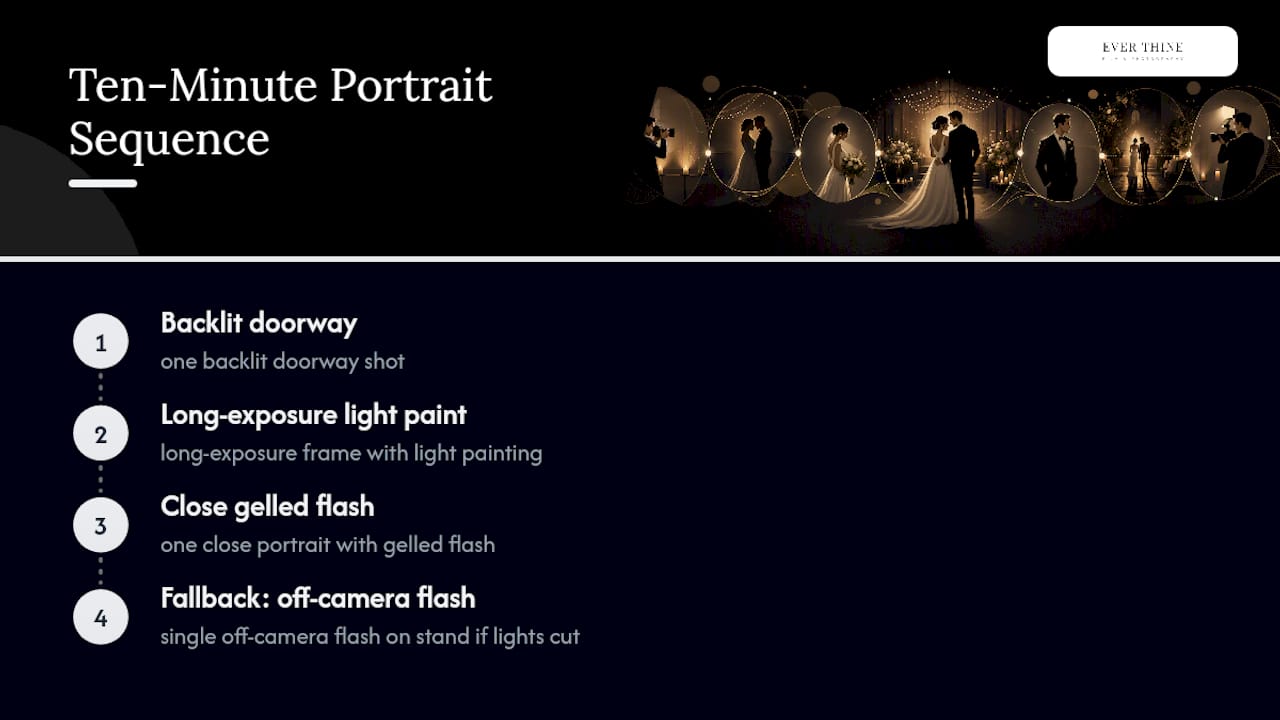
The ten-minute portrait window happens straight after the ceremony: one backlit doorway shot, one long-exposure frame with light painting, one close portrait with gelled flash. When house lights cut out unexpectedly, which happens more often than couples expect, a single off-camera flash on a stand becomes the immediate fallback, echoing the Rangefinder case study on shooting windowless theatres.
Where the conventional advice on dark venues gets it wrong
Most guides to low-light wedding photography obsess over gear: faster lenses, better sensors, brighter flashes. That’s only half the problem. The couples who end up disappointed with their dark-venue photos usually didn’t have a lens issue. They had a planning issue, because nobody scouted the room at the hour it would actually be used.
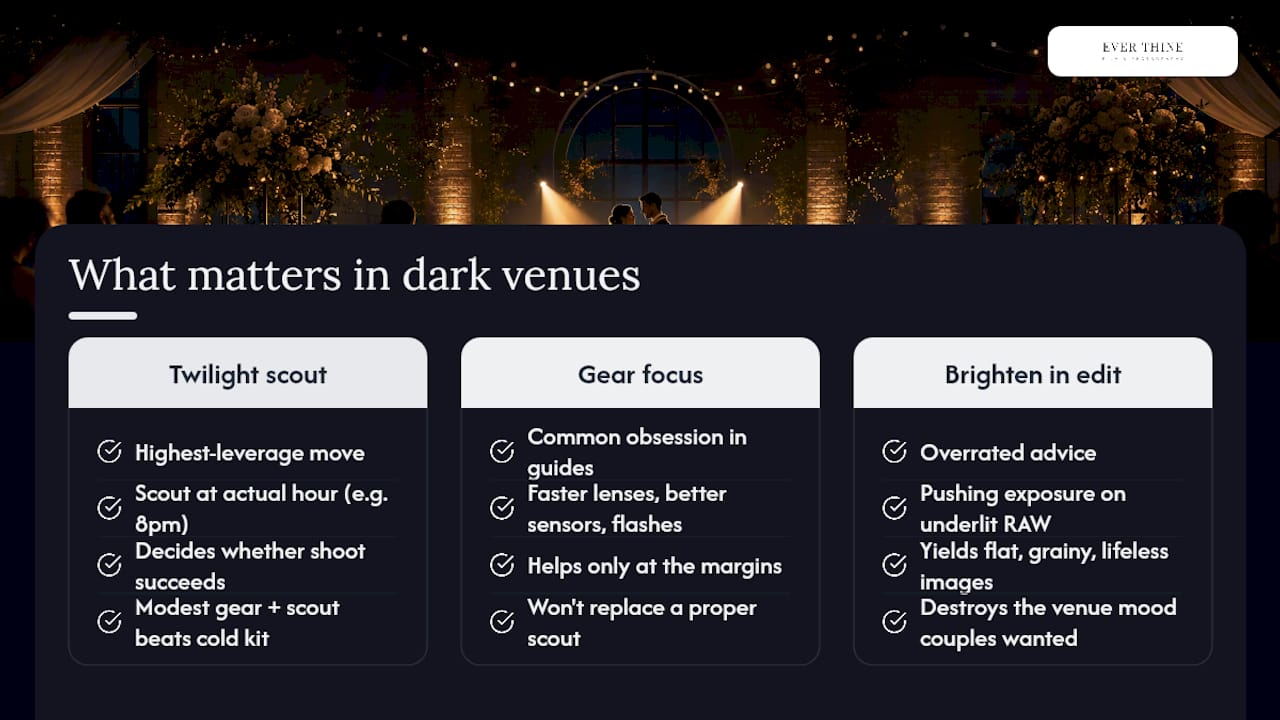
Our view is that the single highest-leverage move in this entire playbook is the twilight scout, not the f/1.4 prime. A photographer with modest gear who has tested the room at 8pm will consistently outperform one with premium kit walking in cold. The gear matters at the margins. The scout decides whether the shoot succeeds at all.
The other overrated piece of advice is “just brighten it in editing.” Push exposure hard on underlit RAW files and you get flat, grainy, lifeless images, not atmosphere. The room’s darkness was never the enemy. Removing it in post is what ruins the photos couples actually wanted. Preserve the mood the venue was chosen for, don’t correct it away, and the technical fixes in this guide will carry you the rest of the way.
— Dawn & Carl
Booking a photographer who’s comfortable in the dark
Not every photographer enjoys shooting a candlelit hall or a windowless barn, and that’s exactly the gap Dawn & Carl fill for couples set on a moody, atmospheric venue. Experienced low-light photographers provide less risk on the day: a proper venue scout, a lighting test before guests arrive, and a photographer who already knows which corner of the room will bounce flash and which will swallow it whole.
[
When you request a quote, ask specifically for a venue scout and a lighting test as part of the package, not an afterthought squeezed in on the morning. Couples marrying in Derbyshire can check availability and packages on the Derbyshire wedding photography page, while those in Staffordshire will find full details on the Staffordshire wedding photographer page. Worcestershire couples can start on the Worcestershire booking page. Photographers building their own dark-venue confidence might also find the questions worth asking before booking useful as a client-facing checklist, and those growing a photography business may want to look at SEO support built for photographers.
Sources
FAQ
What is the 30-minute rule for weddings?
It’s the guidance to reserve a dedicated time after the ceremony for couple and family portraits, before guests move to the reception and the best natural or venue light shifts.
What do photographers do in dark rooms?
They scout the room in advance, switch between ambient, bounce and off-camera flash depending on the moment, and raise ISO or slow shutter speed to hold onto detail without losing the room’s atmosphere, using a baseline around ISO 800 to 3200 and apertures of f/1.8 to f/4, per ShutterReview.
What are some dark wedding themes?
Moody romance themes typically lean on deep burgundy, navy and warm metallic tones alongside layered candlelight and textured surfaces like exposed brick or dark timber, according to Plan A Wedding’s theme guide.
What are common mistakes to avoid in wedding photography?
The biggest ones are relying on direct on-camera flash in tight rooms, forgetting to gel flash against warm ambient light, skipping a twilight scout, and letting autofocus hunt without a manual fallback ready.
Do I need a lighting designer for a dark venue wedding?
Not always, but a lighting designer who layers ambient, task and accent lighting will stop a moody room turning muddy in photographs, a distinction Stylish Entertainment highlights for couples planning candlelit receptions.
Recommended


Comments