
How to select photo backdrops for your wedding

Pick backdrops that match your venue’s light, scale, and your photographer’s style, and they will read beautifully on camera. Get that wrong, and even the most expensive floral wall can look flat, cluttered, or simply out of place. The six decisions to make now: (1) visit the venue at the same time of day as your ceremony; (2) shortlist 2–3 backdrop types that suit the room’s architecture; (3) check light direction and window orientation; (4) confirm mounting options with the venue coordinator; (5) agree scale and clearance with your photographer; (6) lock install and takedown times into the day’s timeline. Do all six before you book a single supplier.
Quick timetable:
Inspect the venue at ceremony time: as soon as possible after booking
Shortlist backdrop types: 6–8 months before the wedding
Hire and install confirmation: 3–4 months before, with final measurements 6–8 weeks out
Table of Contents
What to check on your venue walkthrough
A structured site visit saves you from expensive surprises. Work through this list on every walkthrough:
Stand exactly where you and your partner will stand during the ceremony. Look at the wall behind you.
Note window size, number, and direction. Large windows facing north give consistent, soft light; south-facing rooms receive direct sun at some point on clear days.
Check ceiling height. High ceilings allow taller arches and help bounce flash for softer evening light.
Locate power points for lighting rigs and battery uplights.
Assess back-wall clutter: service doors, fire extinguishers, and signage will appear in ceremony shots if not masked or moved.
Ask the coordinator about permitted fixings (tape, Velcro, screw hooks), access windows for install, and any décor restrictions.
Note where guests will stand or flow so your backdrop is not blocked mid-ceremony.
Identify outdoor open-shade spots: the north side of the building or beneath tree canopies for portrait alternatives.
Pro Tip: Take phone photos from the couple’s eye level and from the position your photographer will shoot down the aisle. What looks fine standing still can look very different through a lens.
How do you choose a backdrop style that suits your venue?
Style matching is simpler than it sounds once you treat the venue’s architecture as the brief.
Formal or classical architecture (manor houses, town halls, churches): structured ceremony arches, draped fabric in neutral or ivory tones, or tall floral columns. Ornate rooms already have strong visual texture; a busy floral wall competes rather than complements.
Rustic barns and farm venues: foliage garlands, simple wooden signage boards, and dried-flower hoops. The raw materials echo the setting.
Modern or industrial spaces (converted galleries, warehouses): minimalist geometric frames, textured panels, or a single statement neon sign. Clean lines suit clean architecture.
Marquees: festoon frames, fairy-light curtains, and draped fabric ceilings. A marquee is a blank canvas, which means you control everything, including the risk of overdoing it.
Season matters too. Autumn foliage reads warm and rich in photographs; summer greenery photographs cool and fresh. Both are beautiful, but they suit different edit styles. If your photographer works with warm, filmic tones, a lush green wall in July can look slightly at odds with the finished gallery.
Pro Tip: Share your shortlist of backdrop ideas with your photographer before you book anything. They will tell you which options read best under your specific venue’s light, and they may have seen that exact room before.
How to assess the venue: light, orientation and space
Light is the primary factor that determines what your wedding photos will look like. The venue sets an upper limit on photographic results before a single backdrop is chosen.
Visit at ceremony time. Photographers recommend scheduling walkthroughs for the exact hour your ceremony is planned. A room that looks bright at 11 AM can be shadowy and flat at 3 PM.
Stand at the altar position and look back. Identify where light enters, where shadows fall on faces, and whether the back wall is in shade or glare.
Test open-shade spots outside. The north side of the building or beneath a canopy gives even, flattering light without squinting.
Measure distances. Note how far the backdrop will sit from the couple, and how much side clearance exists for group shots.
Record artificial lighting. If the ceremony or reception runs into the evening, note whether the venue relies on small overhead downlights. These create harsh shadows; large diffused sources are far more flattering.
Pro Tip: Overcast skies act as a giant diffuser and often produce the cleanest portrait light. If your ceremony falls on a grey day, the outdoor shots may actually be better than on bright sunshine.
Common wedding backdrop types and what they cost in the UK
Backdrop type | Best venue conditions | Visual effect | Install complexity | Typical UK hire range |
Ceremony arch / hoop | Any ceiling height; suits most venues | Framed, elegant focal point | Low to moderate | £150–£600 |
Floral wall | Flat back wall; good ambient light | Lush, statement | High (florist required) | £500–£2,000+ |
Draped fabric | High ceiling; neutral walls | Soft, romantic | Low | £50–£200 |
Greenery / foliage wall | Rustic or outdoor settings | Fresh, natural | Moderate | £200–£600 |
Signage / neon / boards | Modern or barn venues | Graphic, personal | Low | — |
Fairy lights / festoon frame | Marquees, barns, evening receptions | Warm, atmospheric | Moderate | £150–£500 |
Staged area (bench, door, staircase) | Venues with architectural features | Story-led, candid | Low to none | Often venue-included |

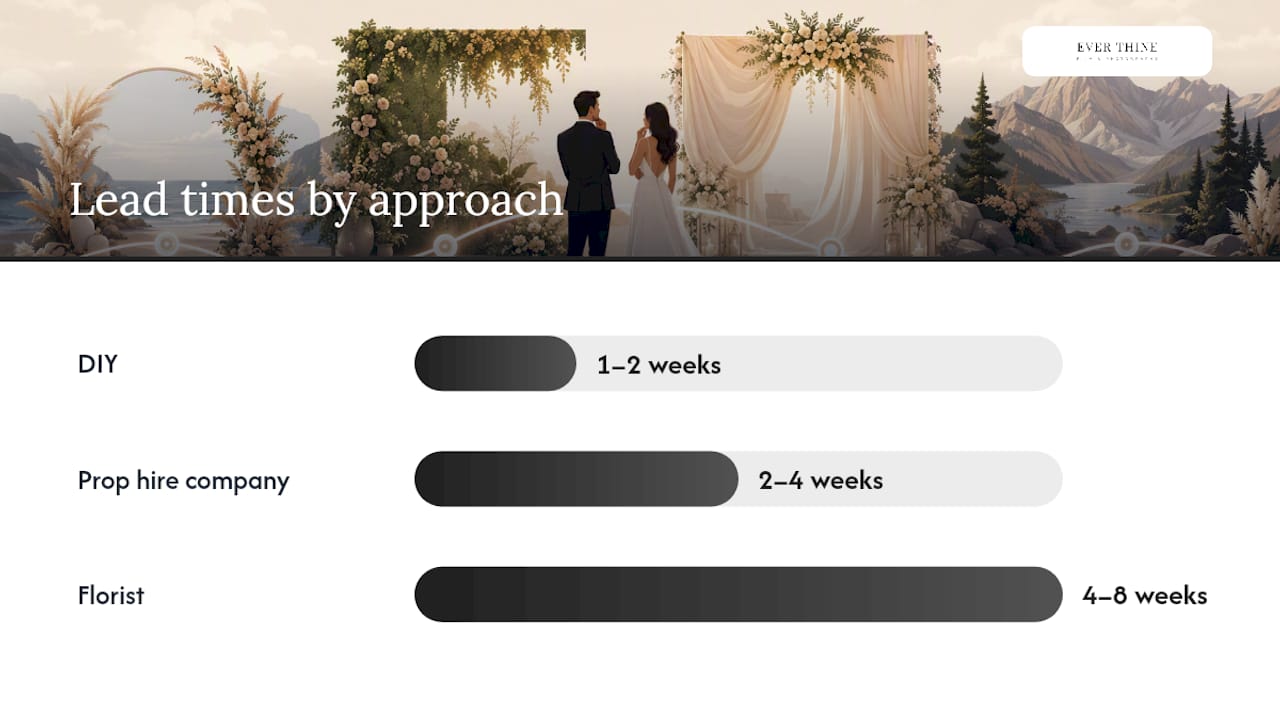
Lead times vary: florists building custom floral walls typically need 4–8 weeks’ notice; prop hire companies usually need 2–4 weeks. Custom neon or laser-cut signage can take 3–6 weeks to produce.
Pro Tip: Plan one statement backdrop for the ceremony, then two smaller spots elsewhere in the venue for variety. A gallery with three distinct settings tells a richer story than one repeated backdrop.
Scale, placement and composition rules for backdrops
Getting the scale wrong is the most common mistake, and it shows immediately in photographs.
Height: the backdrop should be at least 30 cm taller than the tallest person in the shot. For a couple, aim for a minimum of 2.2 m; for group shots, 2.5 m or more.
Width: allow at least 60 cm of backdrop beyond each person’s shoulder for couple shots; for a bridal party, the backdrop needs to be wide enough to accommodate the group comfortably.
Separation distance: position the couple at least 1 m in front of the backdrop to avoid shadows falling directly onto it. Two metres is better for floral walls where depth and texture matter.
Focal area: keep the zone directly behind heads uncluttered. A single flower arrangement at head height behind the couple reads as a halo, not a feature.
Camera axis: the centre of the backdrop should align with the couple and the camera. Even a slight offset makes the composition feel unbalanced in the final image.
During your venue visit, stand at the position your photographer will shoot from and hold your arms out to approximate the frame. It is a rough check, but it immediately shows whether the proposed backdrop is wide enough.
Venue rules, fire safety and insurance: what UK couples must confirm
Written venue sign-off is non-negotiable for any fixing or temporary structure attached to the building. Verbal agreement is not enough, and it will not protect you if something goes wrong.
Safety checklist to confirm with your venue and suppliers:
All textiles (drapes, fabric backdrops, floral foam wrapping) must meet fire-retardancy standards. Ask suppliers for a certificate.
Structural arches and frames must be weighted or fixed so they cannot topple. Confirm the method with the venue.
No trip hazards: cables, guy ropes, and base weights must be covered or positioned away from guest flow.
Outdoor installations need weatherproofing: weighted bases, wind-rated frames, and a wet-weather contingency plan.
Every supplier must carry public liability insurance. Ask for a copy of the certificate before confirming the booking.
The venue’s own fire officer or events coordinator is your first point of contact for textile fire regulations. Local authority guidance and the venue’s licence conditions will specify what is and is not permitted.
How lighting makes or breaks a backdrop on camera
A beautiful backdrop photographed under the wrong light looks flat. A simple drape under the right light looks cinematic. The lighting guide on the Weddingfilmphotography blog covers this in depth, but the core rules are straightforward.
Prefer large, diffused light sources: big windows, open shade, or overcast sky. These wrap light around faces and give backdrops depth.
Avoid small overhead downlights directly above the couple. They create unflattering shadows under eyes and flatten the backdrop texture.
Use battery uplights behind or beside the backdrop to separate subjects from a dark background in evening shots.
A warm spotlight or pin-spot aimed at a floral feature adds dimension and draws the eye to the right place.
Festoon strings and fairy lights work as ambient fill, not as a primary light source. They add atmosphere but will not light faces.
Pro Tip: Visit the venue in the evening and test the artificial lighting before the wedding day. Colour temperature varies widely between venues: some run warm amber, others cool white. Your photographer needs to know which they are working with.
Should you DIY, rent, or hire a specialist?
Approach | Best for | Typical cost level | Lead time needed | Key risk |
DIY | Simple signage, small props, fabric drapes | Low | 1–2 weeks | Time, transport, setup labour |
Prop hire company | Arches, frames, festoon rigs, staging | Moderate | 2–4 weeks | Availability on your date |
Florist | Floral walls, garlands, fresh-flower arches | High | 4–8 weeks | Cost; perishable materials |
Venue-included features | Staircases, doors, courtyards, water features | None | None | Limited control over styling |
Specialist hire is strongly recommended for large floral walls, structural arches over 2 m, and any installation that requires ceiling fixings or weighted ballast. These are not DIY jobs on a wedding morning.
Coordinate all three parties: venue, supplier, and photographer. Share the install window with your photographer so they can plan their arrival and scouting time accordingly. Protecting portrait time in your timeline is one of the most practical things you can do before the day.
When to book and what to budget: a UK timeline
Milestone | Timing | Owner |
Venue walkthrough at ceremony time | As soon as possible after booking | Couple |
Backdrop style shortlist finalised | 6–8 months before wedding | Couple + photographer |
Supplier confirmed and deposit paid | 3–4 months before wedding | Couple + florist/hire company |
Final measurements and layout agreed | 6–8 weeks before wedding | Supplier + venue |
Install window confirmed in writing | 4 weeks before wedding | Couple + venue + supplier |
Photographer briefed on backdrop locations | 4 weeks before wedding | Couple + photographer |
Typical UK budget bands:
DIY (fabric, signage, small props): £50–£200
Prop hire (arch, frame, festoon rig): £150–£600
Custom floral or structural installation: £500–£2,000+
These are broad expectations, not fixed prices. Florists in London and the South East typically charge more than those in the Midlands or North. Always get three quotes.
How to build a shot list and coordinate photo spots with your photographer
A shot list tied to specific backdrop locations is what turns a good idea into a great gallery.
Map the venue. Sketch or photograph every potential backdrop spot: ceremony room, foyer, staircase, courtyard, garden, and any staged areas.
Mark 3–5 priority spots. Rank them by light quality and visual impact. Your photographer can help with this during a planning call.
Assign timing. Couple portraits at golden hour (roughly 45–60 minutes before sunset), first look at a quieter spot before the ceremony, group shots in open shade after the ceremony.
Share the list with all suppliers. The florist needs to know which spot is the priority; the venue coordinator needs to know which areas to keep clear.
Build a must-have shot list: ceremony wide shot, ceremony close-up, couple portrait at the statement backdrop, bridal party group, family groups, one dramatic wide shot showing the full backdrop in context.
Rehearse positioning during quiet moments on the day. Knowing exactly where to stand means your photographer spends less time directing and more time capturing. Pairing a clear shot list with natural posing guidance gives you the best chance of relaxed, authentic portraits at every spot.
Backdrop ideas for common UK venue types
Manor house: a tall classical arch in the entrance hall, or a staircase shot with a simple floral garland on the banister. The architecture does most of the work.
Barn: foliage garlands along the beams, a simple wooden signage board, or a dried-flower hoop. Avoid anything too polished; it fights the setting.
Contemporary gallery or warehouse: a single geometric frame or a neon sign. Minimalism reads better than maximalism in clean, angular spaces.
Town hall or civic venue: draped ivory fabric behind the registrar’s table, or a floral column on each side. Keep it symmetrical to match the room’s formality.
Marquee: festoon frame overhead, fairy-light curtain at the entrance, and a small staged seating area for portraits. You have full creative control here.
Variety across the venue gives your gallery contingency too. If the weather changes or a spot is unavailable, having three or four identified locations means your photographer always has somewhere to work.
Key takeaways
Choosing wedding photo backdrops well means visiting at ceremony time, matching style to venue architecture, and confirming scale, mounting, and safety with your photographer and venue before booking any supplier.
Point | Details |
Visit at ceremony time | Light changes dramatically through the day; a mid-morning tour misleads you about an afternoon ceremony. |
Match style to architecture | Formal venues suit structured arches or drapes; rustic barns suit foliage; modern spaces suit minimal frames. |
Confirm safety and fixings in writing | Get written venue sign-off for all fixings; require fire-retardancy certificates and public liability insurance from every supplier. |
Budget and book early | Florists need 4–8 weeks; prop hire needs 2–4 weeks; finalise suppliers by 3–4 months before the wedding. |
Weddingfilmphotography | Offers venue scouting advice, shot list creation, and timeline coordination to help couples plan backdrops that photograph beautifully. |
The part most couples underestimate
The backdrop conversation almost always starts with Pinterest and ends with a florist quote. What gets skipped is the middle bit: showing the shortlist to your photographer before anything is booked.
A photographer who knows your venue will immediately tell you whether a floral wall will be lit from behind by a window (which makes it glow) or sit in a dark corner (which makes it disappear). They will tell you whether the ceiling is too low for the arch you have chosen, or whether the room already has a feature wall so beautiful that a hired backdrop would only compete with it.
The couples who get the most from their backdrops are not the ones who spend the most. They are the ones who treat the photographer as a planning partner from the start, not a service called in on the day. Share your venue photos, your shortlist, and your timeline early. The conversation takes twenty minutes and saves you from decisions you cannot undo.
Planning your wedding backdrops with Weddingfilmphotography
Choosing backdrops is one of those decisions that looks straightforward until you are standing in the venue trying to work out whether the arch fits, whether the light will reach it, and whether your florist and photographer have even spoken to each other.
[
Weddingfilmphotography works with couples across Staffordshire, Derbyshire, Worcestershire, and the wider West Midlands to plan exactly this kind of detail before the day. The team reviews venue photos, helps build a shot list tied to specific backdrop locations, and coordinates with your suppliers so portrait time is protected and nothing is left to chance on the morning. If you are at the shortlisting stage and want a second pair of eyes on your venue photos, get in touch to arrange a planning conversation. Bring your venue photos taken at ceremony time, your draft timeline, and any venue rules you have received. Book a planning conversation and start with the details that actually make a difference to your gallery.
Useful sources and references
UK venue fire safety guidance: consult your venue’s fire officer and local authority for textile and structure regulations specific to your venue licence.
Emily Young Weddings: choosing a venue for photography: detailed guidance on light, orientation, and what to check before signing a venue contract.
Courtney Bowlden Photography: venue photography tips: practical checklist for assessing venues from a photographer’s perspective.
Weddingfilmphotography: how lighting shapes wedding photos: in-depth guide to light, backdrops, and how to plan for both natural and artificial conditions.
Weddingfilmphotography: natural wedding photography features: venue features that improve photography without any hired backdrop at all.
Always request written confirmation from your venue and every supplier before any installation is agreed. Keep copies of public liability insurance certificates and fire-retardancy certificates with your wedding planning documents.
FAQ
How far in advance should you book a wedding backdrop supplier?
Florists building custom floral walls typically need 4–8 weeks’ notice; prop hire companies usually need 2–4 weeks. Book your supplier by 3–4 months before the wedding to secure your date.
What is the most important thing to check at a venue walkthrough?
Visit at the same time of day as your ceremony to see exactly how light falls. A room that looks bright at 11 AM can be shadowy and flat at 3 PM, which changes everything about which backdrop will work.
Do you need venue permission to install a wedding backdrop?
Yes. Always get written sign-off from the venue for any fixings or temporary structures. Venues differ on acceptable methods, and verbal agreement does not cover insurance liability.
How does Weddingfilmphotography help with backdrop planning?
Weddingfilmphotography reviews venue photos, helps build a shot list tied to specific backdrop locations, and coordinates with suppliers to protect portrait time. Couples can arrange a planning conversation to discuss their shortlist before booking anything.
What backdrop type works best for most UK venues?
A ceremony arch or hoop suits the widest range of venues, from barns to manor houses, and is the lowest-risk choice in terms of installation and scale. Pair it with one or two smaller spots elsewhere in the venue for gallery variety.
Recommended


Comments