
How to organise your wedding day timeline
- Jul 1
- 8 min read

TL;DR:
A wedding day timeline is a detailed schedule that coordinates every event from preparations to the final dance. It should start with a fixed ceremony time, build in realistic buffers, and use separate versions for vendors and guests. Proper planning ensures a relaxed day and smooth coordination among all participants.
A wedding day timeline is a minute-by-minute schedule that arranges every event from the first hair appointment to the final dance, giving you and your vendors a shared roadmap for the day. Most wedding days run 8 to 12 hours, which means there are dozens of moving parts that need coordinating across preparations, ceremony, and reception. Without a written schedule, even small delays compound quickly and steal time from the moments that matter most. Knowing how to organise your wedding day timeline is the single most effective step you can take to protect the day you have spent months planning.
How to organise your wedding day timeline: start with the ceremony
The ceremony start time is the one fixed point in your entire day. Every other event builds around it, either working backward through preparations or forward into the reception. Protect the ceremony start time at all costs; if the morning runs late, compress getting-ready activities rather than delay the ceremony.
Building your step by step wedding day timeline from this anchor looks like this:
Confirm your ceremony time with your venue and officiant first. This is non-negotiable.
Work backward to hair and makeup. Allow 60–75 minutes for the bride and roughly 30–45 minutes per bridesmaid. If you have four bridesmaids, your hair and makeup team needs to start at least five hours before the ceremony.
Schedule getting dressed. Block 30–45 minutes for dressing, including help with buttons, veils, and accessories.
Add a pre-ceremony photography window. First look sessions, bridal party portraits, and any pre-ceremony couple shots need a dedicated slot before guests arrive.
Work forward from the ceremony end. Plan your cocktail hour, family portraits, couple portraits, wedding breakfast, speeches, first dance, and evening reception in sequence.
Account for cultural or religious variations. A civil ceremony typically runs 15–20 minutes. A full religious service can run 45–75 minutes. Ceremony duration varies from 15 to 75 minutes depending on tradition, so confirm the length with your officiant early.
This structure gives your wedding day schedule a logical spine. Every vendor, from your florist to your caterer, can then slot their work around a timeline that makes sense.
What time blocks does a realistic wedding day schedule need?

Realistic time allocation is where most couples underestimate. The 30/5 rule states that any task you think will take five minutes on your wedding day will actually take thirty. That single insight changes how you approach every block in your schedule.
Pre-ceremony preparations
Hair and makeup: 60–75 minutes for the bride; 30–45 minutes per additional person
Getting dressed: 30–45 minutes, including photos of the process
Vendor arrivals: florists, cake delivery, and decorators typically need access 2–3 hours before the ceremony
Photography sessions
Couple portraits: budget 30–45 minutes for relaxed, natural images
Wedding party photos: 30 minutes is standard for a group of six to ten people
Family formals: limit family groupings to 10–15 combinations and assign a family member to gather people efficiently; this prevents the session from eating into your reception
Ceremony and reception flow
Event | Suggested duration |
Civil ceremony | 15–25 minutes |
Religious ceremony | 45–75 minutes |
Cocktail hour | 60 minutes |
Wedding breakfast and speeches | 90–120 minutes |
First dance and evening reception | 2–4 hours |
Grand exit | 10–15 minutes |
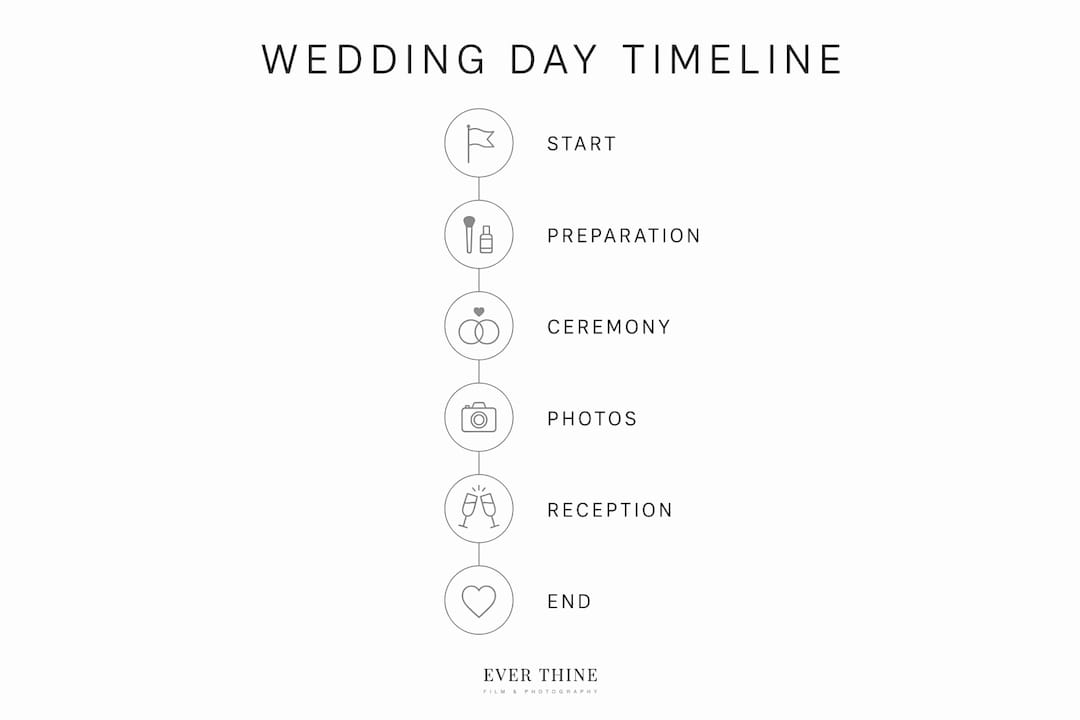
These durations are starting points, not rules. Your venue, caterer, and band or DJ will all have input on what works in practice. Ask each vendor for their realistic timing estimates. Experienced vendors provide accurate timing estimates that help couples build schedules grounded in reality rather than optimism.
Why do buffer times matter so much in wedding itinerary planning?
Buffer time is the most effective tool for managing the unavoidable small delays that occur on every wedding day. A guest stops you for a longer conversation than expected. The florist arrives fifteen minutes late. The groom’s buttonhole needs re-pinning three times. Without buffers, each of these moments pushes the entire schedule back.
The practical rule is to add 10–15 minutes between major events and an additional 15–30 minutes on top of any map-estimated travel time between locations. If your ceremony venue and reception venue are separate, that travel window is critical. A twenty-minute drive on a quiet Tuesday becomes a forty-minute journey when wedding cars, guests, and traffic combine.
Pro Tip: Write your timeline with the buffer already built in. Do not list it as a separate “buffer” slot. If your ceremony ends at 2:30 pm and portraits take 45 minutes, schedule portraits to finish at 3:30 pm, not 3:15 pm. The extra fifteen minutes disappears invisibly when you need it.
Ignoring buffers creates a cascade effect. A fifteen-minute delay in getting dressed pushes back the pre-ceremony photos. That pushes back the ceremony. The caterer holds the starter. The speeches start late. By the evening, your first dance is an hour behind schedule and your guests are restless. One buffer, placed early in the morning, prevents all of it. For more detail on this, the wedding timeline tips guide from Weddingfilmphotography covers buffer placement in depth.
Should you create separate timelines for vendors and guests?
Yes. A single timeline shared with everyone creates confusion. Vendors need operational detail. Guests need clarity on when to arrive and what to expect. Create two timeline versions: a detailed master document for suppliers and a simplified itinerary for guests.
Timeline type | Who receives it | What it includes |
Master vendor timeline | Photographer, caterer, florist, band, officiant | Exact arrival times, setup windows, contact names, logistical cues, contingency notes |
Guest itinerary | All guests, close family, wedding party | Ceremony start time, reception doors open, shuttle schedule, key event times |
The master vendor timeline runs to two pages in most cases. It lists every supplier’s arrival slot, the name of the on-the-day contact, and any venue-specific access instructions. A two-page vendor timeline plus a one-page summary for close family and the wedding party is the format professional planners use most consistently.
Distribute the vendor timeline at least five to seven days before the wedding. Send the guest itinerary with your order of service or post it to your wedding website. Your complete wedding timeline checklist from Weddingfilmphotography covers exactly what to include in each version for UK couples.
Common mistakes that derail even the best wedding day schedule
Most timeline problems come from the same handful of errors. Recognising them in advance is the fastest way to avoid them.
Underestimating getting-ready time. Hair and makeup almost always run longer than planned. Add a minimum of thirty minutes to whatever your stylist quotes.
Skipping meals during preparations. Feeding the wedding party during morning preparations is a logistical necessity. Hungry bridesmaids and groomsmen lose focus and energy, which slows everything down.
Not assigning a timeline owner. You should not be managing the schedule on your own wedding day. Assign a dedicated timeline owner, whether that is your wedding planner, a trusted family member, or your lead photographer, to handle adjustments without interrupting you.
Forgetting travel between venues. If your ceremony and reception are at different locations, build in travel time for the wedding party, the photographer, and the couple separately.
Finalising too late. Confirm the timeline with all vendors five to seven days before the wedding. Last-minute changes cause confusion and missed cues.
Pro Tip: Send your photographer a copy of the wedding photography timeline at least a week before the day. A good photographer will flag any slots that look too tight and suggest adjustments before it becomes a problem on the day itself.
One often-overlooked detail: share your timeline with your venue coordinator separately from your other vendors. The venue controls access, lighting changes, and room turnarounds. If they are working from a different version of the schedule, the day will feel disjointed even when everything else is running smoothly.
Key takeaways
A well-built wedding day schedule anchors every event around the ceremony start time, builds in realistic buffers, and uses two separate timeline formats for vendors and guests.
Point | Details |
Ceremony time is the anchor | Set it first and protect it; compress other activities rather than delay it. |
Use the 30/5 rule | Any five-minute task takes thirty minutes on a wedding day; plan accordingly. |
Build in buffers | Add 10–15 minutes between major events and 15–30 minutes extra for travel. |
Create two timeline versions | Vendors need operational detail; guests need key times and arrival information only. |
Assign a timeline owner | One person manages schedule adjustments so the couple can stay present and relaxed. |
The thing most couples only realise on the day
After photographing weddings across Staffordshire, Derbyshire, and beyond, the pattern I see most often is this: couples who stress about their timeline in the weeks before the wedding almost always have the smoothest days. The ones who leave it until the week before scramble to fill gaps they did not know existed.
The ceremony start time is genuinely sacred. I have seen mornings run forty minutes late, and in every case the couple made the right call by compressing portraits rather than delaying the ceremony. Guests who have travelled far and dressed up deserve to start on time. That decision, made calmly in advance, removes an enormous amount of pressure from the morning.
Buffer time has saved more than a few shoots I have been part of. A fifteen-minute buffer between getting-ready photos and the first look sounds like wasted time on paper. On the day, it becomes the slot where the maid of honour fixes a broken zip, the groom takes a quiet breath, and the photographer repositions for better light. Those fifteen minutes are never wasted.
The most useful reframe I can offer is this: treat your timeline as a flexible guide, not a rigid contract. Wedding timelines are dynamic flows rather than minute-by-minute scripts. The goal is not perfection. The goal is a day that feels relaxed, joyful, and entirely yours.
— Ever
How Weddingfilmphotography fits into your timeline
Planning your wedding day schedule is only half the picture. Having a photographer who understands your timeline and works within it makes the difference between photos that feel rushed and images that feel genuinely alive.
[

Weddingfilmphotography covers weddings across Derbyshire, Staffordshire, and Worcestershire, working in a documentary style that captures real moments without interrupting the flow of your day. The team reviews your timeline before the wedding, flags any photography slots that need adjusting, and coordinates directly with your other vendors. Getting in touch early means your photography is built into the schedule from the start, not squeezed in around everything else.
FAQ
How long should a wedding day timeline be?
A wedding day timeline typically spans 8 to 12 hours, covering everything from hair and makeup through to the grand exit. Adding buffer time at key points extends this to 10–14 hours for most couples.
When should I start building my wedding day schedule?
Start creating your wedding itinerary as soon as your ceremony time and venue are confirmed, ideally six to twelve months before the wedding. This gives vendors enough time to align their own schedules with yours.
How much time should I allow for wedding photos?
Budget 30–45 minutes for couple portraits and 30 minutes for wedding party photos. Limit family formal groupings to 10–15 combinations to keep the session focused and on schedule.
Who should manage the timeline on the wedding day?
Assign a dedicated timeline owner, such as a wedding planner, venue coordinator, or trusted family member, to handle adjustments. This keeps the couple free from logistical decisions throughout the day.
When should I send the timeline to my vendors?
Send the finalised master vendor timeline five to seven days before the wedding. This gives every supplier time to raise questions and confirm their arrival slots without last-minute confusion.
Recommended

Comments