
Wedding timeline tips: plan your perfect day

TL;DR:
A wedding day timeline should be anchored on the ceremony start time, with built-in buffers to accommodate delays. Efficient communication and detailed planning with vendors ensure the schedule remains flexible and realistic. Prioritizing a logical sequence and early distribution of a locked timeline helps create a relaxed and smoothly flowing celebration.
A wedding day timeline is the master schedule that determines whether your celebration flows effortlessly or descends into chaos. The best wedding timeline tips share one principle: anchor everything to your ceremony start time, build in generous buffers, and share a clear plan with every vendor well before the day. Expert planners consistently stress that real-world variability makes perfect timing impossible, so the goal is a schedule built for flexibility, not precision.
1. Understand the ideal length of a wedding day
Most weddings last 5 to 6 hours, with ceremonies running approximately 30 minutes and receptions filling the remaining five hours. That figure matters because events stretching beyond six hours risk guest fatigue, which visibly affects the energy in your reception photographs and on the dance floor.
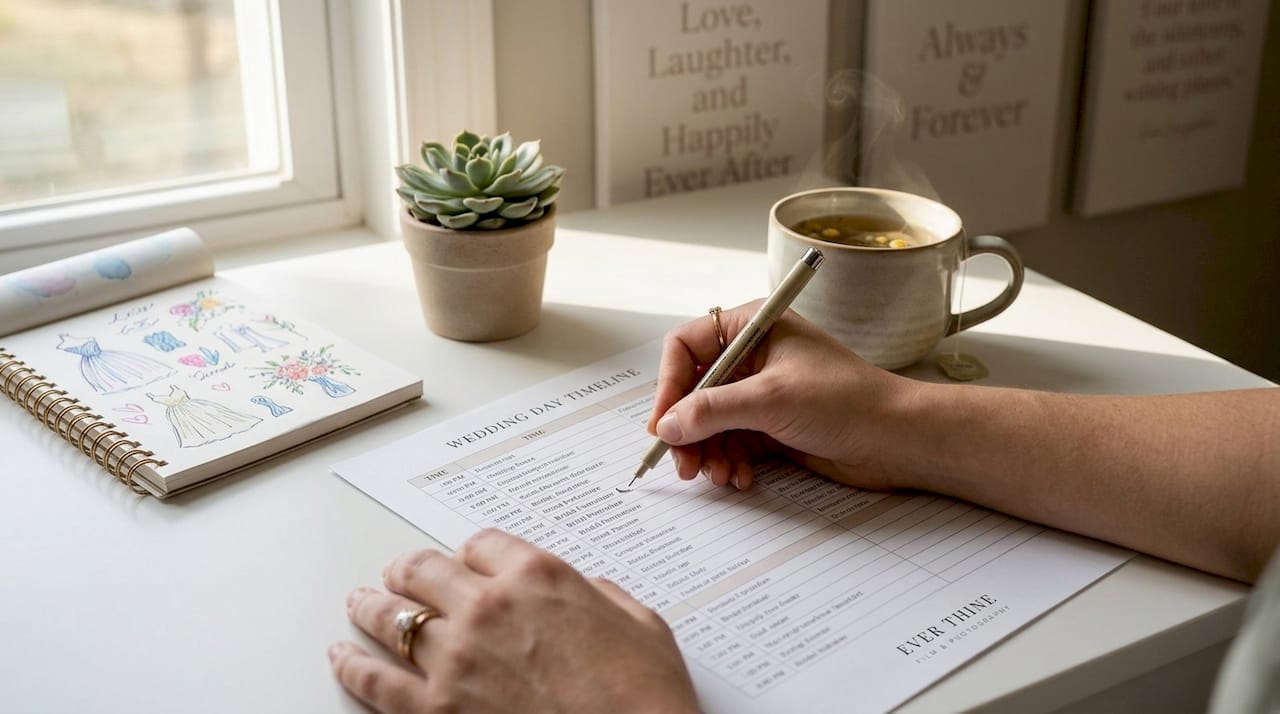
The standard structural blocks look like this:
Block | Typical duration |
Getting ready (hair and makeup) | 3 to 5 hours |
First look and couple portraits | 30 to 60 minutes |
Ceremony | 20 to 45 minutes |
Cocktail hour | 60 minutes |
Reception (dinner, speeches, dancing) | 3 to 4 hours |
Send-off | 15 minutes |
Religious or cultural ceremonies often run longer than civil ones, and some venues impose strict finish times that compress your reception. Know your venue’s rules before you build anything else. Overly precise micro-scheduling almost always fails because delays compound, so round every duration up rather than down.
Pro Tip: If your ceremony is a civil service lasting 20 minutes, schedule 45 minutes in the timeline. The extra time disappears quietly if unused, but its absence causes visible stress if you need it.
2. Anchor your schedule on the ceremony start time
The ceremony start time is the single fixed point around which every other element of your wedding day schedule is calculated. Build your timeline by working backwards from that moment for all preparation, and forwards from it for cocktail hour, dinner, and dancing.
Here is a practical sequence for working backwards from a 2:00 pm ceremony:
Ceremony at 2:00 pm.
Bridal party arrives at venue by 1:30 pm, allowing 30 minutes of buffer.
Travel from getting-ready location: allow actual travel time plus 15 minutes.
Bride finishes hair and makeup at least 45 minutes before departure.
Calculate hair and makeup start time based on party size and number of stylists.
Hair and makeup for a bridal party typically takes 45 to 60 minutes per bridesmaid and 90 to 120 minutes for the bride. Two stylists working simultaneously halve the total time required. If you have four bridesmaids and one stylist, that is four hours of work before the bride even sits in the chair.
A first look, where you and your partner see each other privately before the ceremony, shifts the photography schedule significantly. Couple portraits move to before the ceremony rather than after, which means your guests enjoy the cocktail hour with you present rather than waiting. Many couples find this reduces the post-ceremony photography pressure considerably.
Pro Tip: Ask your photographer how long they need for couple portraits, family formals, and bridal party shots separately. These are three distinct blocks, and photo timing estimates from photographers are far more accurate than guesses from couples.
3. Build in buffer times between every major block
Buffers of 15 to 30 minutes between key moments are the single most effective tool for keeping a wedding day on track. They are not wasted time. They are the mechanism that absorbs the inevitable: a bridesmaid running late, a button that takes five minutes to fasten, or a photographer who needs one more shot.
Hair and makeup is the most common source of overruns. A minimum 30-minute buffer after the scheduled finish time for getting ready is not cautious; it is standard practice among experienced wedding planners. Without it, a 20-minute overrun in the morning cascades into a late ceremony, a compressed cocktail hour, and a delayed dinner.
Key places to build buffers into your bridal timeline planner:
After hair and makeup: 30 minutes minimum before departure.
Travel between locations: add 15 minutes to the actual journey time.
Before the ceremony: 20 minutes for final touches, nerves, and positioning.
Between ceremony and couple portraits: 15 minutes for congratulations and transitions.
Before dinner service: 15 minutes to allow guests to be seated comfortably.
“The couples who enjoy their wedding day the most are the ones who built in time they never needed, not the ones who scheduled every minute and prayed nothing went wrong.”
Label buffers explicitly in your written timeline rather than keeping them as mental notes. If your timeline says “3:45 pm: travel to portrait location” and you privately know you have 20 minutes of slack, that slack disappears the moment someone else is managing the schedule.
4. Communicate your timeline with vendors and your wedding party
Sharing an initial timeline draft with vendors approximately two weeks before the wedding gives them time to flag conflicts, adjust their own schedules, and confirm logistics. A final locked version should go out three days before the event, with no further changes unless absolutely critical.
Follow this communication sequence:
Eight weeks out: share a draft timeline with your photographer, videographer, florist, and caterer for feedback.
Two weeks out: distribute the revised timeline to all vendors and your wedding party.
Three days out: send the final, locked version clearly labelled as “final run of show.”
Morning of: provide printed copies to your wedding party, venue coordinator, and key vendors.
Printed timeline copies on the day prevent errors caused by phone battery failures or poor WiFi at rural venues. Designate one person, a wedding coordinator, a trusted friend, or your venue’s events manager, as the single point of contact for vendors on the day. This prevents your photographer from interrupting your first dance to ask where the cake is being cut.
Pro Tip: Create vendor-specific versions of your timeline that highlight only the information relevant to each supplier. Your florist does not need to know when the speeches start, but they do need to know exactly when the room flip happens.
5. Avoid the most common wedding timeline mistakes
Many couples underestimate the time required for photography because they do not account for gathering people, moving between locations, and the natural pauses that occur during group shots. Consulting your photographer when building your wedding checklist timeline is not optional; it is the step that prevents the most common scheduling failures.
The mistakes that cause the most disruption on the day:
Underestimating hair and makeup time. Always calculate based on the number of people and stylists, not optimism.
Skipping buffers entirely. A timeline with no slack has no resilience. One delay breaks everything downstream.
Not distributing the timeline widely enough. Vendors who do not have your schedule cannot follow it.
Scheduling dinner too late. Guests who have been drinking since the cocktail hour need food by 7:00 pm at the latest. A delayed dinner disrupts speeches, dancing, and the entire reception flow.
Cramming too many events into limited time. Every addition to your reception programme, a surprise performance, a slideshow, a second cake cutting, compresses something else.
Common mistake | Better approach |
One stylist for six people | Book two stylists; halve the morning timeline |
No travel buffer | Add 15 minutes to every journey |
Exact-minute scheduling | Round all durations up to the nearest 15 minutes |
Single timeline for all vendors | Create role-specific versions for each supplier |
The sequencing of events matters more than the exact clock times. A strong order of moments, getting ready, first look, ceremony, portraits, cocktail hour, dinner, speeches, dancing, creates a natural rhythm that guests and vendors follow intuitively. When the order is logical, small timing shifts do not derail the day.
6. Factor in vendor setup and the run of show
Vendor setup and cleanup frequently extend well beyond the times couples expect. Your florist may need two hours to dress the reception room. Your band may need 90 minutes for a sound check. If your venue has back-to-back bookings, these windows are fixed, and failing to account for them creates genuine operational problems.
Ask every vendor two questions when you share your timeline: “What time do you need access to the venue?” and “How long does your breakdown take?” Build both answers into your schedule. A versioned run of show approach, sharing an early draft for feedback and distributing a locked final version shortly before the event, prevents the confusion that comes from vendors working from different versions of the same document.
Your wedding photography timeline deserves particular attention here. Natural light changes throughout the day, and an experienced photographer will tell you exactly which windows produce the best conditions for portraits at your specific venue. Build your couple portrait session around their recommendation, not around what feels convenient on paper.
Key takeaways
A well-structured wedding day timeline anchors on the ceremony start time, builds in 15 to 30 minute buffers between every major block, and is distributed to all vendors at least two weeks before the day.
Point | Details |
Anchor on ceremony time | Work backwards to prep and forwards to reception from your fixed ceremony start. |
Buffer every major block | Allow 15 to 30 minutes between hair and makeup, travel, ceremony, and portraits. |
Consult your photographer | Photo timing estimates from professionals prevent the most common scheduling failures. |
Distribute early and widely | Send a draft two weeks out and a locked final version three days before the wedding. |
Sequence over precision | A logical order of events absorbs small delays without breaking the whole day. |
What I have learned from watching timelines succeed and fail
After photographing weddings across Staffordshire, Derbyshire, and beyond, the pattern is clear. The couples who arrive at their ceremony relaxed and genuinely present are almost always the ones who built their timeline with honesty rather than optimism. They asked their stylist how long it actually takes. They added 20 minutes to every journey. They did not try to fit a sunset portrait session, a surprise performance, and a three-course dinner into the same 90-minute window.
The ceremony anchor approach is not just a planning technique. It is a mindset shift. When you stop thinking about the morning as a series of tasks to complete and start thinking about it as the runway to the most important moment of the day, the priorities become obvious. Everything before the ceremony exists to get you there calm, on time, and ready.
The detail I see couples overlook most often is vendor setup time. A florist who needs two hours to dress a room is not being difficult. They are telling you something critical about your timeline, and ignoring it creates a problem that no amount of buffer time can fix after the fact.
Sharing your timeline with your photographer early is one of the highest-value things you can do in the planning process. A good photographer will not just receive your timeline. They will improve it.
— Ever
How Weddingfilmphotography helps your timeline work on the day
Planning a timeline is one thing. Having a photographer who understands it, works within it, and quietly adapts when reality diverges from the plan is another entirely.
[

At Weddingfilmphotography, we review every couple’s timeline before the wedding and flag anything that could create pressure on the photography coverage. Whether it is a tight window between the ceremony and portraits or a venue with tricky natural light at golden hour, we plan around the specifics of your day. Our Staffordshire wedding photography and Derbyshire coverage is built around documentary-style storytelling that captures the real moments, not a rigid shot list. Get in touch to discuss your timeline and how we can make every moment count.
FAQ
How long should a wedding day timeline be?
Most weddings run 5 to 6 hours, with the ceremony lasting around 30 minutes and the reception filling the remaining time. Events beyond six hours risk guest fatigue and a drop in energy during the reception.
When should I share my timeline with vendors?
Send an initial draft to vendors approximately two weeks before the wedding and a final locked version three days before. Provide printed copies on the day to account for technology failures.
How much buffer time should I include?
Buffer periods of 15 to 30 minutes between major blocks are standard practice. Hair and makeup in particular warrants a 30-minute minimum buffer after the scheduled finish time.
Should the ceremony time on invitations include a buffer?
Wedding invitations should display the actual ceremony start time, not an earlier arrival buffer. Add buffer time within your planning timeline rather than misleading guests about when the ceremony begins.
Do I need a separate timeline for my photographer?
Yes. Consulting your photographer when building your timeline prevents the most common scheduling failures, particularly around portrait sessions, family formals, and natural light windows at your venue.
Recommended
Comments