
Why timelines matter in weddings: 2026 guide

TL;DR:
A wedding timeline is essential for coordinating every moment of the day and preventing delays. It serves as the operational backbone, ensuring smooth transitions and allowing the couple to be present and relaxed. Creating a realistic schedule involves anchoring on the ceremony time, applying the 30/5 rule, building in buffer time, and assigning a dedicated timeline manager.
A wedding timeline is the detailed schedule that coordinates every moment of your day, from the first curl set by your hairdresser to the final dance of the evening. Without one, even the most beautifully planned wedding unravels into a series of delays, missed shots, and frazzled guests. Research from The Barn 305 confirms that a typical wedding spans 8 to 12 hours, making structured planning not a luxury but a necessity. Understanding why timelines matter in weddings is the single most effective step you can take to protect the day you have spent months building.
Why timelines matter in weddings: the core case
A wedding timeline functions as the operational backbone of your entire day. Every vendor, from your photographer to your caterer, works from it. Every transition, from ceremony to cocktail hour to first dance, depends on it. When the timeline is solid, the day flows. When it is absent or vague, the gaps compound into chaos.

The Knot recommends finalising your timeline at least one month before the wedding and confirming all details with vendors no later than one week prior. That advice exists because last-minute changes create conflicts that cascade through the entire schedule. A photographer who does not know the ceremony start time cannot plan the light. A caterer who has not confirmed the dinner slot cannot prep accordingly.
Good timelines also give you something that no amount of décor or flowers can provide: the freedom to be present. According to Elegant Wedding Expo, timelines give couples confidence to stop tracking the clock and simply experience the day. That psychological benefit is as real as any logistical one.
What are the main components of a wedding timeline?
The structure of a wedding day follows a predictable arc, and understanding each block helps you allocate time realistically.
Event block | Average duration |
Getting ready (hair and makeup) | 4 to 5 hours |
First look and couple portraits | 1 to 2 hours |
Ceremony | 20 to 60 minutes |
Cocktail hour | 1 hour |
Reception (dinner, speeches, dancing) | 3 to 4 hours |
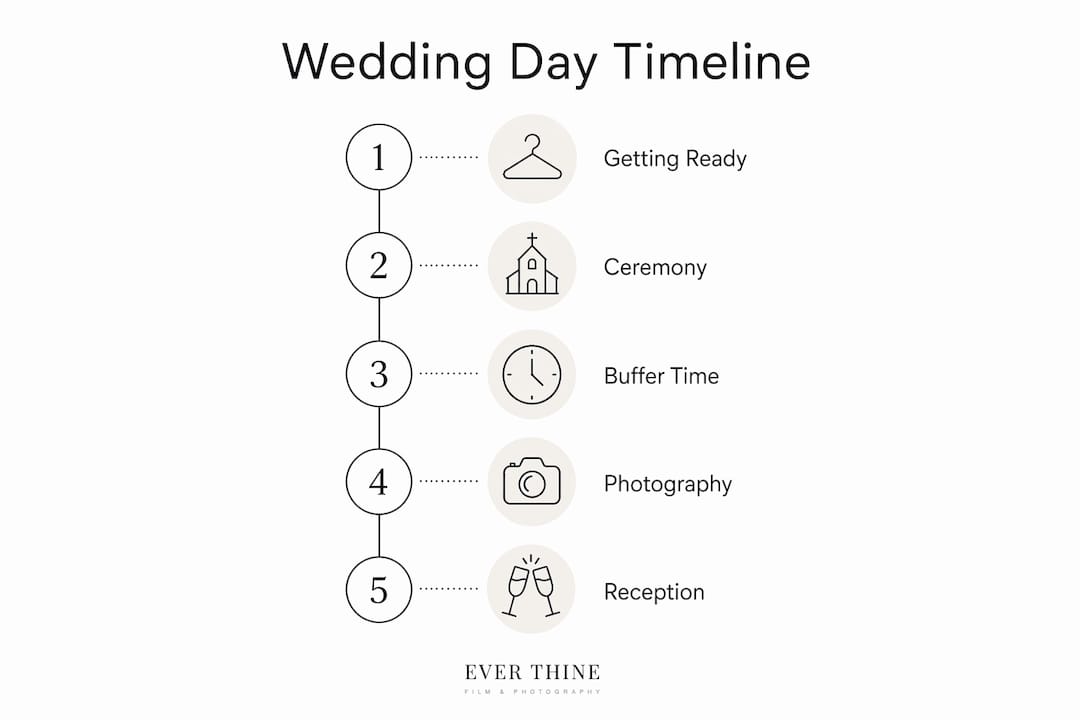
Civil ceremonies typically run 20 to 30 minutes, while religious ceremonies average 45 to 60 minutes. That difference alone shifts your entire afternoon schedule, which is why ceremony type and length must anchor the timeline before anything else is planned around it.
Buffer time is the most underestimated component. Adding 10 to 15 minutes between major events absorbs the inevitable delays caused by transit, group gathering, and logistics. Without buffers, a single 15-minute overrun in portraits can push dinner back by 45 minutes, which then delays speeches, which then cuts into dancing time. The cascade effect is real and entirely preventable.
Pro Tip: Start hair and makeup at least 30 minutes earlier than your instinct tells you. Groups always take longer than individuals, and the final look always needs a touch-up just before the ceremony.
The wedding photography timeline is one of the most time-sensitive blocks to plan correctly. Natural light changes rapidly, and your photographer needs specific windows to capture portraits at their best.
How do wedding timelines prevent delays and stress?
Delays on a wedding day rarely come from one catastrophic event. They accumulate from a dozen small ones. Understanding the typical causes is the first step to preventing them.
Common causes of wedding day delays include:
Late arrivals from the wedding party or key guests
Hair and makeup running over schedule
Extended portrait sessions without a set end time
Transport between venues taking longer than estimated
Dinner service starting late due to kitchen or catering coordination issues
Speeches running significantly over the agreed length
Guests not moving promptly between spaces
Dinner service is a particularly common delay point because it affects every subsequent event. A late dinner pushes speeches into the evening, compresses dancing time, and reduces the perceived quality of the food. Coordinating directly with your caterer on service timing is not optional.
Assigning a point person to manage the timeline on the day is one of the highest-impact decisions you can make. The Barn 305 notes that a month-of coordinator steps in approximately four weeks before the wedding to take ownership of the schedule, freeing the couple entirely from logistical thinking on the day itself. If a full coordinator is outside your budget, a trusted and organised friend or family member can fulfil this role with a clear briefing.
The stress-free wedding day is not an accident. It is the result of a timeline that has been stress-tested, shared with every vendor, and handed to someone capable of enforcing it calmly.
What are the best practices for creating a realistic wedding timeline?
The most common mistake couples make when building a timeline is underestimating how long ordinary tasks take on a wedding day. The Knot’s 30/5 rule addresses this directly: any task that normally takes 5 minutes will take 30 minutes on your wedding day. Group coordination, heightened emotions, and logistical complexity multiply every estimate.
Follow these steps to build a timeline that actually works:
Anchor on the ceremony time. Work backwards to calculate getting-ready start times and forwards to plan the reception flow.
Consult every vendor. Your photographer, caterer, florist, and venue coordinator each have timing requirements that must be factored in.
Apply the 30/5 rule. Round up every estimate. If you think portraits will take 45 minutes, schedule 75.
Build in buffer time. Add 10 to 15 minutes between every major transition, not just the ones that feel risky.
Share the final timeline. Send the confirmed schedule to every vendor at least one week before the wedding.
Assign a timeline manager. Designate one person whose sole job is to keep the day on track.
Review it together. Go through the timeline with your photographer and coordinator at least twice before the day.
Timelines also work best when they are treated as frameworks rather than rigid scripts. Wedding planners consistently advise that treating timelines as flexible guides allows couples to feel present and relaxed rather than pressured by the clock. Build in breathing room deliberately, not as an afterthought.
Pro Tip: Review your timeline with your photographer specifically, not just your planner. Photographers understand light, location logistics, and portrait timing in ways that general coordinators may not.
Your complete wedding timeline checklist is a practical starting point if you are building your schedule from scratch.
How do timelines shape the guest experience?
Guests rarely notice a good timeline. They simply feel that the day flowed beautifully. They notice a poor one immediately, even if they cannot articulate why.
Aspect | With a structured timeline | Without a structured timeline |
Transitions between events | Smooth, clearly signalled | Confusing, with awkward gaps |
Energy levels | Maintained throughout the day | Drops during unplanned lulls |
Dinner and speeches | Well-paced and enjoyable | Rushed or delayed |
Guest engagement | High, with clear cues | Low, with uncertainty |
Overall atmosphere | Relaxed and celebratory | Tense or disorganised |
The Barn 305 confirms that well-spaced activities directly improve guest engagement and the overall atmosphere. The cocktail hour, for example, serves a specific function: it gives guests a social space while the couple completes portraits, preventing the dead time that occurs when guests are left waiting with nothing to do.
Speeches are another timing-sensitive element. Scheduling them too early cuts into the energy of the meal. Scheduling them too late means tired guests and a compressed dance floor. Most experienced planners recommend placing speeches after the starter or between courses, keeping each one to a maximum of five minutes. The impact of timelines on weddings extends to every guest in the room, not just the couple at the centre of it.
The timeline lesson I keep learning at every wedding
After photographing weddings across Staffordshire, Derbyshire, and beyond, the pattern I see most consistently is this: the couples who trust their timeline have the best days. Not because everything goes perfectly, but because they are not mentally managing the clock when something small shifts.
The most overlooked element in almost every timeline I review is the getting-ready window. Couples consistently underestimate it. Hair and makeup for a bridal party of five or six people is a multi-hour operation, and when it runs late, it compresses every subsequent block. I have watched portrait sessions shrink from 90 minutes to 40 because the morning ran over, and those are the moments that are genuinely difficult to recover.
The second thing I would tell every couple is to stop treating the timeline as a document you create and file away. It is a living tool. Revisit it with your photographer and coordinator as the date approaches, because venues change their setup times, guest lists shift, and travel routes vary. The couples who review their timeline three or four times before the day arrive relaxed and prepared.
Finally, do not over-schedule the reception. I have seen timelines packed so tightly with games, activities, and scheduled dances that guests never had a moment to simply enjoy each other’s company. The best receptions have rhythm, not a programme. Give your guests space to breathe, and the atmosphere takes care of itself.
— Ever
How Weddingfilmphotography works with your timeline
[

At Weddingfilmphotography, timeline planning is built into the way we work with every couple. We do not simply show up on the day and follow along. We contribute to the timeline from the first consultation, advising on portrait windows, light conditions at your venue, and realistic durations for every photography block. Our experience across venues in Staffordshire, Derbyshire, and Worcestershire means we understand the logistical specifics that affect your schedule.
If you are planning your wedding and want a photography team that actively supports your day’s flow, explore our work as wedding photographers in Derbyshire or view our Staffordshire photography portfolio to see how we capture each moment within a well-planned day. Get in touch to discuss your timeline and how we can help make it work.
FAQ
What is a wedding day timeline?
A wedding day timeline is a detailed schedule that maps every event from getting ready through to the end of the reception. It coordinates vendors, guests, and the couple to keep the day flowing without confusion or delay.
How far in advance should I finalise my wedding timeline?
The Knot recommends finalising your timeline at least one month before the wedding and confirming all details with vendors no later than one week prior to the date.
How much buffer time should I include in my wedding timeline?
Adding 10 to 15 minutes of buffer time between major events is the standard recommendation. This absorbs small delays before they compound into larger disruptions later in the day.
Why does the 30/5 rule matter for wedding planning?
The 30/5 rule, cited by The Knot, states that any task taking 5 minutes normally will take 30 minutes on your wedding day. Applying this rule prevents the underestimation that causes rushed schedules and missed moments.
Do I need a coordinator to manage my wedding timeline?
A dedicated coordinator or point person significantly reduces stress and keeps the day on track. The Barn 305 notes that month-of coordinators step in around four weeks before the wedding to take full ownership of the schedule, freeing the couple to enjoy the day.
Key takeaways
A well-built wedding timeline is the single most effective tool for protecting your day from delays, stress, and missed moments.
Point | Details |
Anchor on ceremony time | Build the entire schedule forwards and backwards from the confirmed ceremony start time. |
Apply the 30/5 rule | Assume every 5-minute task will take 30 minutes and plan your estimates accordingly. |
Build in buffer time | Add 10 to 15 minutes between every major transition to absorb delays before they cascade. |
Assign a timeline manager | Designate one person to manage the schedule on the day so the couple can stay present. |
Involve all vendors early | Share the finalised timeline with every vendor at least one week before the wedding date. |
Recommended
Comments