
Essential questions to ask your wedding photographer

TL;DR:
Asking detailed questions before booking ensures authentic, stress-free documentary wedding photography.
Clear understanding of style, logistics, and expectations prevents missed moments and surprises on the day.
Building trust through preparation helps photographers capture genuine emotions and create lasting memories.
Imagine receiving your wedding gallery and realising the photographer missed the moment your best friend burst into tears during your vows, or that every group shot looks stiff and rehearsed rather than warm and real. For couples who chose documentary-style coverage because they wanted authentic memories, that kind of disappointment cuts deep. The honest truth is that most post-wedding regrets trace back to one simple oversight: not asking enough of the right questions before signing a contract. This guide walks you through everything you need to ask, why it matters, and how to go into that first meeting with real confidence.
Table of Contents
Key Takeaways
Point | Details |
Preparation prevents regret | Asking detailed questions ensures your wedding story is captured the way you want. |
Structure your questions | Divide topics into style, logistics, packages, rights and backup plans for a smoother interview. |
Verify before booking | Review full galleries and contracts, confirm details, and set expectations to avoid surprises. |
Clear communication is vital | Discuss your priorities openly and clarify group shots or candid moments for seamless coverage. |
Plan early to secure your date | The best photographers book out quickly, so start your search as soon as possible. |
Why asking the right questions matters
Documentary wedding photography is built on a philosophy of non-interference. Rather than directing every shot, a skilled documentary photographer moves quietly through your day, watching for genuine emotion, stolen glances, and unguarded laughter. That approach requires trust, and trust requires preparation from both sides.
When couples skip the detailed conversation and simply book based on a highlight reel, they leave far too much to chance. A photographer might assume you only want natural candids and skip the wide family portrait you were counting on. Or they may not realise that your grandmother’s reaction during the ceremony is the single most important moment of your entire day.
“Couples who meet with photographers and discuss their priorities genuinely have higher satisfaction with their wedding photography preparation outcomes.”
The consequences of skipping those conversations are more common than most couples expect:
No photos of key emotional moments because the photographer did not know they mattered
Awkward, slow group shots that ate into the drinks reception and felt out of place
Editing style surprises when the delivered gallery looks darker or more filtered than expected
Missed coverage at the venue because arrival time was never confirmed
Each of these outcomes is entirely avoidable. The difference is a thorough initial conversation where both you and your photographer leave knowing exactly what is expected on the day.
Top categories of questions to cover
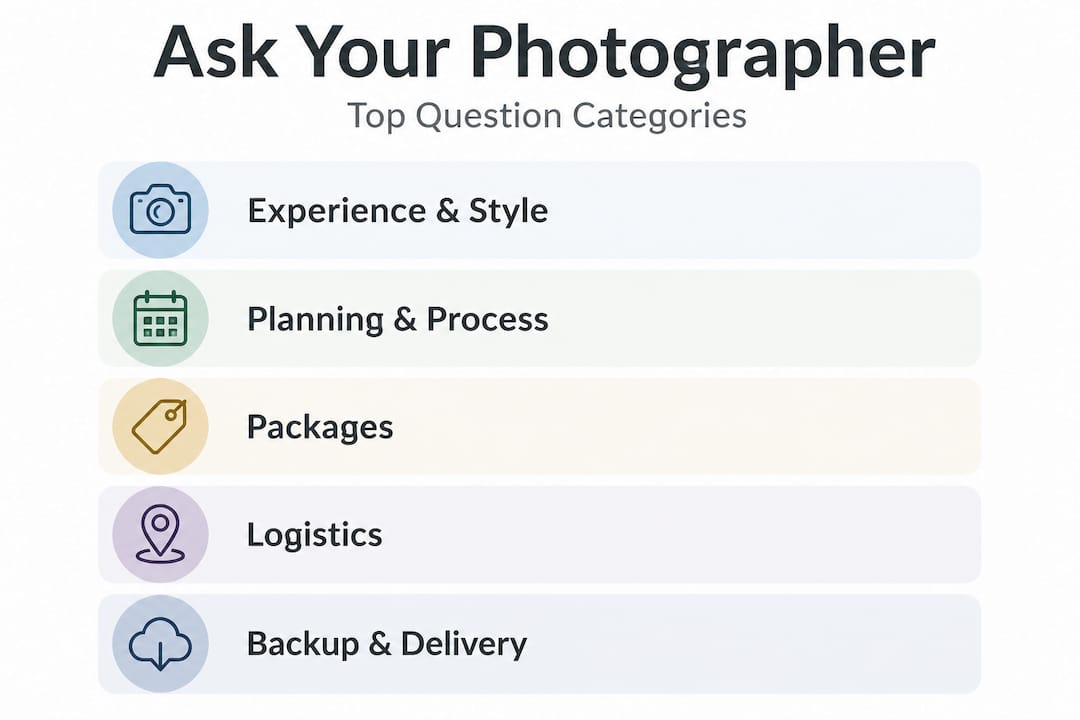
It helps to think of your pre-booking questions in logical categories rather than a jumbled list. That way, nothing important slips through the gaps. Understanding your package and photographer’s style prevents confusion and misaligned expectations on the wedding day itself.
Here are the five core categories to work through:
Experience and style: How long have they been shooting documentary weddings? Can you see full galleries, not just edited highlights?
Logistics: When do they arrive, how do they travel between venues, and who is their main point of contact?
Packages and pricing: What is actually included, and what sits outside the quoted price?
Rights and delivery: Who owns the images, when will you receive them, and in what format?
Contingency planning: What happens if they fall ill, equipment fails, or the weather forces a location change?
Pro Tip: When reviewing what film packages include, compare what is listed line by line. Two packages at similar prices can vary enormously in coverage hours, editing time, and the number of final images.
Category | Key focus | Why it matters |
Experience and style | Documentary approach, portfolio depth | Ensures their work genuinely matches your vision |
Logistics | Travel, arrival, second shooter | Prevents day-of gaps in coverage |
Packages and pricing | Inclusions, extras, payment schedule | Avoids unexpected costs |
Rights and delivery | Copyright, print rights, timeline | Protects your investment long term |
Contingency planning | Backup kit, illness policy, substitutions | Safeguards your memories |
Working through each category systematically means you walk away from every meeting with a clear picture of whether this photographer is the right fit, not just a good feeling based on their Instagram feed.
Essential pre-booking questions for your photographer
Now you know what to cover overall, here are the actual questions to use in your meetings, plus why each one matters for documentary-style weddings specifically. Wedding day workflows become far smoother when responsibilities and timelines have been discussed in detail well before the big day.
How many documentary-style weddings have you covered? Experience matters. A photographer who has shot forty documentary weddings understands the pace and rhythm of an unscripted day in a way that someone newer simply cannot replicate.
How do you approach capturing emotional moments without interfering? Listen for specifics here. A strong answer includes how they position themselves, how they anticipate moments, and how they move without drawing attention.
How do you handle difficult lighting, such as dark ceremonies or harsh midday sun? Natural light is beautiful, but it is unpredictable. Ask for examples of their work in dim churches, bright outdoor settings, and mixed evening receptions.
What is your backup plan if you are ill or your equipment fails? Any professional should have a clear answer. Look for backup camera bodies, duplicate memory card writing during shooting, and a named substitute photographer they trust.
Can you walk me through your editing style? This is where surprises most often happen. Ask about colour grading, how long they retain original files, and whether you have any input on the editing direction.
Is a second shooter included, and what is their role? For documentary coverage, a second perspective captures moments happening simultaneously in different rooms. Knowing this is included avoids expensive add-on surprises.
Can we see a full gallery from a recent wedding, start to finish? Highlight reels are curated. A full gallery shows you the consistency, the quieter moments in between, and whether their style holds up throughout an entire day rather than just in ideal conditions.
Who retains copyright, and what print rights do we receive? Most photographers retain copyright but grant you a personal use licence. Make sure this covers printing, sharing, and any future use you might want.
What does the contract include, and what is the payment schedule? Read everything before signing. Key clauses to look for include cancellation terms, force majeure provisions, and what happens if they need to send a substitute.
How flexible are you if our timeline shifts on the day? Weddings run late. A documentary photographer who understands this and builds in flexibility is far more valuable than one who adheres rigidly to a shot list. Asking about questions for videographers can also help if you are booking combined coverage, since coordination between both becomes critical.
Question | Priority if candid style is important | Priority if group shots matter |
Emotional moments approach | Essential | Important |
Lighting experience | Essential | Essential |
Second shooter included | Very important | Very important |
Full gallery review | Essential | Essential |
Timeline flexibility | Essential | Moderate |
Copyright and print rights | Important | Important |
Pro Tip: Before your meeting, write down your three most important moments of the day. Share those with your photographer at the start. It immediately tells them what to prioritise and shows them you have thought carefully about what matters most.
Logistics and on-the-day coordination
The final step before you book is making sure the wedding day itself will run smoothly alongside your photographer. Coordinating day-of photographer coordination details well in advance reduces stress considerably and prevents the kind of missed moments that couples mention most when things go wrong.
Here is what to confirm before you finalise the booking:
Arrival time: Confirm when they will arrive at each venue, including prep coverage if that matters to you. Being present while you are getting ready can yield some of the most relaxed, genuine images of the entire day.
Venue access: Some venues restrict photography in certain areas or at certain times. Your photographer should contact the venue in advance to understand these restrictions.
Primary contact number: Decide who your photographer should contact on the morning of the wedding if there are any last-minute changes to the schedule.
Group shot list: Even for documentary-style coverage, most couples want a handful of family portraits. Agree on a short, realistic list and schedule a specific window for them rather than letting it interrupt natural moments.
Travel between venues: If your ceremony and reception are in different locations, confirm how they will travel and whether travel time is included in their coverage hours.
Weather or location contingency: Outdoor ceremonies and portrait sessions depend on conditions. Discuss alternative plans so you are not making stressed decisions on the morning of the wedding.
Pro Tip: Assign one trusted family member or friend to gather people for group shots. Tell your photographer who this person is before the day. This single step saves an enormous amount of time and removes pressure from both you and your photographer, freeing them to return to capturing the natural moments they do best. For a more structured reference, the wedding photography preparation guide offers a helpful breakdown of how to plan each stage, while the essential photography checklist can serve as a useful final check in the weeks before your wedding.

Common mistakes to avoid and final checks
Having covered the key questions, let’s round out the preparation with the pitfalls to watch for before you finalise the booking.
Many couples make the mistake of assuming the contract covers everything. It rarely does. Contracts set legal terms but seldom address creative expectations in detail. That is the job of your conversations, not the small print.
The most common oversights before signing include:
Not viewing a full gallery: Seeing only a curated selection tells you very little about how a photographer handles the quieter, less dramatic parts of the day.
Failing to confirm edit timelines: Eight to twelve weeks is typical for a full edited gallery, but some photographers take considerably longer. If you are expecting images quickly, confirm this in writing.
Skipping the backup plan conversation: Equipment failure is rare but real. Every professional worth booking will carry at least two camera bodies and will write to multiple memory cards simultaneously.
Not confirming social media policies: Some photographers share images on Instagram before delivering your gallery. If you want to control when your photos go public, say so clearly and confirm it is noted.
Assuming your vision is obvious: A photographer cannot read your mind. Even the best professionals deliver better results when they understand your priorities, your family dynamics, and the moments that carry the most meaning for you.
According to many industry reports, managing photography stress becomes significantly easier when couples establish clear expectations before the wedding rather than trying to resolve misunderstandings afterwards.
Final pre-booking checklist:
Viewed a full gallery from a recent, similar wedding
Discussed the three most important moments of your day
Confirmed backup equipment and contingency plans
Read and understood the full contract including cancellation terms
Agreed on edit timeline and delivery format in writing
Confirmed logistics including arrival times and venue access
Our perspective: why your questions shape your wedding story
Here is the thing most wedding advice misses entirely. Style and pricing matter, but they are not what separates an extraordinary documentary photographer from a merely competent one. What actually makes the difference is how well your photographer understands you.
Conventional wisdom says browse portfolios, check reviews, compare packages, and sign. That is the minimum, not the standard to aim for. In our experience, the couples whose galleries genuinely take your breath away are the ones who came to their initial meeting having thought carefully about what they wanted to feel when they look at their photos twenty years from now.
When you share your story, not just your timeline, a documentary photographer can be so much more intentional. Knowing that you both met at a chaotic family gathering, for instance, might lead them to linger longer during those moments of joyful family chaos rather than rushing to the next set up. That kind of personalised instinct cannot come from a brief email exchange. It comes from a real, honest conversation.
We have also seen how couples who ask thoughtful, searching questions help us do our very best work. There is no pressure in those questions. Quite the opposite. They tell us what matters most, and that gives us a map for the day. The photography checklist advice is useful practically, but the deeper value is in the mindset it encourages: that preparation is a form of care for your own memories.
Do not underestimate the interview itself. A photographer who listens carefully, asks their own thoughtful questions in return, and takes time to understand your personalities is demonstrating exactly the kind of presence and attentiveness they will bring on your wedding day. Trust that instinct.
Book your ideal documentary wedding photographer
If you have worked through these questions and feel ready to move forward, the next step is finding a documentary photographer whose work genuinely resonates with you and who has real experience at the kind of venue you have in mind.
[
We are an award-winning documentary wedding photography and film duo based in Staffordshire, covering weddings across the Midlands and beyond. Whether you are planning a celebration with a Derbyshire documentary photographer, searching for a trusted Staffordshire wedding photographer, or looking for a Worcestershire wedding photographer who understands documentary storytelling, we would love to hear from you. Popular dates book up quickly, often more than a year in advance, so if your date is already set, get in touch sooner rather than later for an obligation-free conversation about your day.
Frequently asked questions
How do I know if a wedding photographer’s style suits us?
Ask to see full galleries from recent weddings, not just curated highlight reels. A complete gallery shows you how consistent their style is throughout an entire day, including the quieter, less photogenic moments.
Should we ask about backup equipment?
Yes, absolutely. Confirm your photographer carries backup cameras and memory cards to protect against technical failure. No professional should attend a wedding without duplicate equipment.
What are red flags when choosing a photographer?
Vague answers about process, reluctance to share full galleries, or unclear communication and contracts should all be treated as warning signs worth paying close attention to before you commit.
Is it okay to request specific group shots at a documentary-style wedding?
Absolutely. Pre-discussing group shots ensures they are smoothly integrated into the day without undermining the natural, candid approach that makes documentary coverage so special.
How early should we book our wedding photographer?
Book at least 12 to 18 months in advance, particularly for summer dates or popular venues, as skilled documentary photographers fill their calendars well ahead of the season.
Recommended

While looking for additional information, I recently came across https://proshtuchnyiintelekt.com/ and found several useful examples there
While looking for additional information, I recently came across https://101pryvitannia.com/ and found several useful examples there
One of the resources that gave me a similar impression was https://krasatazdorovia.com/, mainly because of its practical and easy-to-follow content
I discovered https://novynypoltavy.com/ not long ago and was pleasantly surprised by how practical the content was
While looking for additional information, I recently came across https://infowomenspace.com/ and found several useful examples there