
Guest photos vs photographer: which should you choose?

Hire a professional photographer for the day’s core story, then set up a frictionless guest-photo system to catch everything they can’t. The professional gives you a consistent, edited gallery of the moments that matter most; guests fill in the candid, parallel-story gaps a single photographer physically cannot reach. Done right, this costs only a little more than hiring a photographer alone, and it’s the approach that consistently produces the fullest wedding archive.
TL;DR:
Using a QR-code-based guest photo system can collect three to ten times more images than hashtags or messaging apps, often exceeding 300 photos.
Setting up the guest photo collection before the wedding and briefing a dedicated person reduces chasing guests for images and improves overall quality.
Combining a professional photographer’s gallery with a guest QR gallery provides a fuller record of candid, unposed moments that the photographer cannot capture.
Clear communication about guest photo policies and timing helps avoid interference with key moments and protects privacy and image quality.
Relying solely on guest photos limits the number and quality of images, so a hybrid approach offers the best coverage and systematically captures the day.
Table of Contents
Guest photos vs photographer: what each one actually gives you
A professional wedding photographer is the only part of your day’s documentation you can fully predict in advance. That predictability is the whole point. You know roughly how many images you’ll get, roughly when they’ll arrive, and roughly what they’ll look like, because a professional works to a style and a brief, not to instinct alone.
Most professional wedding photographers deliver between 400 and 800 edited images, with galleries typically arriving 4 to 8 weeks after the wedding. That range depends on coverage hours, but it’s a useful benchmark when you’re comparing quotes.
What a booked package usually includes:
A set number of coverage hours, often 8 to 10 for a full day
A defined range of final, colour-graded, edited images (not raw files)
A delivery window measured in weeks, not days
Posed portraits, formal group shots, and detail photography (rings, venue, flowers)
A single consistent visual style across every image in the gallery
A two-person team changes what’s physically possible on the day. One shooter can only be in one place, which means either the groom’s reaction or the bride’s entrance, never both, unless there’s a second camera covering the other angle. Adding a second photographer typically means simultaneous coverage of separate spaces, useful when your ceremony and getting-ready rooms are far apart, though it comes at extra cost and isn’t standard on every package.
Pro Tip: If your ceremony and reception venues are more than a short walk apart, ask your photographer directly how they plan to cover the gap. A good answer tells you whether you need a second shooter or a tighter timeline.
Here’s the limit nobody puts on the brochure: even the best photographer is one person with one set of eyes, working one thread of the day at a time. While they’re capturing your first dance, they cannot simultaneously be at the bar catching your uncle’s terrible dancing, or in the smoking area where the best man is telling the story that never made it into his speech. That’s not a flaw in their service. It’s physics. And it’s exactly the gap guest photos are built to fill.
What do guest photos add that a photographer can’t capture?
Guest photos exist in the spaces a professional simply isn’t standing in. They come from dozens of different angles at once, they catch the unguarded seconds between the posed ones, and they keep going long after your photographer has packed up and gone home.

Guest photos capture candid details and parallel storylines the professional may never see: the in-joke shared across a table, the grandparent wiping their eyes during the speech, the dance floor at 11pm when the DJ finally plays something everyone actually wants. Combining both sources gives you a noticeably fuller record of the day for comparatively little extra outlay.
The catch is that guest photos are only as good as the system you use to collect them, and most couples get this badly wrong. Here’s how collection method affects what you actually end up with:
Collection method | Typical photo yield | Common problems |
Hashtag on Instagram | 20–80 photos | Scattered across public feeds, easy to miss, compressed |
Shared group chat / WhatsApp | 20–80 photos | Buried in unrelated messages, heavily compressed images |
Browser-based QR upload platform | 300–800+ photos | Requires setup in advance, otherwise minimal downside |
Frictionless QR-code-based systems typically collect 300 to 800 or more photos, against just 20 to 80 from manual methods like hashtags or shared albums. That gap isn’t about how enthusiastic your guests are. It’s about friction. Every extra tap, login, or app download between “I took a nice photo” and “it’s in the couple’s collection” loses you contributors.
Social platforms carry two other costs beyond low participation. First, messaging apps and social feeds compress images and strip metadata, so a photo that looked crisp on someone’s phone arrives blurry and unprintable. Second, a public hashtag means your wedding photos, and sometimes your guests’ faces, are visible to strangers scrolling a public feed, which is a privacy trade-off many couples don’t think to weigh until afterwards.
How do you set up guest photo collection without the chaos?
Getting a genuinely useful guest gallery isn’t complicated, but it does need setting up before the day, not during it. Here’s the order that actually works.
Choose a browser-based QR upload platform weeks in advance. No app, no account, no login for guests, just a scan and an upload. This single choice does more for your final photo count than anything else on this list.
Brief your photographer. Let them know you’re running a guest gallery alongside their coverage, and ask where they’d prefer guests not to point a phone (this is worth revisiting in the coordination section below).
Prepare table cards and signage with the QR code printed clearly, placed on every table and near the bar or entrance.
Nominate an “upload champion”, usually a sibling or close friend, whose one job is checking the gallery is filling up as the evening goes on and nudging stragglers. This single step measurably reduces the amount of chasing couples do after the wedding.
Announce the QR link after the ceremony, not during the invitations stage when nobody remembers it. Get your MC or DJ to repeat it once during the reception.
Set your privacy and retention settings before the day, and if you want an unplugged ceremony, say so clearly and enforce it kindly through your celebrant or MC.
Download every original file before the platform’s free tier expires. Some event platforms only guarantee storage for 30 to 90 days on free plans, so this step is not optional.
Merge the guest gallery with your professional gallery once both arrive, and back up the combined archive in at least two places.
Pro Tip: Set your guest platform’s privacy so uploads are visible only to people with the link, not searchable publicly. It keeps the fuller resolution promised by private gallery platforms and avoids the exposure risk that comes with public hashtags.
Our top wedding day photo tools guide covers specific platform features worth checking before you commit to one, and our wedding photography checklist walks through the same timeline in more granular, printable form.
What should you tell guests and your photographer?
Most of the awkwardness around guest photography comes down to unclear communication, not conflicting interests. A short, direct message solves nearly all of it.
For your invitation or wedding website, something like: “We’d love you to capture your own view of the day. Scan the QR code at your table any time to add your photos, no app needed.” For the MC or DJ to announce mid-reception: “If you haven’t already, scan the code on your table to share your photos, they’ll go straight into the couple’s gallery.”
If you want an unplugged ceremony, say so plainly and early, ideally on the invite itself: “We’ve asked our photographer to capture the ceremony, so we’d love for you to be fully present, phones away, until the confetti.” That single line protects your photographer’s sightlines without singling anyone out on the day.
Photographers rarely object to guest galleries in principle. The main professional concern is physical interference during key moments, someone stepping into the aisle for a better angle, a phone blocking the first kiss, a flash going off mid-vow. Addressing this before the day, rather than hoping it works itself out, is worth the two-minute conversation.
A quick dos and don’ts for guests:
Do use the QR code freely during the reception and party
Do avoid flash photography during the ceremony and speeches
Don’t stand up or move into the aisle during key moments
Don’t post ceremony photos publicly before the couple has shared their own
Our guide on coordinating with your wedding photographer covers how to raise these points without it feeling like a rulebook.
Does the hybrid approach actually work in practice?
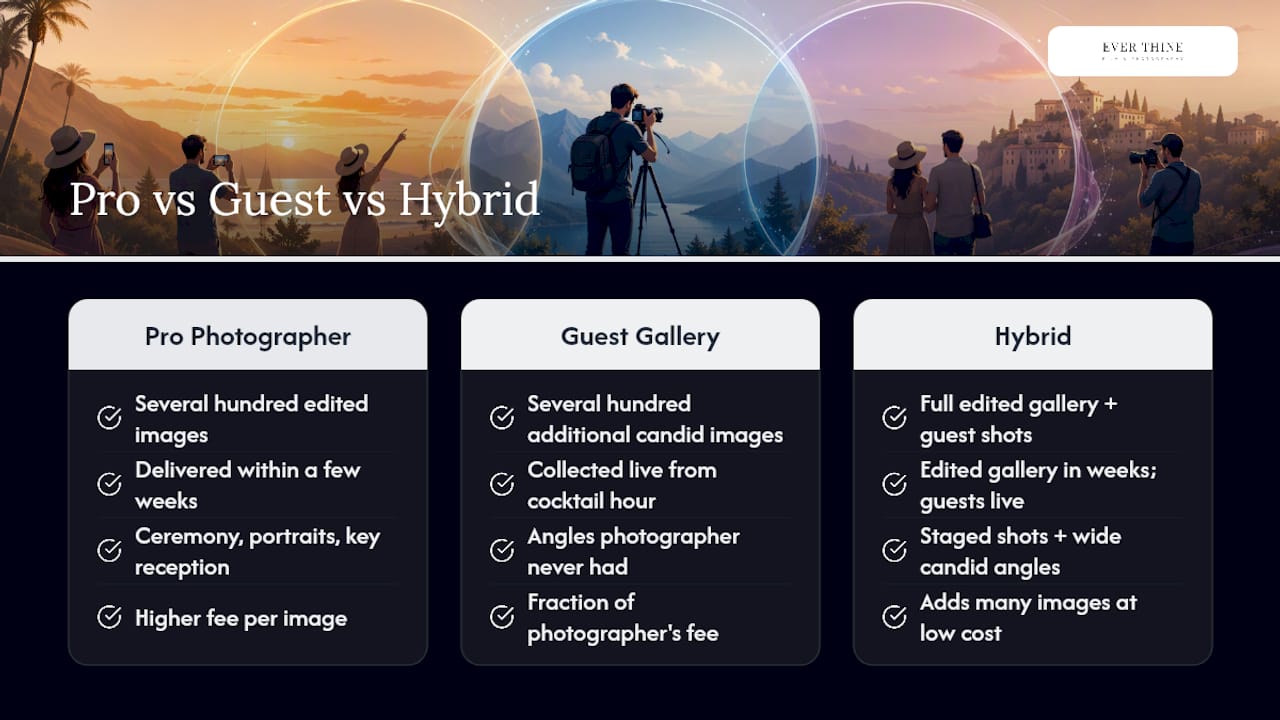
A useful comparison: a couple with a single photographer booked for 8 hours typically ends up with a gallery of several hundred edited images delivered within a few weeks, covering the ceremony, portraits, and key reception moments. Add a QR-based guest gallery running from cocktail hour onward, and that same couple often receives several hundred additional candid images spanning angles and moments the photographer never had a lens on, at a fraction of the photographer’s fee.
At Weddingfilmphotography, documentary-style coverage across Staffordshire and the wider West Midlands is built around exactly this complementary structure: a full edited gallery from the day, paired with practical guidance on running a guest-collection system that doesn’t compete with the shots that matter.
What the industry gets wrong about guest photography
Most wedding advice treats guest photos and professional photography as rivals, one is “the real photos”, the other is “just for fun”. That framing is backwards and it costs couples genuinely good images.
The actual evidence points the other way: guest photos and professional coverage solve different problems. A photographer gives you control, consistency, and the moments you’ve planned for. Guests give you the moments you didn’t know to plan for. Treating them as competing options means couples either overspend on a second shooter to cover ground guests would have covered for free, or they rely entirely on scattered phone photos and lose most of them to compression and forgotten group chats within a year.
What’s overrated is the second shooter as a default fix for coverage gaps. What’s underrated is a five-minute setup task, printing a QR code and briefing one friend, that costs almost nothing and multiplies your archive. If you do only one thing differently after reading this, make it that: choose your guest-collection method before the invitations go out, not the week of the wedding.
— Ever
Get documentary coverage and a guest-photo plan sorted in one conversation
Weddingfilmphotography gives you what a DIY guest-only approach never can: a guaranteed, consistently edited gallery from someone who knows exactly where to stand during your vows, paired with practical guidance on running the QR-based guest system alongside it, so you’re not choosing between the two or figuring out the logistics alone.
[
Documentary-style coverage across Staffordshire and the West Midlands means candid, unobtrusive photography on the day, plus the planning conversation that sorts out your guest-collection setup before it becomes a last-minute scramble. Get in touch through the Staffordshire wedding photographer page to check dates and see packages, or visit the Derbyshire landing page if you’re planning nearby.
Your priority | What fits best |
Consistent, edited gallery of key moments | Professional coverage |
Candid, after-hours, multi-angle shots | Guest QR gallery |
Both, without the admin headache | Hybrid plan with Weddingfilmphotography |
Check availability for your date and ask about how the guest-gallery briefing works as part of your package.
Sources
FAQ
What is the difference between a photograph and a photographer?
A photograph is the resulting image, taken by anyone with a camera or phone; a photographer is a trained professional who controls composition, lighting, and timing to produce a consistent, edited body of work rather than a single lucky shot.
What is a guest pic?
A guest pic is any photo taken by a wedding guest, usually on a phone, rather than by the hired professional; guest pics tend to capture candid, informal moments the photographer may not see.
Should you rely on guest photos instead of hiring a photographer?
No. Guest photos are a valuable complement, not a substitute; they lack the consistency, technical control, and guaranteed coverage of key moments that a professional provides, so the strongest results come from combining both.
How many photos should I expect from a professional versus from guests?
A professional typically delivers 400 to 800 edited images within 4 to 8 weeks, while a well-run QR-based guest gallery can add 300 to 800 or more photos, compared with just 20 to 80 from hashtags or group chats.
What are the four types of wedding photography?
Wedding photography generally covers four styles: traditional/posed, documentary or candid, fine art, and editorial, with most professional packages, including Weddingfilmphotography’s documentary approach, blending several of these across one day.
Recommended


Comments