
Step by step wedding planning: your 2026 UK guide
- 2 days ago
- 12 min read

TL;DR:
Planning a wedding successfully begins with setting your budget, guest list, and booking the venue first. These decisions guide all other choices, reducing the need for reworking plans later.
Planning a wedding well comes down to doing the right things in the right order. Set your budget first, build your guest list second, book the venue third, and everything else slots into place around those three decisions. Miss that sequence and you will spend months revisiting choices you thought were settled.
Here is the core framework at a glance:
Set your budget and discuss priorities with your partner and any contributing family members before looking at a single venue
Draft a provisional guest list so you know what venue size and catering scale you actually need
Book the venue as early as possible, since popular UK venues fill 12–18 months in advance
Secure key suppliers once the venue and date are confirmed: photographer, caterer, and entertainment, in that order
Give legal notice at your local register office at least 29 days before the ceremony, having lived in that registration district for the prior 7 days
Send save-the-dates 6–12 months out, then formal invitations 8–12 weeks before the wedding
Plan ceremony and reception details, including seating, readings, and the day schedule
Complete final checks in the last four weeks: confirm all suppliers, delegate responsibilities, and prepare a written day-of timeline
How to follow a step by step wedding planning timeline
Most UK couples plan over 12–18 months, though a well-organised couple can manage in 6–9 months if key suppliers are still available. The timeline below treats venue booking as the anchor point, because everything else, from catering to photography to legal notices, flows from having a confirmed date and location.
Wedding planning timeline at a glance
Months before | Key tasks |
18–12 | Set budget, draft guest list, book venue, consider wedding insurance |
12–9 | Book photographer, caterer, entertainment, florist |
9–6 | Choose attire, arrange guest accommodation, send save-the-dates |
6–3 | Send invitations, give legal notice, book hair and make-up |
3–1 | Finalise seating plan, confirm suppliers, arrange transport |
4–6 weeks | Share day-of timeline with all suppliers, final dress fitting |
Final week | Confirm every supplier, pack essentials, rehearsal dinner |
Wedding day | Trust the plan, delegate problems, eat breakfast |
Phase 1: The foundations (12–18 months out)
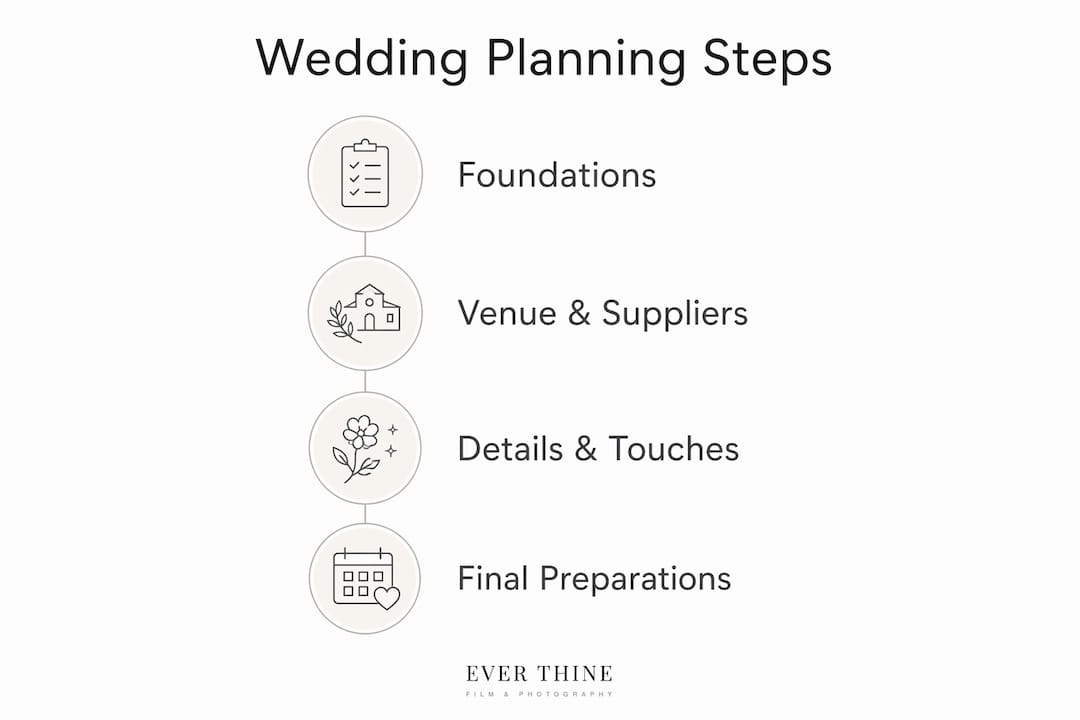
Budget and guest list are the two decisions that determine every other choice. Agree a total figure with your partner, subtract 10% as a contingency buffer, and treat what remains as your working budget. Then draft a rough guest list: “must invite” first, “should invite” second, “would like to invite” third. That order keeps the list honest.
Phase 2: Venue and core suppliers (months 6–12)

Once the venue is booked, photographers book 9–12 months ahead of peak-season dates, caterers 6–12 months, and entertainment 6–9 months. Book in that order. Leaving any of these three until the six-month mark risks losing your preferred choice entirely, particularly for summer Saturdays.
Phase 3: Details and personal touches (months 3–6)
This phase covers invitations, attire fittings, hair and make-up trials, menu tastings, and accommodation arrangements for guests. Delegating tasks to your partner, family, and wedding party at this stage prevents one person carrying the full load.
Phase 4: Final preparations (last month)
Finalising all supplier timings 4–6 weeks before the wedding protects your emotional energy for the day itself. Write a single shared document with every supplier’s arrival time, contact number, and responsibility. Share it with your on-the-day coordinator or a trusted person in the wedding party.
What are the legal requirements for getting married in England and Wales?
UK marriage law has firm deadlines, and missing them can delay or invalidate your ceremony. The rules below apply to England and Wales; Scotland and Northern Ireland operate under different legislation.
The notice period
You must give notice at your local register office at least 29 days before the ceremony. If you give notice on 1 May, the earliest you can marry is 30 May. The notice remains valid for 12 months, so the ceremony must take place within that window.
Residency requirement
You must have lived in the registration district where you give notice for the 7 days immediately before your appointment. If you and your partner live in different districts, you each give notice separately at your own register office. You do not need to attend on the same day.
Documents you will need
Passport or birth certificate as proof of identity
Proof of address confirming your residency in the district
Full details of the ceremony venue, including its name and address
Decree absolute if either partner is divorced
Death certificate if either partner is widowed
Ceremony types
A civil ceremony can take place at a register office or any venue approved by the local council. A religious ceremony takes place at a registered religious building. Both require at least two witnesses. If your religious venue does not have an authorised person on staff, you will need to book a registrar separately, which costs £114.50.
Failing to meet the 29-day notice period or the 7-day residency requirement can legally prevent your wedding from proceeding on the date you have planned. Book your register office appointment as soon as your venue and date are confirmed.
Key documents checklist
Valid photo ID (passport or birth certificate)
Proof of address dated within the last three months
Venue name, address, and ceremony date
Any relevant divorce or bereavement certificates
How do you manage the final month without losing your mind?
The last four weeks before a wedding are where planning either holds together or unravels. The difference is almost always preparation done earlier, not heroics at the last minute.
Confirm every supplier in writing 4–6 weeks out. Send each one a single email containing the day-of timeline, their arrival time, the venue address, and your contact number. Ask for a written confirmation back. This takes an hour and eliminates the most common source of day-of confusion.
Create a written day-of schedule and share it with at least two people who are not you: your on-the-day coordinator if you have one, or your best man and maid of honour if you do not. The schedule should list every supplier arrival, every ceremony milestone, and every reception transition, down to the first dance and the cake cut.
Pro Tip: Write your day-of schedule in 15-minute blocks, not hours. Vague timings like “photos: afternoon” create gaps that suppliers fill differently. “Couple portraits: 4:15 PM, garden” leaves no room for misinterpretation.
Protect your energy in the final two weeks. Stop making new decisions. If something is not already booked, either accept the gap or delegate the fix to someone else. Decision fatigue in the final stretch is real, and it affects the day itself more than any unresolved detail does.
How to get properly organised from the start
Good organisation at the beginning saves hours of backtracking later. Open a shared document or spreadsheet with your partner on the day you get engaged, and use it as the single source of truth for every booking, payment, and contact detail.
Track deposits and final balances separately. Many UK suppliers take a deposit at booking and the balance 4–8 weeks before the wedding. Missing a final payment deadline can void your contract, so note every due date in your calendar with a reminder set two weeks earlier.
A wedding planning checklist broken into monthly phases keeps the workload visible without being overwhelming. Assign each task to a person and a deadline. Unassigned tasks tend to stay undone.
How do you choose a wedding style or theme?
Your venue will do most of the work here. A converted barn in the Cotswolds pulls naturally towards rustic and relaxed; a Georgian country house lends itself to classic elegance; a city rooftop suits something more contemporary. Let the space lead and build the aesthetic around it rather than fighting the architecture.
Beyond the venue, think about three things: the season, your personal style as a couple, and your budget for décor. A winter wedding with candlelight and deep florals costs differently from a summer garden party with loose wildflowers. Neither is better, but each requires a different supplier brief and a different budget allocation.
Mood boards on Pinterest or a shared folder of saved images help florists, stylists, and photographers understand your vision quickly. Bring a concise brief to every supplier meeting rather than a phone full of screenshots. The clearer your direction, the more accurately they can quote and deliver.
When should you set your wedding date?
Set the date only after you have a shortlist of venues, not before. Choosing a date in the abstract and then discovering your preferred venues are unavailable on that day wastes time and creates unnecessary pressure.
Season matters more than most couples expect. Peak UK wedding season runs from late may through september, when demand for venues, photographers, and caterers is highest and prices reflect that. An autumn or winter date often unlocks better availability, lower venue hire fees, and more negotiating room with suppliers.
Flexibility with the day of the week also opens options. Fridays and Sundays at popular venues can cost noticeably less than Saturdays, and mid-week dates suit smaller, more intimate weddings particularly well. If your guest list includes many people who would need to travel or take time off work, factor that into the decision before you commit.
How do you create a seating plan that actually works?
Start with the tables, not the people. Decide how many tables you have, their shape (round or long), and their capacity before you begin placing guests. Trying to fit people around an undefined layout is where seating plans become genuinely stressful.
Group guests by relationship and energy, not just by family connection. A table of your partner’s university friends will have a better time than a mixed table of distant relatives who have nothing in common, even if the latter looks more “balanced” on paper. Seat people with whom they will actually talk.
Leave the seating plan until your final RSVP deadline has passed, which should be 4–6 weeks before the wedding. Finalising it earlier means redoing it when guests drop out. Use a digital tool or a simple spreadsheet rather than sticky notes, which fall off walls at inconvenient moments.
Pro Tip: Always keep two or three spare seats distributed across tables rather than clustered together. Last-minute additions or unexpected plus-ones are far easier to absorb when the slack is spread across the room.
What does a solid wedding day timeline look like?
A well-built wedding day schedule starts from the ceremony time and works backwards to the morning, then forwards through the reception. Build in buffer time at every transition: guests take longer to move between spaces than you expect, and photographers need time to set up shots.
A typical UK wedding day runs roughly as follows. Getting ready: 3–4 hours, including hair, make-up, and dressing. Ceremony: 30–60 minutes depending on type. Drinks reception and photographs: 60–90 minutes. Wedding breakfast: 90–120 minutes including speeches. Evening reception: 4–5 hours. These are starting points, not rules.
Share the finalised schedule with every supplier at least two weeks before the day. Your wedding photographer needs to know when natural light will be best for portraits; your caterer needs to know when to begin service; your entertainment needs to know when the first dance is. A shared timeline means no one is waiting on a phone call to know what happens next.
Should you take out wedding insurance?
Yes, and you should do it before you sign any supplier contracts. Wedding insurance covers cancellation due to illness, supplier failure, venue closure, and in some policies, adverse weather. Once you have paid a deposit, you have a financial exposure that insurance can protect.
UK wedding insurance policies vary considerably in what they cover and at what cost. Read the exclusions carefully, particularly around pre-existing conditions, government restrictions, and supplier insolvency. Some policies exclude cancellation if a supplier goes out of business after a certain point, which is precisely when you need the cover most.
Take out a policy as soon as your venue is booked. Waiting until closer to the date means some risks, particularly those related to pre-existing circumstances, may already be excluded.
How do you plan and send wedding invitations?
Send save-the-dates 6–12 months before the wedding, particularly if guests need to arrange travel or accommodation. A save-the-date can be a simple card or a digital message; it does not need to include every detail, just the date, location, and a note that a formal invitation follows.
Formal invitations go out 8–12 weeks before the wedding. Set your RSVP deadline 4–6 weeks before the day, which gives you enough time to finalise the seating plan and confirm catering numbers with your venue. Chase non-responders one week after the deadline, not before.
Your invitation suite should include the invitation itself, a details card covering accommodation and transport, an RSVP card or a link to an online RSVP, and any dietary preference form if your caterer requires one. Keep the wording clear and the design consistent with your overall wedding aesthetic.
How should you arrange transport for the wedding day?
Transport is one of the most overlooked logistics in wedding planning, and it causes a disproportionate share of day-of delays. Plan it in three legs: getting the wedding party to the ceremony, moving guests between ceremony and reception if they are at different venues, and arranging transport home for guests at the end of the night.
Book wedding transport 3–6 months ahead. Classic cars, vintage buses, and horse-drawn carriages book quickly for peak-season dates. Confirm the pick-up address, the drop-off address, and the timing in writing with the supplier, and share those details with your on-the-day coordinator.
For guest transport between venues, a hired coach is often the most practical solution and doubles as a way to keep the group together. Include the coach schedule in your invitation details card so guests know exactly when and where to board.
How do you plan attire and manage dress fittings?
Bridal gowns typically take 4–6 months to arrive after ordering, and some designers require longer. Start shopping 12–18 months before the wedding if you want the widest choice, and order no later than 9 months out to leave adequate time for alterations. Budget separately for alterations, as they are rarely included in the gown price.
Plan for two to three fittings after the gown arrives. The first fitting checks the overall fit; the second addresses alterations; the third is a final check, ideally with your shoes and any accessories. Bring the shoes you plan to wear to every fitting, not just the last one.
For bridesmaids, groomsmen, and other members of the wedding party, set a clear brief and a firm deadline for ordering. Coordinating multiple people’s measurements and preferences takes longer than expected, particularly if anyone is ordering from abroad. For luxury jewellery such as wedding rings or statement pieces, allow similar lead time for bespoke or made-to-order items.
How do you sort accommodation for your guests?
Start by identifying how many guests are travelling from outside the area and what their budget range is likely to be. Then contact two or three nearby hotels or B&Bs to ask about room blocks: a reserved allocation of rooms at an agreed rate, held until a release date. Most venues have preferred accommodation partners who are used to this arrangement.
Include accommodation options in your invitation details card, with a booking link or phone number and a note of the release date. Guests who miss the release date lose the reserved rate, so give them enough notice. Six to eight weeks before the wedding is a reasonable deadline for guests to book.
If your venue has on-site accommodation, prioritise it for the wedding party and immediate family. Having key people on-site the night before simplifies the morning considerably and reduces the risk of anyone running late.
Why does a rehearsal matter, and how do you organise one?
A rehearsal removes the guesswork from the ceremony. Walking through the order of service, the processional, the vows, and the recessional once means that on the day itself everyone knows where to stand, when to move, and what comes next. It takes 30–45 minutes and saves a disproportionate amount of anxiety.
Schedule the rehearsal the day before the wedding, or two days before if the day before is too hectic. Invite everyone with a role in the ceremony: the wedding party, any readers, the person conducting the ceremony, and the parents who will be seated or walking in the processional.
The rehearsal dinner follows naturally from the rehearsal and serves a practical purpose beyond celebration. It brings together the people who matter most before the day itself, gives out-of-town guests a chance to meet each other, and creates a calm, connected atmosphere going into the wedding morning. Keep it relaxed: a private dining room at a local restaurant or a casual meal at someone’s home works perfectly well.
Weddingfilmphotography captures documentary-style wedding films and photography across Staffordshire, Derbyshire, Worcestershire, and beyond. If you are looking for natural, unobtrusive coverage that tells your story as it actually happened, take a look at the wedding photography packages available for your area.
[

Key takeaways
Planning a UK wedding well means locking in budget, guest list, and venue first, then building every other decision around those three anchors.
Point | Details |
Budget and guest list come first | Every other decision, from venue size to catering cost, flows from these two figures. |
Venue books 12–18 months out | Popular UK venues fill quickly; secure yours before approaching any other supplier. |
Legal notice takes 29 days minimum | Give notice at your local register office at least 29 days before the ceremony, after 7 days’ residency. |
Finalise suppliers 4–6 weeks ahead | Sharing a written day-of timeline with all suppliers at this point prevents most day-of confusion. |
Delegate to reduce stress | Assigning tasks to your partner, family, and wedding party keeps the workload manageable throughout. |
FAQ
In what order should a wedding be planned?
Set your budget and guest list first, then book the venue, then secure core suppliers (photographer, caterer, entertainment) in that order. Legal notice, invitations, attire, and final details follow once the venue and date are confirmed.
How much notice do you need to give before a UK wedding?
You must give notice at least 29 days before the ceremony in England and Wales, having lived in your registration district for the prior 7 days. The notice remains valid for 12 months.
How far in advance should you book a wedding photographer?
Photographers typically book 9–12 months ahead, especially for peak-season Saturdays. Book yours as soon as your venue and date are confirmed to avoid losing your preferred choice.
How do you plan a wedding step by step without getting overwhelmed?
Break the process into monthly phases, assign each task to a named person with a deadline, and resist the urge to tackle everything at once. A month-by-month checklist keeps the workload visible and manageable from engagement through to the wedding day.
Recommended

Comments