
UK Sunset Wedding Photos: Planner Words and a 15–20 Minute Photographer Plan
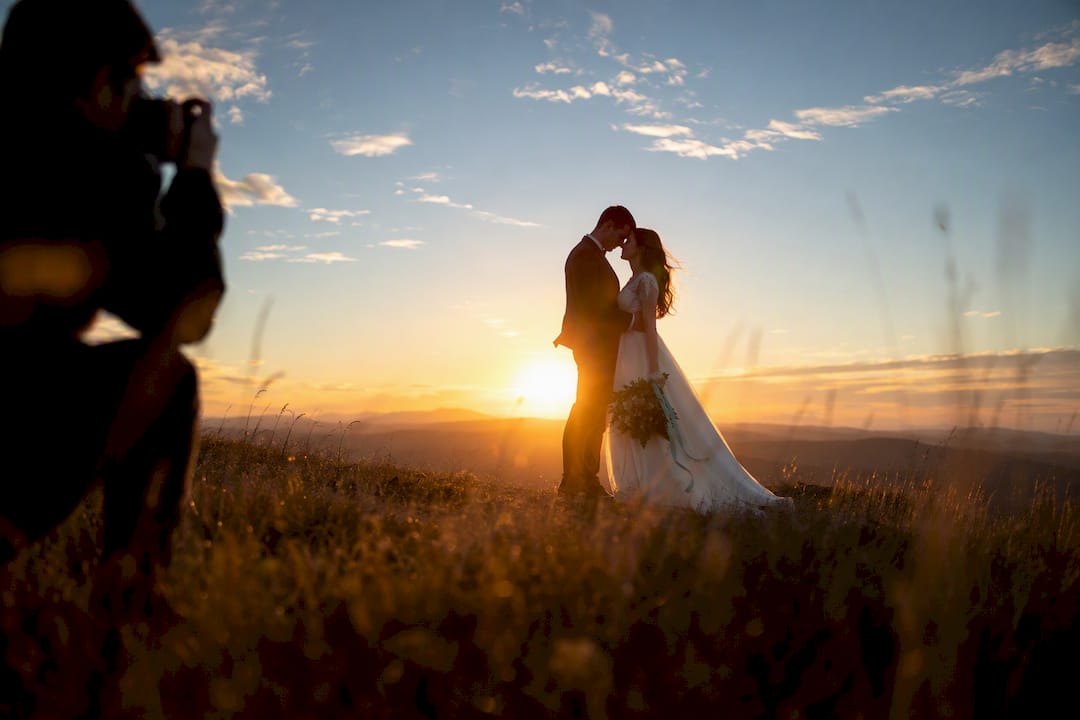
Yes, protect a sunset slot on your wedding day. Golden hour, the period just before the sun dips below the horizon, gives you the softest, most flattering light of the entire day. Your usable window is short, typically 15 to 20 minutes, so it needs a fixed spot on the timeline rather than a hopeful “we’ll fit it in.” Everything below covers how to plan it, what to wear, where to stand, and what to do if the sky does not cooperate.
TL;DR:
Securing a fixed 15 to 20 minute window for sunset photos is crucial, as light changes rapidly and can turn flat within minutes.
Planning and communicating the exact timing with your venue and photographer beforehand helps ensure the window is protected and not disrupted by other events.
Open locations with water, trees, or structures enhance the cinematic effect of sunset photos by reflecting or framing the sky’s colors.
Camera settings should be adjusted based on the desired mood, with longer lenses and wider apertures emphasizing the couple while maintaining color saturation.
Dressing in muted, warm tones and selecting textured fabrics will help outfits complement the golden hour light rather than clash with it.
Table of Contents
What makes golden hour and sunset light so good for photos?
Golden hour is the stretch of low sun before sunset (and after sunrise) when light travels through more of the atmosphere and loses its harshness. At midday, sunlight hits your face nearly straight down, digging shadows under eyes and noses. Low in the sky, it comes in almost sideways, wrapping around features instead of carving into them.
The warm colour is not a filter trick. Sunlight passing through more atmosphere at a low angle scatters its shorter blue wavelengths away, leaving the longer red and orange ones to dominate, which is why the sky (and everything it lights up) turns amber and pink, according to National Geographic.
Couples notice three things straight away:
Skin tones look calmer and more even, with none of the harsh midday shine
Contrast softens, so shadows stretch long and gentle rather than sharp and black
Backgrounds glow rather than glare, adding depth without a single edit
When should you actually schedule sunset portraits?
A short window is usually all you need for a strong set of sunset portraits, and most experienced photographers would rather you treat that window as fixed than “whenever we get a moment.” Sunset light shifts fast. What looks perfect at 7:42pm can turn flat and grey by 8:00pm, so the timeline has to work backwards from sunset, not forwards from the ceremony.
Here’s a simple way to build it in:
Check your local sunset time for the wedding date using a sun calculator, then subtract 20 minutes to find your call time for portraits.
Apply a buffer using the 30/5 rule, adding roughly 30 minutes for major parts of the day (like the ceremony or wedding breakfast) and 5 minutes per person for any group shots, so those don’t eat into golden hour.
Block the slot on paper, not just in conversation. Write “6:50 to 7:10pm: couple portraits (sunset, do not move)” into the schedule your planner, venue coordinator, and caterer all see.
Tell your photographer your rough evening plan (speeches, first dance, cake cutting) so they can flag clashes weeks before the day, not on it.
A short example: ceremony 2pm, wedding breakfast 4pm, speeches 6pm, sunset portraits 6:50 to 7:10pm, reception open 7:15pm. Tight, but it holds.
How do you protect the sunset window without derailing the day?
Your planner and venue coordinator will happily protect this slot, but only if you ask early and frame it the right way — this is important for coordinating with your photographer via professional Photography SEO Services that help keep your schedule clear. Rather than announcing a rigid demand, HuffPost’s advice is to frame it as protecting a moment that lifts everyone’s evening, not a scheduling obstacle. Something like “we’d love ten minutes to step out for photos as the sun goes down, it’ll only pull us away briefly” lands far better than a flat instruction.
Practically, this means:
Agree the exact time with your photographer the week of the wedding, once you have a firm sunset time
Ask your venue whether guests can be served drinks or canapés during your absence, so nobody notices the gap
Have your photographer walk the intended photo location in daylight beforehand, checking for the best angle and any obstructions
Bring one bridesmaid or usher as a runner, someone who can fetch you both quickly without a fuss
Keep a small touch-up kit (blotting papers, lip colour, a travel mirror) in a pocket or with your runner
Good photographers also work a “safe set” approach: they capture a handful of reliable, well-lit shots in the first few minutes, then push into more creative poses only if the light holds. That way, even a rushed five minutes still produces images you’ll want to print. For more on getting this coordination right before the day, see this guide to communicating with your photographer.
Where to shoot and how to compose the shot
Location does most of the heavy lifting in a sunset photo. Open horizons, still water, and tree lines all catch and reflect the colour of the sky, turning a plain field or car park into something cinematic. Buildings and archways work too, framing the couple against the glow rather than competing with it.
A few compositional approaches to discuss with your photographer:
Backlighting: standing you both between the camera and the sun creates a warm rim of light around your outlines, especially flattering on hair and shoulders
Silhouettes: shooting directly into the sun with the couple as dark shapes against a bright sky, dramatic and simple, works well for a kiss or an embrace
Managing lens flare: a little flare adds warmth and dreaminess, but too much washes out detail, so photographers often angle slightly off-axis or use a lens hood to control it
Distance from the sun: standing further from the horizon line and shooting at an angle, rather than dead-on, tends to deepen colour saturation and add more texture to the sky
Whether you shoot at sunrise or sunset changes the mood too. Sunset tends to run warmer and more dramatic, while sunrise is cooler, calmer, and usually less crowded if you’re at a public location, according to Offshore Clipping’s golden hour guide.
Camera settings and equipment that make golden hour work
You don’t need to operate the camera yourself, but knowing the basics helps you have a useful conversation with your photographer about what they’re aiming for. Most will meter for skin tone when the priority is a clean, flattering portrait, letting the sky slightly overexpose. When the goal is a rich, saturated sky or a silhouette, they’ll deliberately underexpose the scene, letting faces fall into shadow for a moodier result.
Lens choice matters more than people expect. A longer focal length (85mm and up) compresses the background, blurring it into soft colour and making the couple the clear subject. A wide aperture (f/1.8 to f/2.8) adds that separation and lets more light in as the sun drops, which matters once the light starts fading fast.
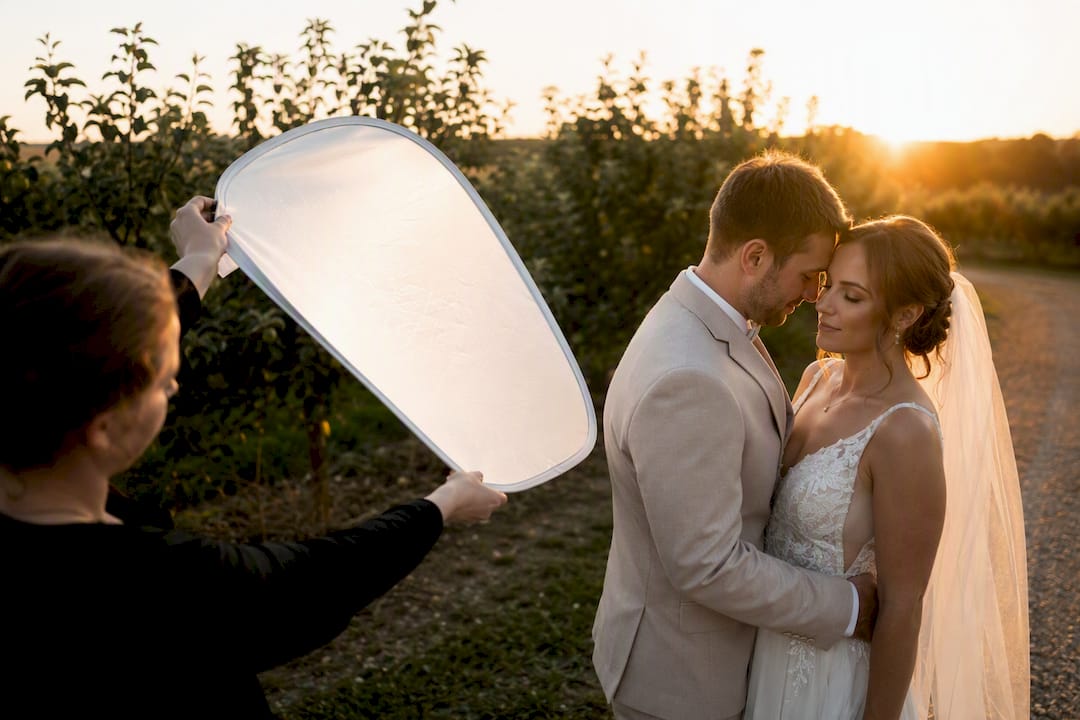
When faces need a lift without losing the sky’s colour, photographers often use a small reflector or a single gentle burst of fill flash, bouncing just enough light onto the face to balance it against a bright background.
Pro Tip: Ask your photographer whether they carry a spare battery and memory card specifically for the golden hour slot. Batteries drain faster in cooler evening air, and this is the one part of the day you cannot reshoot.
What to wear so your outfit works with the light, not against it
Warm light flatters warm, muted colours and clashes with anything too bright or busy. Tikesha Moorehead’s guide to golden hour styling recommends creams, navy, olive, and blush tones, all of which sit comfortably alongside an amber sky. Neon shades, stark white, and small busy patterns tend to fight the light or read as a distracting blur in photos.
Fabric matters as much as colour. Flowing skirts and lightweight layers catch the breeze and the light at the same time, giving photos movement. Textured wool or linen holds shape and depth better than a stiff, glossy satin, which can throw an odd shine under low sun.
If you want variety in the shots without burning precious minutes on outfit changes, swap accessories instead: a wrap or jacket over the shoulders, a change of bouquet, or simply letting hair down partway through the set.
Ten pose ideas that photograph beautifully at sunset
A little direction goes a long way when the light is fading and nerves are running high. These prompts work because they’re quick to set up and look natural rather than staged:
Walk hand in hand towards the camera, talking to each other, not posing
A slow forehead touch with eyes closed, letting the rim light catch both faces
A full silhouette embrace against the brightest part of the sky
The classic dip, timed just as the sun clips the horizon
Veil caught mid-air in a breeze, shot from slightly below
Standing at the water’s edge for a reflection shot, if your venue allows it
A quiet moment sitting together, looking out rather than at the camera
One partner spinning the other gently, capturing motion blur in the skirt
Foreheads together, laughing, prompted by a shared joke rather than “say cheese”
A single lingering kiss shot from a distance, keeping the whole scene in frame
Keep movement simple and avoid props that need setup time, umbrellas, sparklers, and confetti all eat into your window. If your venue has water, uneven ground, or steps near the shoot location, walk it in daylight first so nobody twists an ankle chasing the light.
How Dawn & Carl protect the golden hour on the day
Dawn & Carl approach sunset portraits the way most experienced wedding photographers do: plan for the light to move faster than the schedule allows. On the day, that means scouting the intended location earlier when possible, carrying a charged spare battery specifically for the evening slot, and knowing exactly which shots come first if time runs short.
Their working checklist looks something like this:
Confirm sunset time and portrait slot with the couple during final planning
Scout the shooting location in similar light where the venue allows it
Capture a safe set of core portraits within the first few minutes
Expand into creative poses only once the essentials are secured
Keep a buffer built into the schedule so a late speech or delayed car doesn’t cost the light
You can see how this fits into a full day’s coverage on the Staffordshire wedding photography page, which covers packages and local availability in more detail.
What if the weather or timeline doesn’t cooperate?
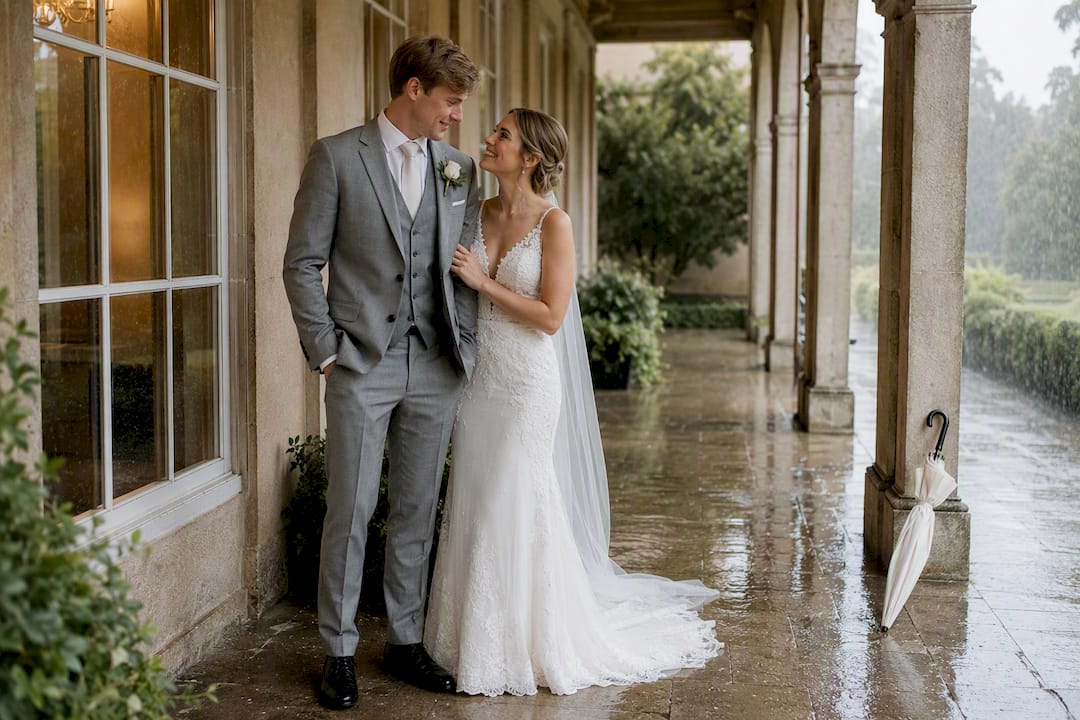
British weather rarely reads the wedding schedule, so it’s worth agreeing a backup plan with your photographer well before the day, not during it. Overcast skies are actually more forgiving than you’d think. Cloud cover diffuses light beautifully, and you’ll still get soft, flattering portraits, just without the dramatic orange sky. Heavy rain or wind is the real problem, and that’s where a covered spot near your venue, a porch, a walkway, an orangery, earns its place as Plan B.
If the ceremony or wedding breakfast runs late and eats into your sunset slot, don’t scrap the portraits, shorten them. A rushed five minutes using the safe set approach still beats skipping the moment entirely. Agree in advance with your photographer which shots matter most so nobody has to make that decision on the spot.
Timing disruptions are usually more common than weather ones. Speeches overrun, cars arrive late, and guests linger over canapés. Building a buffer into your timeline using the 30/5 rule absorbs most of this without anyone noticing. If the sun sets before you can step out, ask your photographer about a “blue hour” alternative, the 20 to 30 minutes after sunset when the sky turns a deep, rich blue. It’s a different mood, but it photographs just as well, and it’s a solid fallback worth discussing at your planning meeting rather than discovering by accident.
Why the conventional advice on sunset photos undersells the planning part
Most wedding advice treats sunset portraits as a romantic bonus rather than a planning task, and that’s backwards. The light itself is genuinely special, warmer, softer, more forgiving, but the couples who get the best results are the ones who treated the 15 to 20 minute window as fixed rather than aspirational. Conventional wisdom leans hard on inspiration boards and pose ideas while glossing over the fact that most missed sunset shots come down to a schedule that ran long, not a lack of good ideas.
If we had to pick one priority for couples to fix first, it’s writing the exact time into the day’s schedule and telling the planner and caterer why it matters, using language that frames it as protecting a moment rather than making a demand. The rest, wardrobe, poses, camera settings, matters, but it only gets used if the window survives contact with a real wedding day. Treat the timing as the foundation, and the romantic part takes care of itself once you’re standing in the light.
— Dawn & Carl
Book your golden-hour session with Dawn & Carl
The sunset slot should be planned into your timeline from the first conversation, not as an afterthought squeezed in after speeches run over. Dawn & Carl scout locations, agree the exact call time with your venue, and run a safe set approach so you get strong portraits even if the evening runs behind.
[
Booking starts with a short planning call where we talk through your ceremony time, venue, and rough sunset window for your date, then build the portrait slot into your day alongside speeches, formals, and the reception. Couples across Staffordshire can see packages and availability on the Staffordshire wedding photography page, while those closer to the Peak District or the Derbyshire Dales can check the Derbyshire wedding photographer page. Worcestershire couples have a dedicated page too, on the Worcestershire wedding photography service. Get in touch to check your date and start planning your golden hour.
Sources
FAQ
What is the 30-minute rule for weddings?
It’s part of the wider 30/5 rule: add roughly 30 minutes of buffer to major parts of the day, like the ceremony or wedding breakfast, so nothing runs so tight that it eats into portrait time.
What colours are best to wear for sunset photos?
Muted warm tones such as cream, navy, olive, and blush photograph best against golden-hour light, while neon shades and busy small patterns tend to clash with the warm colour palette.
Is 3 hours before sunset good for photos?
Three hours before sunset still gives strong, even daylight, but it’s not golden hour. Save your dedicated 15 to 20 minute portrait slot for the true golden hour window closer to sunset itself.
How long do sunset wedding photos actually take?
Most photographers only need 15 to 20 minutes to capture a full set of sunset portraits, provided the timing is agreed in advance and the couple steps away from the reception promptly.
What happens if it’s cloudy on the wedding day?
Overcast skies diffuse light and still produce soft, flattering portraits, just without the dramatic orange colour. Agree a backup plan with your photographer, including a covered spot, in case rain or wind rules out the outdoor session entirely.
Recommended

Comments