
How long should a wedding film be?
Aim for a 30 to 60 second teaser plus a five to eight minute highlight film. That single reel does most of the work: it gets watched in full and gets shared, which a full ceremony edit rarely does. Add a ceremony edit or a longer documentary version only if you want a complete archive of the day, not just the story of it.
Analysis finds that highlight reels running within a moderate minute range are common, and another overlapping range shows peak satisfaction, completion, and shareability, according to OurStoria’s data analysis. Beyond that window, casual viewers start dropping off.
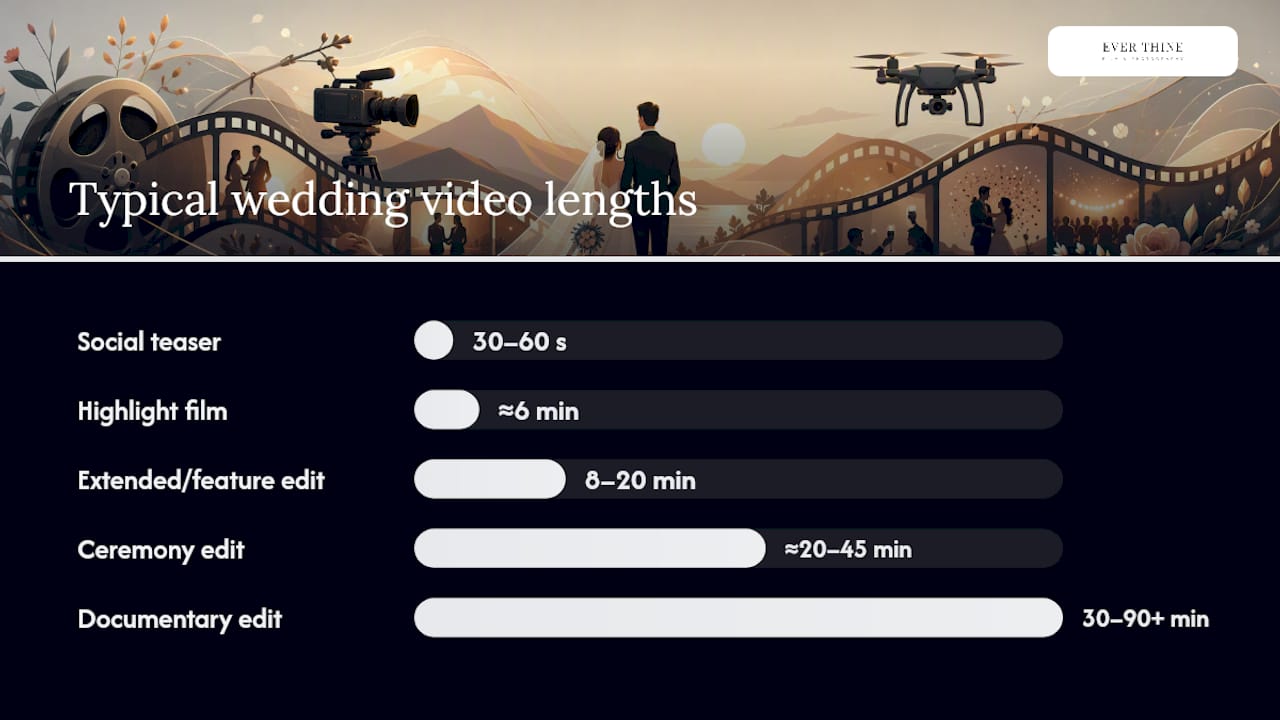
Teaser: 30–60 seconds, for social media and quick sharing
Highlight film: a few minutes over five, the version most people actually finish watching
Extended/feature edit: a longer extended range, for couples who want more speeches and detail
Ceremony edit: approximately twenty to forty-five minutes, near-complete ceremony footage
Documentary edit: 30–90+ minutes, the full-day archive
Data point: Family and friends’ completion rates drop sharply after a few minutes of viewing, according to OurStoria’s viewing-completion research — which is exactly why the highlight film, not the ceremony edit, is the version you send to the group chat.
Key Takeaways
A five to eight minute highlight film, paired with a short teaser and an optional ceremony edit, delivers the best balance of completion, shareability, and archival value for most weddings.
Point | Details |
Highlight sweet spot | Aim for a 5–8 minute highlight film, the range shown to maximise satisfaction and shareability. |
Match deliverable to audience | Use teasers for social sharing and ceremony edits for family who want full vows preserved. |
Bundle deliverables sensibly | Teaser plus highlight plus ceremony edit covers sharing, rewatching, and archival needs together. |
Agree scope before filming | Get a written highlight concept, maximum runtime, and revision limit agreed with your videographer in advance. |
Weddingfilmphotography’s approach | Builds packages around a defined highlight concept and a 5–8 minute core film, with ceremony edits added where full vows matter. |
Table of Contents
What is the ideal wedding video length for each deliverable?
“Wedding film length” isn’t one number. It’s a set of decisions across several distinct deliverables, each built for a different audience and a different moment of rewatching. Confusing a highlight film with a documentary edit is the most common source of disappointment couples report to their videographer, because the two serve opposite purposes.
A teaser or same-day edit is a fast, punchy cut released within hours or days, built almost entirely from ceremony and reception highlights with no dialogue. It exists purely for social sharing, which is why practitioner guidance consistently pegs it at 30 to 90 seconds, according to JustMarriedFilms.
A highlight film is the main event: a music-led cut of the day’s best moments, usually including snippets of vows or speeches but rarely the full versions. This is the deliverable most couples watch repeatedly and the one they send to relatives abroad who couldn’t attend.

An extended or feature edit stretches to 8 to 20 minutes by including more of each speech, more reception detail, and a slower pace. A ceremony edit is closer to a document than a film. It’s audio-led rather than music-led, built to preserve full vows and readings rather than compress them, and Zola’s editorial guidance notes it can run considerably longer than any highlight version, per Zola’s guide to wedding video length. A full documentary edit covers the entire day from getting-ready shots to the last dance, often 30 minutes or beyond.
Deliverable | Typical length | Primary purpose |
Social teaser | 30–60 seconds | Quick sharing, social platforms |
Highlight film | a few minutes over five | Main rewatchable story, wide sharing |
Extended/feature edit | a longer extended range | Fuller story with more speeches |
Ceremony edit | approximately twenty to forty-five minutes | Preserving vows and readings intact |
Documentary edit | 30–90+ minutes | Full-day archive |
The same footage can feel shorter or longer depending on how it’s cut. A music-led highlight with tight pacing feels quicker than its runtime suggests, while an audio-led ceremony edit feels appropriately slower because that’s the point. Read more on how wedding highlight films are structured to hold attention despite their brevity.
What does a typical wedding video package include?
Most studios bundle deliverables into tiers, and understanding the shape of those tiers helps you ask for the right combination rather than the most expensive one. An essential package usually covers a teaser and a highlight film. A standard package adds a ceremony edit, so you get both the shareable story and the full record of your vows. A premium package layers in a documentary edit, extended speeches, and sometimes drone or same-day footage.
For most couples, teaser plus highlight plus ceremony edit is the practical sweet spot. It covers the three things people actually do with a wedding film: share it, rewatch it, and preserve the vows word for word. Everything beyond that is archival nice-to-have rather than a genuine gap.
A few things to confirm before signing anything:
Ask whether the highlight comes as both a landscape and a vertical crop, since Instagram Reels and TikTok need the vertical version.
Confirm the file formats and resolution for each deliverable, including a low-resolution version optimised for quick downloads and messaging.
Check whether a same-day edit is available if you want something to show at the reception itself.
Pro Tip: Ask for a low-resolution, quick-download version of your highlight film alongside the full-quality file. Grandparents and group chats don’t need a 4K master, they need something that opens in three seconds on a phone with patchy signal.
How do you decide the right wedding film length?
Start with who’s actually going to watch it, and how often. A highlight film gets replayed at anniversaries and sent to friends overseas, so it needs to earn repeat viewing. A ceremony edit gets watched once or twice, usually by immediate family who want every word of the vows, not a condensed version.
Work through these before your first proper meeting with a videographer:
Audience first. Decide who this film is really for: wide sharing, close family archive, or both.
Purpose over length. Social sharing wants brevity; archival needs wants completeness. Pick the priority, then let length follow.
Coverage hours. A four-hour coverage window produces less usable footage than a full-day booking, which caps how long any edit can credibly run without padding.
Budget reality. Longer edits mean more editing hours, which means higher cost. Decide what you’re actually paying for before adding an extra deliverable.
Bring two sets of questions to that meeting. First, on the deliverables themselves: what exactly counts as “highlight” content, does the ceremony edit include full vows and readings, and how many revision rounds are included? Second, on logistics: what’s the delivery timeline for each version, who owns the raw footage, and what format will the final files arrive in?
Watch for a few warning signs. A quote that says “highlight film” with no runtime attached is vague by design. A ceremony package that doesn’t mention audio synchronisation is a red flag, since ceremony audio is notoriously difficult to capture cleanly. And if nobody can tell you a delivery schedule, you don’t have a real timeline, you have a hope. Our planning checklist walks through these questions in more depth before you sit down with anyone.
Why do longer wedding films cost more?
Every extra minute of finished film represents hours of editing, not just filming. A five to eight minute highlight might take several days of selection, colour grading, and audio mixing. A 45 minute ceremony edit adds full audio synchronisation across multiple cameras, which is a slower, more technical process than cutting music-led highlights.
Music licensing adds another layer. A highlight film built around two or three licensed tracks with tempo changes can feel shorter than its actual runtime, because pacing and scoring choices alter perceived length by roughly 10 to 30%. That’s a genuinely useful lever if you want a fuller-feeling highlight without asking for extra minutes, and extra cost.
Delivery timelines scale with runtime too. A teaser typically lands within days. A highlight film usually takes a few weeks. Full documentary or extended edits can run four to twelve weeks or longer, depending on studio demand and how many revision rounds are built into your contract, per EternaEdits’ pricing guidance.
If cost is a genuine constraint, a few adjustments help without gutting the final film:
Ask your videographer to prioritise key moments (first look, vows, first dance) rather than covering every hour evenly.
Limit filming to the hours that matter most instead of booking full-day coverage you won’t use in the edit.
Accept a capped number of revision rounds, which keeps editing time (and price) predictable.
Ask whether bundling a teaser, highlight, and ceremony edit together earns a discount versus ordering them separately.
How Weddingfilmphotography approaches wedding film length
Most couples who come to Weddingfilmphotography end up booking a teaser plus a five to eight minute highlight as the core deliverable, with a ceremony edit added when they want vows preserved word for word. That structure isn’t arbitrary. It reflects the same pattern the wider data shows: a tight highlight gets watched by everyone, a ceremony edit gets watched carefully by the people who were actually standing at the altar.
Highlight films are treated as the primary deliverable, not an afterthought to a longer documentary.
A written highlight concept agreed in advance defines what counts as highlight content and sets a maximum runtime, so scope stays controlled.
Revision rounds are agreed upfront rather than left open-ended.
One recent couple booked a highlight film alongside a ceremony edit specifically so grandparents unable to travel could watch the full vows separately from the shareable version sent to wider friends and family.
A defined highlight concept, agreed in writing before filming begins, is what stops a five-minute brief turning into a fifteen-minute negotiation later.
Does wedding style affect how long the film should be?
Wedding traditions shape runtime more than most couples expect going in. A South Asian wedding spanning several days of separate ceremonies (mehndi, sangeet, the wedding itself) often needs either multiple shorter highlight films per event or one longer compilation edit, simply because there’s more distinct content to represent fairly. Compressing three days into five minutes usually means cutting entire ceremonies, which rarely sits well with families.
Traditional Western church weddings with a single reception tend to fit comfortably into the standard teaser and highlight structure, since the day follows one narrative arc from ceremony to first dance. Jewish weddings with a longer ceremony structure, or Orthodox Christian ceremonies with extended liturgical elements, often push couples toward a ceremony edit rather than relying on the highlight alone, because so much of the meaning sits inside ritual moments that a music-led cut would otherwise compress into seconds.
Destination weddings introduce a different variable: multi-day itineraries (welcome dinner, ceremony, day-after shoot) sometimes justify a longer documentary-style edit purely because there’s more footage worth preserving, not because the ceremony itself runs longer.
None of this changes the core recommendation. It changes which optional deliverable earns its place alongside it. A couple with a single-day, single-ceremony wedding rarely needs more than teaser, highlight, and perhaps a ceremony edit. A couple with a multi-event celebration should budget for either a longer highlight or a second edit covering the additional day, and should say so at the very first planning conversation rather than assuming it’s included.
Has wedding film length changed in recent years?
Wedding films have got shorter on average, and the reason is almost entirely social media. A decade ago, a 15 to 20 minute highlight film wasn’t unusual. Now, the five to eight minute range dominates because that’s the length that survives being shared, watched in full, and rewatched without anyone reaching for the skip button.
Platform behaviour drove much of this shift. Instagram Reels, TikTok, and Stories reward short-form content, and couples increasingly want a version of their wedding film that works on those platforms without heavy re-editing. That pushed studios towards delivering a teaser as standard, not as an upsell, and towards trimming highlight films that once ran closer to fifteen minutes.
Attention spans generally have shifted too, and viewing habits have followed. Community discussion among working videographers, including threads like the one on r/weddingvideography, consistently converges on four to seven minutes as the practical norm for highlight films, echoing the same range the broader data shows.
The counter-trend worth knowing about: documentary-style and “raw” full-length edits have grown in parallel, not shrunk. Couples increasingly want both a short, polished highlight for sharing and a separate, longer archival version for themselves, rather than treating one film as a compromise between the two jobs. That’s less about changing taste in runtime and more about couples realising a single film can’t do both roles well, which is exactly why the bundled package model has become standard rather than optional.
How do you keep a longer wedding film engaging?
Length and engagement aren’t the same problem, and treating them as one is where most home-edited or budget wedding films go wrong. A seven-minute highlight with flat pacing feels longer than a ten-minute one that’s been cut with intent. The lever that matters most isn’t runtime, it’s rhythm.
Music choice does more work here than almost anything else. Switching tracks or shifting tempo partway through a highlight film resets viewer attention, which is why scoring and pacing choices measurably affect perceived length. A single slow ballad stretched across eight minutes will feel twice as long as the same footage cut against two tracks with a tempo lift halfway through.

Sequencing matters as much as music. Front-loading the strongest visual moments (first look, ceremony entrance, first dance) rather than saving them for the end keeps viewers watching through to the finish, because they’ve already been rewarded early. Saving every highlight for a slow build risks losing casual viewers before they get there.
For longer formats like ceremony or documentary edits, structure does the job music does for highlights. Chaptering a documentary edit into clearly separated sections (getting ready, ceremony, reception) lets viewers watch in stages rather than committing to ninety uninterrupted minutes in one sitting.
Couples often ask for more length because they’re worried about leaving something out, not because longer genuinely serves the film better. A tightly cut five to eight minute highlight, built around real editorial choices rather than including everything, usually preserves the emotional weight of the day while staying watchable in full, which is the entire point of making one in the first place.
What Ever thinks couples get wrong about film length
The advice couples hear most often, “ask for as long a highlight as possible so nothing gets left out,” gets the priority backwards. Length doesn’t protect memories. Editing does. A ten-minute highlight stuffed with everything you’re afraid to lose usually gets watched once, by you, out of guilt rather than genuine want to rewatch it.
What the data actually supports is narrower and more useful: a five to eight minute highlight, built with a defined concept agreed in advance, will get shared further and watched more completely than a longer, less disciplined cut. If you want everything preserved, that’s what the ceremony edit and documentary version are for. Don’t ask one film to do both jobs.
The thing couples should prioritise first isn’t runtime at all. It’s the written brief. Agree what “highlight” actually means with your videographer before the day, not after the first draft lands and doesn’t match what you pictured. That single conversation prevents most of the disappointment couples report months later, far more reliably than adding two extra minutes ever will.
Book a videographer who builds your film length around you
There are other ways to approach this: cutting your own highlight from raw footage, asking a friend with a camera to cover the day, or booking a videographer with no fixed process and hoping the brief gets interpreted correctly. Each leaves the actual runtime, and the editing quality behind it, down to guesswork until the final file arrives.
[
Weddingfilmphotography works differently because the deliverable structure gets agreed before a single frame is filmed. Every package built around documentary-style coverage includes a clearly defined highlight concept, so you know the runtime, the content, and the revision terms in writing, not as an assumption. That structure comes from experience across weddings throughout Staffordshire, the West Midlands, and beyond, covering everything from single-ceremony weddings to multi-day celebrations that need a different length strategy entirely.
If you’re planning a wedding in Derbyshire, Weddingfilmphotography’s Derbyshire wedding photography and videography packages set out exactly what’s included at each tier. For couples closer to Staffordshire, the Staffordshire wedding photographer page covers availability and package details directly. Check your date and ask for the highlight concept in writing before you book anyone.
Sources
FAQ
What is the 30 minute rule for weddings?
It typically refers to keeping speeches, key ceremony segments, or planning buffers within roughly 30 minutes so the day stays on schedule, as explained in guidance about coordinating bridal attire and timing from Woman in a wedding dress on white background – DARIUS COUTURE, not a rule about final film length itself. Videographers use it informally when advising couples on pacing the day, which then shapes how much usable footage ends up in the edit.
How long should you wait for a wedding video?
A teaser or same-day edit often arrives within days, a full highlight film typically takes a few weeks, and documentary or extended edits can take four to twelve weeks or longer depending on studio demand, according to EternaEdits. Ask for a specific delivery date in writing rather than a vague estimate.
How much does a 2 minute video cost?
Cost depends heavily on coverage hours, editing time, and music licensing rather than runtime alone, since a two-minute teaser cut from a full day’s footage still requires substantial editing work. A defined highlight concept agreed in advance, as Weddingfilmphotography recommends, helps keep that cost predictable rather than open-ended.
How many photos should I expect from a 2 hour wedding?
This varies by photographer and shooting style, and isn’t tied to film length at all, so it’s worth asking your photographer directly what their typical delivery count looks like for similar coverage windows.
Why do highlight films get watched more than full ceremony edits?
Highlight films are built for repeat viewing and wide sharing, while ceremony edits are longer, audio-led records watched once or twice by close family. Data from OurStoria’s analysis shows completion rates drop sharply once a film runs past 7 to 12 minutes, which is exactly why the shorter highlight does the sharing work.
Recommended


Comments