
What is a micro wedding? Your guide to intimate UK celebrations

TL;DR:
A micro wedding offers an intimate, meaningful celebration with a curated guest list of 10 to 30 people, including a full ceremony and reception. It balances the structure of traditional weddings with the closeness and flexibility of elopements, allowing for personalized details and creative venue choices. Planning begins with defining the guest count, selecting a suitable venue, and prioritizing deliberate, meaningful elements for an emotional, memorable day.
Forget the idea that choosing a smaller wedding means settling for less. A micro wedding can be one of the most meaningful, beautiful, and emotionally charged celebrations imaginable, yet so many couples dismiss the format because they assume it signals compromise. Micro weddings are intimate weddings with a deliberately smaller guest list, typically under 50 people, but the experience they create is anything but small. This guide will walk you through everything: what a micro wedding actually is, how it differs from elopements and traditional weddings, why couples across the UK are embracing this format, and precisely how to plan one that feels full, joyful, and completely yours.
Table of Contents
Key Takeaways
Point | Details |
Micro weddings defined | A micro wedding typically means 10–30 guests, a full ceremony, and reception. |
Not just ‘small’ | Micro weddings are intentional, personal celebrations—not merely scaled-down events. |
Benefits for couples | Couples enjoy intimacy, budget flexibility, and more creative options with micro weddings. |
Planning priorities | Start with your guest list, pick a fitting venue, and retain meaningful traditions. |
What is a micro wedding? The clear definition
The term “micro wedding” gets used loosely, so let’s be precise. A micro wedding is a properly structured wedding celebration, complete with a ceremony, a reception, a sit-down meal, and all the meaningful rituals you associate with a wedding day. The defining characteristic is simply the guest count. Most UK planning guides put the sweet spot at 10 to 30 guests, though some extend this to 50.
What separates a micro wedding from other formats is that it sits between elopements and small weddings: elopements involve just the couple, sometimes with two to ten witnesses, whilst micro weddings have a curated, intentional guest list. You’re not sneaking off to sign paperwork. You’re hosting a real wedding, just for the people who matter most.
Micro weddings keep the full wedding day structure, meaning ceremony followed by reception and meal, with traditional elements scaled thoughtfully rather than removed entirely. Think a beautifully set table for twenty rather than a banqueting hall for two hundred.
Here is a quick breakdown of what typically defines each guest count range in the UK:
Format | Typical guest count | Ceremony type | Reception included? |
Elopement | 2 to 10 | Minimal or registry | Rarely |
Micro wedding | 10 to 30 | Full ceremony | Yes |
Small wedding | 30 to 80 | Full ceremony | Yes |
Traditional wedding | 80 to 200+ | Full ceremony | Yes |
Key characteristics that define a genuine micro wedding:
A deliberately curated guest list, not a reduced one
A full wedding ceremony with legal vows
A sit-down reception and meal for guests
A venue chosen to feel comfortably full, not cavernous
Every element scaled with intention, not simply removed
Guest numbers matter more than most couples realise. The guest count is not just a logistical detail. It shapes your venue options, your catering budget, your atmosphere, and even how your photographs and films will feel on the day.
Micro weddings vs elopements vs small weddings: A quick comparison
Many couples arrive at this decision feeling muddled, unsure whether they want to elope, go micro, or simply book a smaller version of a traditional wedding. These are genuinely different experiences, and knowing the distinction helps you make a choice that aligns with your vision rather than default expectations.
Elopements are couple-centred. They prioritise the two of you above all else, often with just a handful of witnesses present, and rarely involve a structured reception. They can be wildly romantic and spontaneous, but they are not designed for shared celebration with family and friends.
A small wedding, on the other hand, can start to feel logistically similar to a traditional one once your guest count climbs. If guest management starts to feel complex, with dozens of RSVPs to chase, seating plans to agonise over, and venue capacity constraints to navigate, your wedding may no longer feel like a true micro wedding, even if you intended it to be one. This is a useful reality check.
The micro wedding sits in the middle, offering the intimacy and freedom of an elopement alongside the celebratory structure and shared joy of a traditional wedding. You get to look around the room and recognise every face. You get to have an actual conversation with every guest at your reception. That is remarkably rare at a traditional wedding.
“A micro wedding gives you the chance to be completely present on your wedding day. You are not managing crowds or worrying whether Aunt Janet found her seat. You are simply celebrating.”
Here is a side-by-side comparison to make the choice clearer:
Factor | Elopement | Micro wedding | Small wedding |
Guest count | 2 to 10 | 10 to 30 | 30 to 80 |
Full ceremony | Sometimes | Always | Always |
Reception and meal | Rarely | Always | Always |
Venue flexibility | Very high | High | Moderate |
Planning complexity | Low | Low to moderate | Moderate to high |
Atmosphere | Intimate, spontaneous | Warm, curated | Celebratory, social |
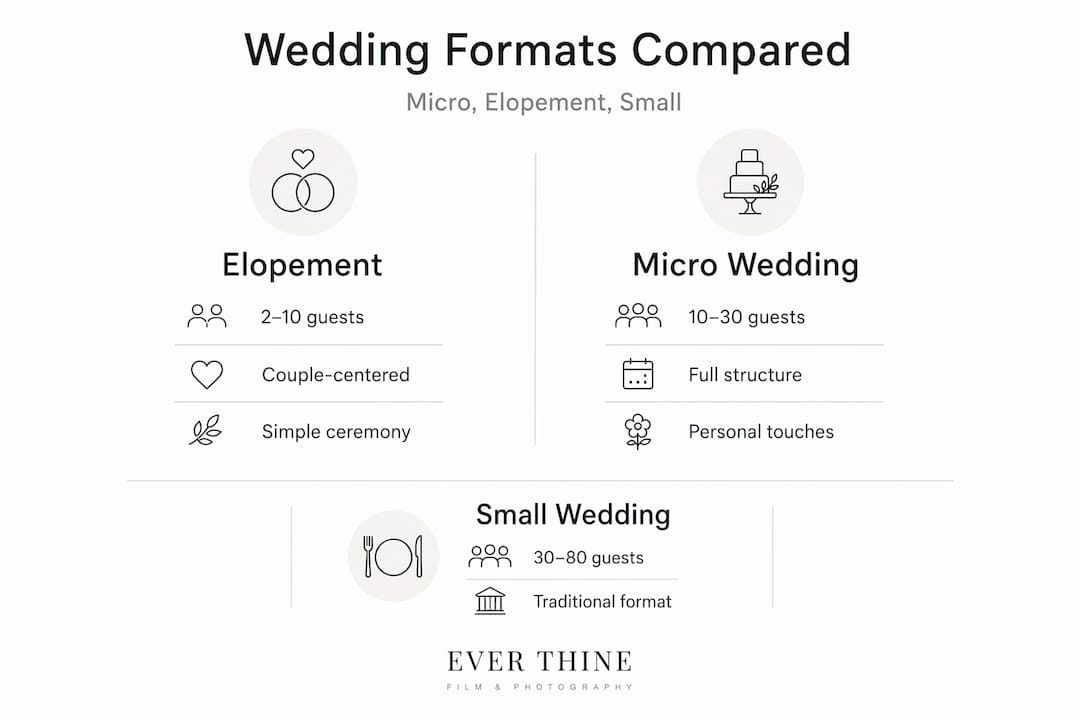
Choosing the perfect venue becomes significantly more creative when your guest count is under 30. Private gardens, converted barns, lighthouse cottages, boutique hotel dining rooms, and even private home settings all become viable. You are no longer restricted to venues with minimum spend requirements or capacity rules designed for large gatherings. Managing guest numbers also becomes far simpler, reducing logistical stress and allowing you to focus on the experience itself.
Why couples choose a micro wedding: Benefits and motivations
There is a growing movement of UK couples actively choosing micro weddings, not because of budget constraints, but because of what this format genuinely offers. Here are the most compelling motivations, each of which deserves its own moment of consideration.

1. Meaningful time with every guest At a traditional wedding, it is almost impossible to have a proper conversation with every guest. At a micro wedding with 20 people, you will. That changes the emotional texture of the day entirely. You are not performing for a crowd. You are celebrating with your closest people.
2. Significantly lower overall cost Micro weddings cost less in absolute terms. Catering for 20 people is dramatically cheaper than catering for 120. Venue hire for an intimate space is more accessible. Flowers, favours, and décor all reduce in quantity. This does not mean the quality drops. In fact, many couples redirect savings into higher-quality food, more considered décor, or exceptional photography and film.
3. Greater creative freedom Unusual venues, unconventional timings, and personalised details are all far more achievable with fewer guests. A weekday micro wedding in a walled garden with a bespoke menu is entirely realistic. The same vision for 150 guests would require a much larger budget and far more complex logistics.
4. Lower stress across the entire planning processLocking your guest-count ceiling early anchors every planning decision that follows, including venue fit, seating, catering, and the overall atmosphere. When that number is 20 rather than 120, the planning process becomes proportionally simpler.
5. Environmental and ethical considerations Fewer guests means lower food waste, smaller venue footprint, less travel for guests, and reduced overall resource consumption. For couples who care about sustainability, a micro wedding is a genuinely lower-impact choice.
6. Unique venue access Small numbers open doors to venues that simply cannot accommodate larger weddings. Heritage properties, woodland clearings, private chapels, and boutique restaurants all become possibilities when you need space for 25 rather than 150.
Pro Tip: Set your guest cap before you start any other planning. Write down your absolute must-have guests first, then work outward. If you hit 30 before you have finished, you have your list. If you struggle to reach 15, consider whether an elopement might actually suit you better.
The videography options for micro weddings also open up in a way that is genuinely exciting. A skilled videographer working with a smaller guest count can capture every glance, every quiet laugh, every whispered word between you. There is nowhere to hide at a micro wedding, which means the emotional footage is extraordinary.
How to plan a micro wedding in the UK: Key steps and tips
Planning a micro wedding follows a clear sequence. The good news is that each step is simpler, faster, and more enjoyable than the equivalent stage in a traditional wedding plan.
Step 1: Decide your guest count ceiling Everything flows from this number. Aim for 10 to 30 guests for genuine micro wedding character. Think of this as a deliberate guest-list decision, followed by choosing a venue that fits comfortably, and keeping a full but scaled wedding-day flow rather than treating it as a quick registry ceremony. Write your list with that ceiling in mind and resist the temptation to keep adding names.
Step 2: Choose a venue that feels full This is crucial. A venue built for 100 people will feel empty and slightly melancholy with 20 guests. Choose a space that your group will fill warmly. Private dining rooms, boutique hotel suites, walled gardens, and intimate country cottages are all worth considering. Visit venues in person and stand in the space with your guest count in mind.
Step 3: Retain the full wedding-day structure Do not let the small scale tempt you into cutting the ceremony short or skipping the reception. The ceremony, the meal, the speeches, the first dance. These are the moments that make a wedding feel like a wedding, and they are all the more powerful when shared with a small, emotionally invested group.
Step 4: Personalise every single detail With fewer guests and a more contained budget, you can afford to go deeper on personalisation. Handwritten menus. A bespoke cocktail named after your first date. A playlist you curated together. A wedding cake designed around your genuine tastes rather than tradition.
Step 5: Book your photographer and videographer early Talented wedding photographers and videographers book up quickly, particularly those who specialise in intimate celebrations. Your wedding film package and photography options deserve as much consideration as the venue. With a micro wedding, the images and film become even more central to how you remember the day.
Pro Tip: At a micro wedding, your photographer can work more quietly and intimately than at a large event. Brief them thoroughly on the key relationships and moments you want captured. With fewer distractions, they can truly focus on the emotional story of your day.
Why the best micro weddings aren’t just ‘smaller’, they’re more intentional
Here is something most planning guides will not tell you: the couples who have the most extraordinary micro weddings are not the ones who simply scaled down their original wedding vision. They are the ones who started with a blank page and asked themselves, “If we could design the perfect day for the two of us, with no expectations attached, what would it actually look like?”
That is a fundamentally different starting point. And it produces fundamentally different results.
There is a tendency, even among couples who have chosen a micro format, to treat the smaller guest count as a constraint rather than a creative freedom. They mourn the people they could not invite rather than celebrating the depth of connection they are about to experience with those they have chosen. That mindset shift is everything.
The most memorable micro weddings we encounter share one quality. Every single element was a considered choice, not a default. The venue was chosen because it genuinely reflects who the couple are. The food was selected because they love it. The music, the flowers, the vows. All of it carries meaning because there was space to think.
At a traditional wedding, the scale forces a certain genericness. You cannot write 150 personalised place settings. You cannot have a genuine conversation with everyone. You cannot have the ceremony feel like a private, sacred moment when there is a crowd of 200 watching.
With 20 guests, every choice is visible. Every detail is noticed. Your guests will remember the day with remarkable clarity because they were fully present in it, not managing travel and seating and timing logistics.
We would also gently challenge the idea that a micro wedding is somehow less ambitious than a large one. In our experience, the opposite is true. Designing something small and perfect is harder than designing something large and adequate. It requires more courage, more clarity, and more honesty about what actually matters to you both.
The cinematic videographers who work best with micro weddings understand this instinctively. They are not trying to fill a frame with spectacle. They are finding the small, quiet, true moments that carry the weight of the day. And at a micro wedding, those moments are everywhere.
Capture your micro wedding beautifully: Our expert photography and film
Your micro wedding deserves photography and film that match its intentionality. Every glance, whispered word, and quiet laugh is a story worth keeping.
[
At Wedding Film Photography, we specialise in documentary-style coverage for intimate celebrations, working quietly and naturally so your day unfolds without interruption. Our packages are designed with micro weddings in mind, giving your day the full, attentive coverage it deserves. Whether you are planning an intimate celebration in the Midlands or beyond, our Derbyshire micro wedding photographer, Staffordshire micro wedding photographer, and Worcestershire micro wedding photographer services are ready to capture every meaningful moment. Get in touch to explore how we can tell your story.
Frequently asked questions
How many guests for a micro wedding in the UK?
Most UK planners define a micro wedding as 10 to 30 guests, though some guides extend this to 50. The key is that the guest count feels curated and intimate rather than simply reduced.
What is the difference between a micro wedding and an elopement?
Elopements involve just the couple, sometimes with two to ten witnesses, whilst micro weddings include a planned guest list, a full ceremony, and a proper reception for 10 to 30 people. Elopements are couple-centred; micro weddings are shared celebrations.
Can you have a traditional wedding ceremony at a micro wedding?
Absolutely. Micro weddings keep the full wedding-day structure, including the ceremony, vows, meal, and reception, simply on a more intimate scale. Nothing meaningful has to be removed.
What is the biggest planning difference for micro weddings?
Your guest cap is the single most important early decision. Locking a guest-count ceiling early drives your venue choice, seating layout, catering, and the overall atmosphere of the day. Set it first and let everything else follow.
Recommended


Comments