
Why document family moments: the complete guide
- 3 hours ago
- 8 min read
TL;DR:
Documenting family moments combines photographs, stories, voices, and emotions to preserve lasting family memories. This practice strengthens intergenerational bonds, builds identity, and supports emotional resilience by providing context and meaning beyond visual images. Starting with short, question-led recordings and organizing archives ensures future generations can access and understand their family history more deeply.
Documenting family moments is the practice of preserving not only photographs but also the stories, voices, and emotions that give those images their lasting meaning. Most families own thousands of photos yet struggle to recall the feelings, conversations, or context behind them. That gap between image and experience is precisely why document family moments matters as a deliberate, ongoing practice rather than a casual habit. Research on family storytelling and identity shows that narratives of hardship and hope build children’s psychological adjustment and sense of belonging in ways that photographs alone cannot achieve. The standard term for this combined approach is family memory preservation, and it draws on photography, oral history, and narrative documentation together.
Why document family moments for emotional resilience and identity
Family memory preservation is psychological infrastructure, not a hobby. Family stories build identity and a sense of belonging by giving children continuity across time, particularly through narratives that include both struggle and triumph. When children understand where their family came from and what it has overcome, they develop a stronger internal framework for handling their own challenges. This is not abstract theory. Research on immigrant families demonstrates measurable links between shared family narratives and positive psychological adjustment in children.
Stories function as connective tissue between generations. A photograph of a grandmother at her kitchen table is a visual record. The story of why she came to Britain, what she sacrificed, and what she hoped for her grandchildren is the meaning behind that image. Without the story, the photograph is a face without a voice.
“Family stories are not just entertainment. They are the architecture of identity, giving children a sense of where they come from and the confidence to face where they are going.”
The benefits extend beyond children. Adults who regularly revisit and share family memories report stronger feelings of cohesion and cultural belonging. Re-accessing shared memories during family gatherings triggers detailed childhood recollections, supporting deeper memory retrieval for everyone present. This means that the act of documentation itself, not just the archive it creates, actively strengthens family bonds in real time.
Family narratives build resilience by providing children with models of how their family has navigated difficulty
Shared stories create cultural capital that photographs alone cannot transmit
Regular storytelling sessions reinforce belonging and reduce feelings of isolation
Documented memories give future family members a framework for their own identity
What role do photographs play compared to storytelling?
Photographs and stories serve distinct but complementary functions in family memory preservation. Understanding the difference helps families capture moments more intentionally.
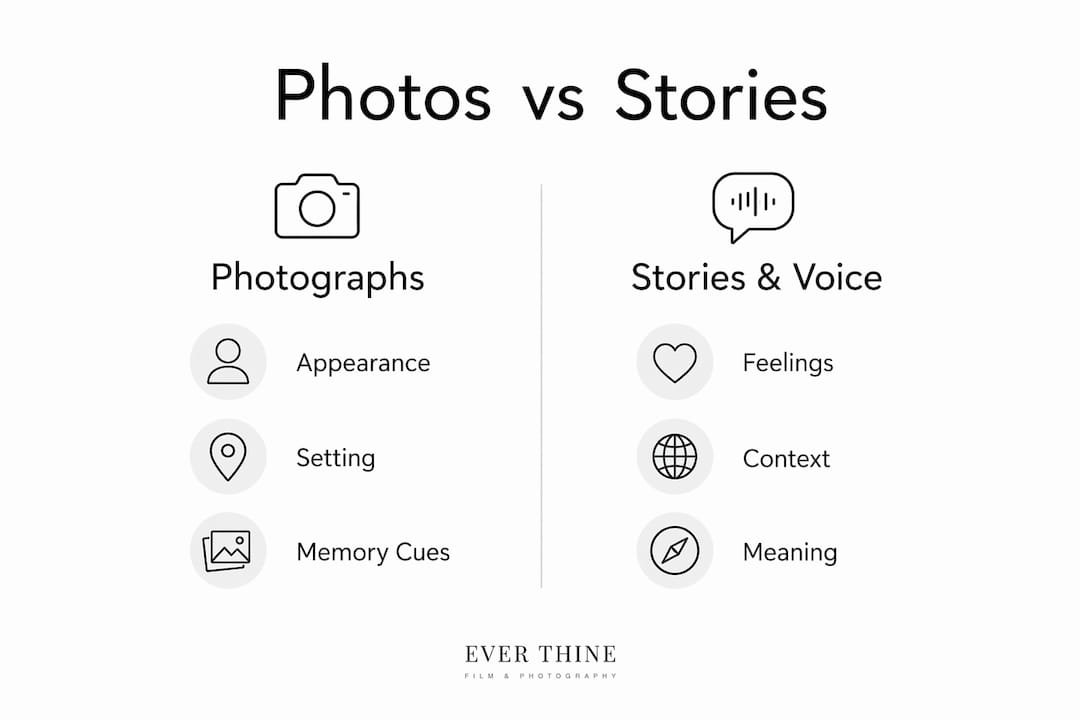
Element | Photographs | Stories and voice recordings |
What they preserve | Appearance, setting, external moment | Feelings, values, personality, context |
How memory uses them | As cues to reactivate emotion and recall | As direct transmission of lived experience |
Risk of loss | Image fades or file corrupts | Voice and meaning lost when storyteller dies |
Depth of connection | Surface recognition | Emotional and biographical understanding |
Photographs serve as memory cues that reactivate emotion by bridging inner experience with a concrete record of a moment. Memory is reconstructive, meaning the brain rebuilds a memory each time it is accessed, and photographs provide the anchor points for that reconstruction. A well-taken image of a birthday party does not store the memory. It triggers the retrieval of it.
Stories and voice recordings go further. Voice recordings add a deeper layer of meaning to photographs by capturing feelings, values, and personality that images cannot convey. The warmth in a grandparent’s voice, the specific phrase they always used, the way they laughed at their own jokes. None of that survives in a photograph. It survives only if someone records it.
Adding narrative layers to photo archives changes their meaning drastically. A photo album becomes a biography. A collection of images becomes a living record of who your family actually was, not just what they looked like.
Pro Tip: When you look through old family photos, record a short voice note describing what you remember about that moment. Even two minutes of audio attached to an image transforms it from a visual record into a genuine memory.
How to document family events practically and consistently
The most common reason families fail to document moments effectively is not lack of intention. It is lack of a simple, repeatable system. The good news is that short, question-led recordings of around 15 minutes are effective and require no expensive equipment. A smartphone, a quiet room, and a handful of prepared questions are sufficient to capture stories that would otherwise be lost.
Here is a practical framework for families starting their documentation practice:
Choose your prompts before you record. Questions like “What is your earliest memory of this house?” or “What did you want to be when you were ten?” unlock far richer responses than open-ended invitations to “tell me about yourself.” Specific questions reduce hesitation and produce detailed, emotionally honest answers.
Use existing photo albums as conversation starters. Sitting with a physical or digital album and asking “What was happening just before this photo was taken?” triggers memories that the image alone would never surface. This technique is particularly effective with older family members.
Separate capture from curation. Record first, organise later. Stopping to label or sort files during a recording session breaks the emotional flow and produces shorter, less candid responses. Capture the authentic voice first, then add metadata, summaries, and tags in a separate session.
Index your archive as it grows. Indexed and curated oral history archives enable accessibility and deeper engagement across generations. Scattered files with no labels become unusable within a few years. A simple naming convention such as “Name, Year, Topic” costs nothing and makes the archive searchable for decades.
Record at natural moments, not just formal occasions. The car journey home from a family gathering, the Sunday morning before everyone disperses, the quiet hour after a birthday dinner. These unplanned moments often produce the most honest and memorable recordings.
Pro Tip: Apps such as StoryCorps or the Tell Me Your Story app offer guided question sets specifically designed for family oral history sessions. They lower the barrier to starting and help less confident recorders feel prepared.
Documentary photography approaches to capturing authentic stories apply equally well to everyday family life. The principle is the same whether you are documenting a wedding or a Sunday lunch: observe, wait, and capture the moment as it happens rather than staging it.
How do documented memories strengthen intergenerational connection?
The long-term value of family memory preservation becomes most apparent across generations. A child born twenty years from now will never meet their great-grandparents. But they can hear their voices, understand their values, and feel connected to people they never knew, if those stories were recorded while the storytellers were still alive.
Capturing voice and lived context alongside photographs connects future generations more deeply to family members than images alone ever could. Faces become people. Dates become stories. A photograph of a wedding becomes the account of how two people met, what they were afraid of, and what they hoped their life together would hold.
The window for capturing these stories is finite. Attaching story layers while source storytellers are available to interpret photo archives is the single most important principle in family memory preservation. Once a storyteller is gone, the meaning they held goes with them. The photograph remains, but the biography it contained is lost.
Record legacy messages for future milestones. A grandparent’s message to a grandchild for their eighteenth birthday, recorded today, is a gift that no photograph can replicate.
Pair every significant photograph with at least one recorded story from someone who was present.
Preserve dialect, humour, and the specific rhythms of how family members speak. These are irreplaceable markers of personality and era.
Share archives across family branches so that cousins, aunts, and distant relatives can contribute their own perspectives and fill gaps in the collective memory.
The families who invest in this practice do not simply preserve the past. They give future generations the tools to understand themselves. Wedding storytelling photography demonstrates this principle clearly: the most meaningful images are those that capture not just the event but the emotional truth of the people living it.
Key takeaways
Family memory preservation requires both photographs and recorded stories to create archives that carry genuine emotional meaning across generations.
Point | Details |
Stories build identity | Family narratives of hardship and hope support children’s psychological resilience and sense of belonging. |
Photos need narrative layers | Photographs serve as memory cues, but voice recordings preserve feelings and personality that images cannot capture. |
Short sessions work best | Question-led recordings of around 15 minutes are effective and require no specialist equipment. |
Index your archive | Organised, labelled files remain accessible across generations; scattered recordings become unusable. |
Record while storytellers are alive | The meaning held by a storyteller cannot be recovered once they are gone. Start now, not later. |
Why I think most families are getting this backwards
After years of working with families and couples to document their most significant moments, the pattern I see most often is this: families invest heavily in photographs and almost nothing in stories. They have thousands of images and almost no recordings of the voices behind them. The photographs are beautiful. The meaning is missing.
The uncomfortable truth is that a photograph without a story is a question without an answer. You can see that your grandmother was happy at that table. You cannot know why, or what she was thinking, or what she would want you to know about that day. That knowledge exists only in living memory, and living memory has a deadline.
I have seen families sit down for a first recording session and produce forty minutes of extraordinary material in a single afternoon. Laughter, tears, stories nobody had ever heard before. The barrier was never time or equipment. It was simply the assumption that someone else would do it, or that there would be more time later.
The families who combine genuine emotional photography with deliberate storytelling create something that outlasts any individual image. They create a record of who their family actually was. That is worth far more than a well-organised photo library.
Start small. Record one story this week. Ask one question you have never asked before. The archive you build from that single session will matter more to your grandchildren than any photograph you have ever taken.
— Ever
Capture your family’s story with expert photography
[

The photographs that carry the most meaning are those taken by someone who understands that the real subject is never the setting. It is the people, the emotion, and the unrepeatable atmosphere of a moment lived together. At Weddingfilmphotography, the approach is documentary and instinctive: no forced poses, no manufactured expressions, just authentic moments captured as they happen.
Whether you are based in Derbyshire, covered by the award-winning Staffordshire team, or located in Worcestershire, Weddingfilmphotography brings the same commitment to honest, emotional storytelling to every event. These are the images your family will still be looking at in fifty years, and the ones your grandchildren will want to hear the stories behind.
FAQ
Why is documenting family moments more than just taking photos?
Photographs preserve appearance and external moments, but stories and voice recordings capture feelings, values, and personality that images cannot convey. True family memory preservation requires both.
How do family stories affect children’s development?
Family storytelling builds identity and a sense of belonging by giving children continuity through narratives of hardship and hope, which supports positive psychological adjustment.
How long does a family recording session need to be?
Question-led sessions of around 15 minutes are effective and produce rich, usable material without requiring expensive equipment or significant time commitment.
What is the best way to organise a family memory archive?
Use a consistent naming convention such as Name, Year, and Topic for every file, and index your oral history archive with metadata so that recordings remain accessible and searchable across generations.
When should families start documenting special occasions and stories?
The best time is while the storytellers are still alive and able to provide context. Attaching narrative layers to photo archives while source storytellers are available is the single most important principle in preserving family meaning for future generations.
Recommended


Comments