
What is natural light photography: a practical guide

TL;DR:
Natural light photography involves capturing images using only available sunlight, sky, or indoor sources without artificial equipment. Its key is understanding light’s shifting qualities—direction, color, and intensity—to create compelling, authentic images. Success depends on observation, positioning, and environmental modifiers rather than fixed settings or gear.
Natural light photography is defined as the practice of capturing images using only light from natural sources, such as sunlight, open sky, window light, or moonlight, without flash or studio strobes. This approach is not simply about shooting outdoors. It applies equally to a portrait beside a bedroom window or a landscape at dusk. Understanding natural light photography means learning to read light as a constantly shifting variable, one that changes in direction, intensity, and colour throughout the day. That skill is what separates a technically correct photo from one that genuinely moves people.
What is natural light photography and why does it matter?
Natural light photography uses available light in any setting, whether indoors or outdoors, rather than introducing artificial sources. The sun is the primary driver, but reflected skylight, light bouncing off a pale wall, or the diffused glow through a curtain all count. What makes this discipline demanding is that none of those sources stay the same. The same garden at 7 a.m. and 2 p.m. looks like two entirely different locations because light quality shifts in colour temperature, angle, and intensity throughout the day.
The significance for photographers is practical. Working without artificial lighting removes the barrier of expensive equipment and forces a deeper understanding of light itself. That understanding transfers directly to every other area of photography. Beginners who learn to see light naturally develop an instinct that no amount of flash technique can replicate.
What are the key qualities and types of natural light?
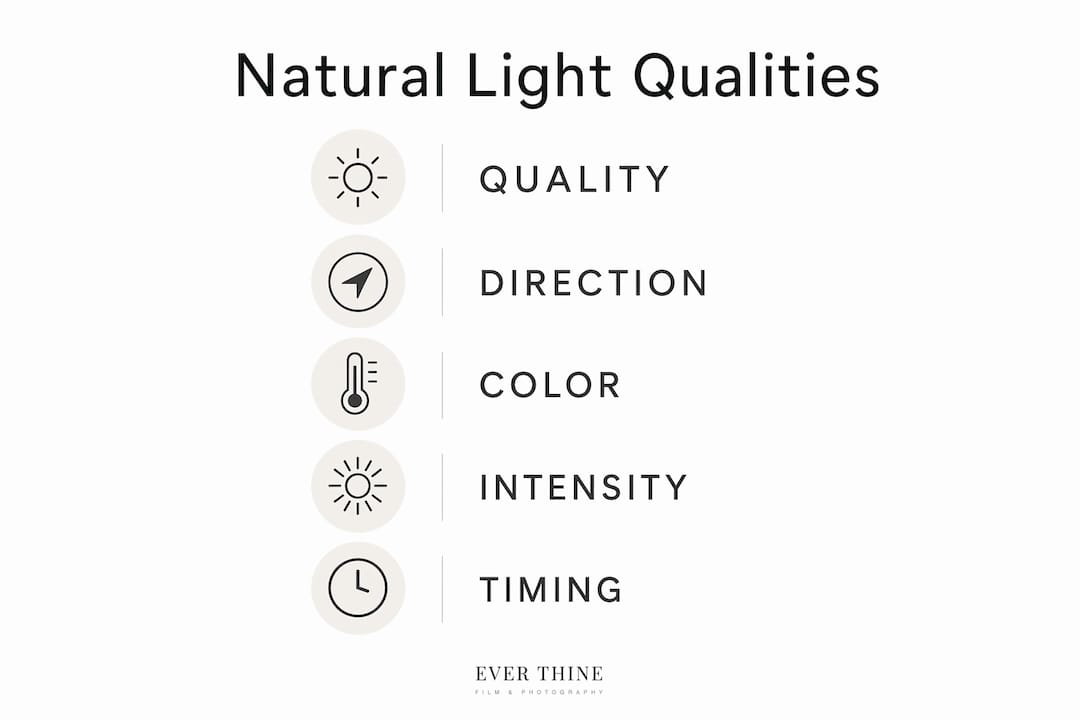
Every natural light situation can be described by four properties: quality, direction, colour temperature, and intensity. Getting comfortable with these four gives you a reliable framework for any shooting condition.

Light quality: hard versus soft
Hard light produces sharp-edged shadows, while soft light produces gradual, nearly blended transitions between light and shadow. Direct midday sun is the classic hard light source. An overcast sky acts as a giant diffuser, spreading light evenly and producing the soft, flattering quality favoured for portraits. Neither is superior. Hard light suits dramatic landscapes and textured surfaces; soft light suits skin tones and intimate scenes.
Common natural light types
Direct sun: High contrast, strong shadows, best used early or late in the day when the angle is lower and the light is warmer.
Open shade: Subjects are shielded from direct sun but still receive illumination from the open sky. The result is soft, flattering light without harsh shadows, making it a reliable choice for portraits at any time of day.
Window light: Regarded as one of the most versatile natural sources for indoor portraits. The window acts as a large, directional soft box.
Overcast sky: Uniform, diffused light with minimal shadows. Excellent for product photography and portraits where consistency matters.
Colour temperature and time of day
Light colour shifts from the cool blue of early morning, through the neutral white of midday, to the warm orange and gold of the golden hour, which falls roughly one hour after sunrise and one hour before sunset. This shift affects mood directly. Warm light reads as intimate and romantic; cool light reads as clean and calm.
Light direction shapes mood and texture in equally powerful ways. Backlight creates a rim of light around a subject, adding drama and separation from the background. Side light rakes across surfaces and reveals texture. Front light is flat and even, reducing shadows but also reducing depth.
Pro Tip: When shooting portraits outdoors in harsh midday sun, move your subject into open shade beside a building or under a tree. You retain the brightness of the day while eliminating unflattering shadows under the eyes and nose.
How to read and adapt to changing natural light conditions
Natural light demands continuous observation and repositioning. There is no fixed formula because the light is never fixed. A cloud passing over the sun can drop the light level by two stops in seconds. Learning to anticipate and respond to those changes is the core skill of natural light photography.
Subject and photographer positioning relative to the light source is the single most powerful tool available. Before adjusting any camera setting, move. Walk around your subject and observe how the light falls from different angles. Shift the subject a metre to the left and watch the shadows change entirely.
The environment itself acts as a natural modifier:
Pale walls and pavements reflect light back onto a subject, acting as a free fill reflector and reducing shadow depth.
Sandy beaches bounce warm, golden light upward, which is why beach portraits often have a luminous quality.
Forest canopies filter and dapple light, creating a soft, textured quality that is impossible to replicate artificially.
Alleyways and narrow streets funnel directional light, producing a dramatic, controlled beam effect.
Environmental modifiers like walls and pavements expand creative options without any additional equipment. Recognising them is a matter of training your eye to see the scene as a lighting diagram rather than just a location.
Pro Tip: Carry a small collapsible reflector. Positioned just outside the frame, it bounces existing natural light back into shadow areas and can transform a flat, overcast portrait into something with genuine dimension. A white foam board works just as well and costs almost nothing.
What camera settings suit different natural light scenarios?
The exposure triangle, aperture, shutter speed, and ISO, applies to natural light photography exactly as it does to any other discipline. The difference is that natural light forces you to adjust all three dynamically rather than dialling in a fixed studio setting.
Scenario | Aperture | Shutter speed | ISO |
Bright midday sun | f/8 to f/11 | 1/500s or faster | 100 to 200 |
Golden hour | f/2.8 to f/4 | 1/125 to 1/250s | 200 to 400 |
Overcast sky | f/4 to f/5.6 | 1/250 to 1/500s | 200 to 400 |
Indoor window light | f/2 to f/2.8 | 1/60 to 1/125s | 400 to 800 |
Deep open shade | f/2.8 to f/4 | 1/125 to 1/250s | 400 to 800 |
These typical exposure ranges are starting points, not rules. The most common beginner mistake is reaching for the ISO dial first when the light drops. Before increasing ISO, open the aperture and slow the shutter speed. Noise from a high ISO is far harder to correct in post-processing than slight motion blur in a static scene.
A few practical points worth knowing:
In bright midday conditions, a narrow aperture like f/8 keeps the entire scene sharp and prevents overexposure without needing a neutral density filter.
During golden hour, a wide aperture like f/2.8 separates the subject from the warm, blurred background and creates the characteristic shallow depth of field associated with the style.
For indoor window light portraits, the distance between the subject and the window controls both softness and shadow depth. Moving closer to the window produces softer, more wrap-around light; moving further away increases contrast and shadow definition.
What are the benefits and applications of natural light photography?
The benefits of natural light photography are both practical and aesthetic. On the practical side, you need no additional equipment beyond your camera and lens. There are no batteries to charge, no triggers to sync, and no light stands to carry. This makes natural light the default choice for travel, documentary, street, and wedding photography, where mobility and discretion matter.
Aesthetically, natural light produces images with an authenticity that artificial lighting rarely matches. The subtle gradations, the way warm evening light wraps around a face, the cool blue cast of a shaded doorway: these qualities carry emotional weight because they reflect the world as we actually experience it.
Applications span every photographic genre:
Portraits: Golden hour and open shade produce flattering, warm skin tones without the clinical quality of flash.
Landscapes: The low angle of early morning and late afternoon light creates long shadows and reveals surface texture in ways that midday light cannot.
Product photography: Overcast window light produces clean, even illumination ideal for e-commerce and editorial product shots.
Documentary and wedding photography: Natural light preserves the atmosphere of a moment. A flash fired into a candlelit reception destroys the mood; available light preserves it.
The challenges are real. You cannot control the weather, the time of day is often fixed by the event, and light can change faster than you can react. The solution is preparation: scout locations in advance, understand how light moves through a space at different times, and build flexibility into your shooting plan.
How can you modify natural light without artificial lighting?
Reflectors and diffusers are the two primary tools for shaping natural light without introducing artificial sources. A reflector bounces existing light back into shadow areas, reducing contrast and adding fill. A diffuser placed between the sun and the subject spreads harsh direct light into something softer and more even.
The key principle is subtlety. Overuse of reflectors creates an unnaturally lit look that undermines the authenticity natural light photography is prized for. The best modifications are invisible in the final image.
Beyond dedicated tools, consider these environmental approaches:
Position subjects near light-coloured walls, which act as passive reflectors.
Use a sheer white curtain over a window to diffuse harsh direct sunlight indoors.
Shoot in locations where the ground surface, such as pale stone or sand, reflects light upward naturally.
Use a dark flag, which is simply a piece of black card or fabric, to block unwanted reflected light from bright surfaces.
Professional photographers shift subject positioning to manage harsh midday sun rather than relying solely on camera adjustments. Moving a subject two metres into shade changes the entire character of the light. That is a more effective and more natural solution than trying to correct a fundamentally unflattering light source with exposure settings alone.
Pro Tip: Treat the size of a window and the distance of your subject from it as your two most powerful lighting controls indoors. A large window close to the subject produces light as soft as a professional studio soft box, at no cost.
Key takeaways
Natural light photography succeeds through observation, positioning, and adaptation rather than fixed settings or expensive equipment.
Point | Details |
Definition is broader than outdoors | Natural light includes window light, open shade, and reflected skylight, not just direct sun. |
Light quality determines mood | Hard light suits drama and texture; soft light suits portraits and intimate scenes. |
Position before you expose | Move the subject or yourself before adjusting camera settings to change light character. |
Environment is a free modifier | Walls, pavements, and canopies reflect or diffuse light without any additional gear. |
Subtlety preserves authenticity | Reflectors and diffusers work best when their effect is invisible in the final image. |
Why I think most beginners misunderstand natural light entirely
Most beginners treat natural light as a limitation. They wait for perfect golden hour conditions, avoid midday shoots entirely, and assume overcast days are a write-off. That thinking costs them thousands of usable images.
The real skill in natural light photography is not finding perfect light. It is finding the best light available in any given moment and working with it. I have shot portraits in harsh midday sun that looked genuinely beautiful, simply by moving the subject two metres into open shade beside a building. I have shot in grey, flat overcast conditions and produced images with a quiet, emotional quality that warm golden light would have ruined.
The photographers who struggle most are those who wait for conditions to improve rather than adapting to conditions as they are. Natural light is constantly shifting, and that is not a problem. It is the entire point. Every change in cloud cover, every degree the sun moves across the sky, every new location you step into offers a different creative opportunity. Your job is to see it and respond.
Start by spending time in one location at different times of day with no pressure to produce a finished image. Watch how the light moves. Notice where the shadows fall at 9 a.m. versus 3 p.m. That kind of deliberate observation builds the instinct that no tutorial can give you directly. For wedding photographers in particular, understanding how light behaves in a specific venue before the day itself is the difference between scrambling and creating.
— Ever
Capture beautiful natural light moments with Weddingfilmphotography
[
At Weddingfilmphotography, natural light is not a stylistic preference. It is the foundation of every image we create. Based in Staffordshire and covering weddings across the Midlands and beyond, we specialise in documentary-style photography that preserves the real atmosphere of your day, the soft morning light through a bedroom window, the warm glow of an outdoor ceremony, the candlelit reception exactly as it felt. If you are planning a wedding and want photography that reflects genuine moments rather than manufactured ones, explore our services as wedding photographers in Derbyshire, our award-winning Staffordshire coverage, or our work as wedding photographers in Worcestershire. We would love to hear about your day.
FAQ
What is natural light photography in simple terms?
Natural light photography means capturing images using only available light from natural sources such as the sun, sky, or window, without flash or artificial lighting. It applies indoors and outdoors.
What is the best time of day for natural light photography?
The golden hour, roughly one hour after sunrise and one hour before sunset, produces warm, low-angle light that is widely considered the most flattering for portraits and landscapes. Open shade works well at any time of day.
Do I need special equipment for natural light photography?
No specialist equipment is required beyond a camera and lens. A collapsible reflector is a useful and inexpensive addition for managing shadows, but many photographers work entirely without one by using environmental surfaces as natural modifiers.
How do I avoid harsh shadows in natural light portraits?
Move your subject into open shade, such as the shadow of a building or tree, where they receive soft, diffused skylight rather than direct sun. Alternatively, position them near a large window indoors for wrap-around, flattering light.
How does window light compare to outdoor natural light?
Window light is directional and controllable, making it ideal for portraits. The distance from the window determines softness: closer produces softer, more even light, while further away increases contrast and shadow depth.
Recommended
Comments