
How to capture genuine emotional moments at your wedding
Updated: May 15

TL;DR:
Authentic emotional moments at weddings capture spontaneous feelings that hold lasting significance. Preparation, gentle prompting, and trusting your photographer help ensure these genuine scenes are preserved naturally. The most treasured images often happen unplanned, reflecting true connection and vulnerability.
Your wedding day will pass in a blur of noise, laughter, nerves, and love. Years from now, the images you’ll reach for again and again won’t be the stiff formal line-ups — they’ll be the tear on your father’s cheek, the grin you exchanged before the first dance, the tiny hand squeezing yours. Yet so many couples quietly worry: what if those moments happen too fast, or too quietly, for anyone to notice? This guide gives you the practical steps, honest advice, and genuine insight to ensure those fleeting, irreplaceable scenes are preserved exactly as they happened.
Table of Contents
Key Takeaways
Point | Details |
Preparation pays off | Clarifying your vision and building trust with your photographer ensures more genuine moments are captured. |
Let emotions lead | The best wedding photos emerge when everyone feels relaxed, uninhibited, and true to themselves. |
Balance candid and gentle direction | Combining documentary coverage with subtle guidance creates authentic yet flattering images. |
Embrace imperfection | It’s the messy, unplanned moments that usually become couples’ most cherished memories. |
Understanding emotional moments in weddings
Now that we’ve set the scene, let’s clarify what truly counts as an ‘emotional moment’ and why it holds such significance in your wedding story.
An emotional moment isn’t necessarily a dramatic outburst of tears. It’s any spontaneous, unguarded instance where real feeling breaks through: a nervous laugh whilst waiting at the altar, the glance between two old friends who haven’t seen each other in years, or the quiet hug a parent gives before you walk out of the door. These micro-moments are the building blocks of a wedding story that genuinely moves people.
Some of the most common emotional highlights include:
The first look, when you see each other for the first time on the day
Vow exchanges, particularly unscripted additions or trembling voices
Parent dances and family reunions, full of layered history and tenderness
Candid guest reactions, especially from those who weren’t expecting to feel so much
Behind-the-scenes nerves, from getting ready through to the final countdown
Unscripted embraces, often captured between formal moments
Modern couples increasingly prioritise emotional authenticity over technically perfect images, and for good reason. Memory itself is emotional. Research in cognitive psychology consistently shows that we encode events more deeply when they carry emotional weight. A photograph that makes your chest tighten with recognition will always outlast one that simply shows you looking neat and composed.
“The photographs and films that couples return to most often are the ones where something real was happening — not something arranged.” This truth sits at the heart of documentary-style authentic wedding moments and explains why so many couples are moving away from traditional posed-only coverage.
Genuine emotion is also notoriously difficult to fake on camera. As photographing real wedding emotions requires, the best results come when the camera is almost invisible and the people in front of it have simply forgotten it’s there.
Checklist: How to prepare for genuine candid moments
Knowing what to look for is vital, but a bit of forethought ensures nothing is missed on the big day.
Documentary wedding photographers depend on natural interactions and thoughtful planning to do their best work. Your preparation directly shapes how much freedom your photographer has to move, observe, and capture without interrupting the flow of events.
Here’s a practical checklist to work through before the wedding:
Share a rough priority list (not a rigid shot list) with your photographer — mention the moments that matter most to you personally
Brief immediate family and close friends that you want natural, candid coverage so they’re not constantly looking at the camera
Choose a photographer who specialises in authentic documentary wedding photography rather than a generalist who poses every shot
Review the guide to documentary wedding photography to understand what to expect from your coverage
Allow proper buffer time in your schedule so moments aren’t rushed or cut short
Discuss lighting at your venue so your photographer can plan discreet positioning
Pro Tip: Assign one trusted friend or family member as a quiet point person. Their job is simply to give the photographer a subtle nod when they sense an emotional moment is about to happen — perhaps Grandma tearing up, or your best friend about to deliver a heartfelt toast. This small step makes an enormous difference.
Preparation step | Why it matters | When to do it |
Share a priority list | Ensures key moments aren’t missed | 4 to 6 weeks before |
Brief family on candid style | Reduces stiff, camera-aware behaviour | 2 weeks before |
Walk the venue with photographer | Identifies light and position opportunities | 1 to 2 months before |
Assign an emotional moment spotter | Gives photographer advance notice | Week of the wedding |
Build schedule buffer time | Prevents rushing between emotional scenes | During planning stage |
Working collaboratively with your photographer, as outlined in practical advice on working with your photographer, is the single biggest difference between a gallery full of candid magic and one that feels slightly flat. Aiming for 90% candid wedding moments in your coverage is an achievable and deeply rewarding goal when both you and your photographer are aligned from the start.
Step-by-step: Capturing emotion as it unfolds
With your groundwork set, here’s exactly how to maximise emotional photo opportunities on your wedding day.
A great documentary-style photographer will already know most of these instinctively, but understanding the process yourself means you can actively support it rather than accidentally working against it.
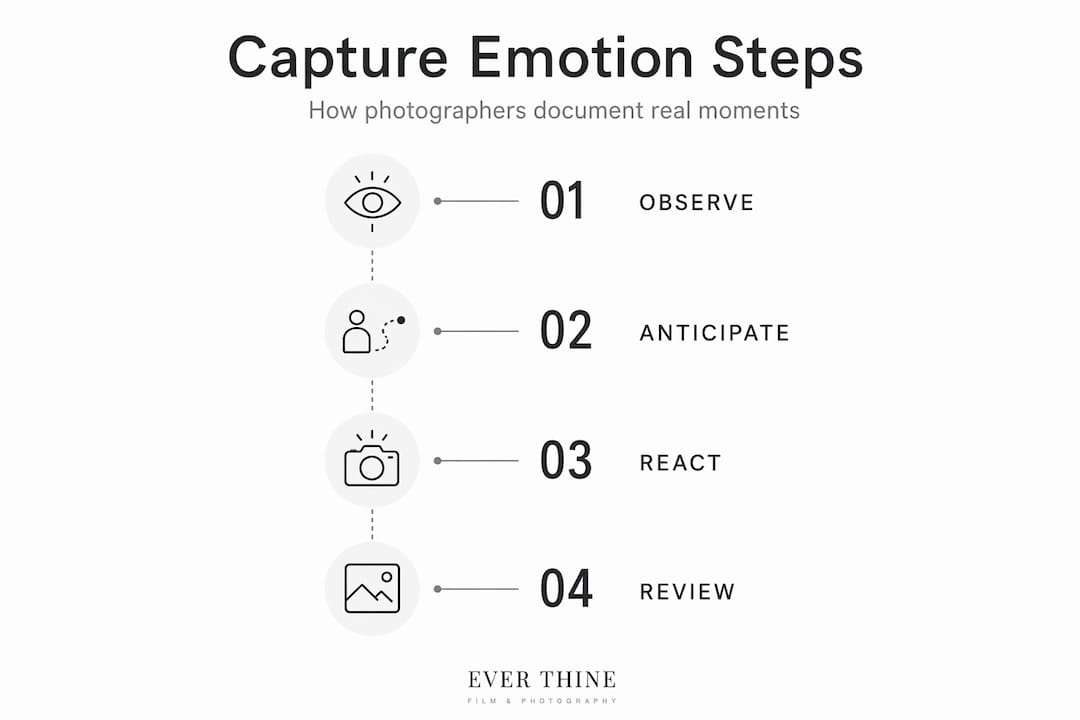
Create space for unscripted couple time. Even 15 to 20 minutes alone together during the reception, away from guests, gives both of you room to breathe, laugh, and connect. This is where some of the most quietly beautiful images happen.
Let your photographer observe subtle cues. The best candid photographers read body language constantly — a hand reached for, a whispered word, eyes that well up before the person even knows they’re emotional. The skill lies in anticipating the peak moment, not reacting to it after it’s passed.
Embrace gentle editorial prompting. There’s a middle ground between rigid posing and pure observation, sometimes called “candid editorial.” According to the Zola Documentary Photography Guide, this approach blends authentic moments with gentle prompting, producing images that feel completely natural whilst still being visually strong. A prompt might be as simple as “walk slowly and talk to each other” rather than “stand here and smile.”
Blend a few directed portraits with free-flowing coverage. Two or three gently directed couple portraits give you versatility in your gallery without sacrificing the spontaneous majority. Think of them as anchors within a sea of genuine moments, rather than the main event.
Let your schedule flex around feeling. If the speeches run long because everyone is laughing too hard to stop, that’s not a problem — it’s the story. A rigid timeline can suffocate emotional atmosphere rather than protect it.
Pro Tip: Let emotions lead the schedule where you can, not the other way around. Some of the most extraordinary wedding images come from unplanned pauses where nobody had anywhere to be.
Approach | What it looks like | Best for |
Strictly candid | Photographer only observes, never prompts | Couples very comfortable being watched |
Candid editorial | Gentle prompts, natural reactions | Most couples; balances authenticity and coverage |
Directed portrait | Posed, structured, controlled | Formal portraits only; not for emotional moments |
Learning to feel relaxed and yourself in front of a lens is genuinely helpful, and guidance on natural wedding poses can remove a lot of anxiety before the day. Equally, reading up on a guide for authentic couple portraits gives you realistic expectations for how those moments will look and feel. Wearing something comfortable matters too — being at ease physically directly affects how natural you appear emotionally, so consider wedding attire tips for comfort as part of your overall preparation.
Troubleshooting: Avoiding awkwardness and missed moments
Even with a strong plan, some challenges may arise. Here’s how to sidestep the most common ones while keeping things authentic.

The most frequent problems couples encounter aren’t dramatic — they’re subtle. Over-posing is one. When everyone stands stiffly waiting to be told where to look, genuine emotion retreats. Spontaneity quietly suffocates. The solution is to trust your own reactions rather than performing them.
Common pitfalls and how to avoid them:
Rigid shot lists: A shot list is a useful tool, but when it becomes a script, it kills natural flow. Share priorities rather than a frame-by-frame plan
Camera-shy guests: Some people freeze when they spot a lens. Brief your photographer to use longer focal lengths from a distance with guests who seem uncomfortable
Ignoring in-between moments: The pauses between events — walking from ceremony to reception, catching your breath before the speeches — are extraordinarily fertile ground for genuine emotion
Rushing the day: When schedules are too tight, emotional moments get sacrificed for logistics. Build in time generously
“Combining a documentary approach with gentle editorial prompting avoids both rigidness and chaos,” as the Zola Documentary Photography Guide notes. This balance is what separates a truly moving wedding gallery from one that simply documents an event.
Pro Tip: Embrace little imperfections. A slightly windswept veil, a smudged mascara tear, an uncontrollable laugh at the wrong moment — these are not flaws to correct. They are the details that reveal the most truth about who you are together.
For couples considering video as well as stills, these same principles apply directly. Understanding documentary wedding video tips will help you think about your coverage holistically rather than treating photography and film as separate exercises. Integrating both mediums thoughtfully, as discussed in guidance on integrating candid and posed shots, ensures your story is told with full richness across every format.
How to know your story was captured: Reviewing your images
Once the celebrations end and the images arrive, you’ll want assurance that the real heart of your wedding shines through.
A strong documentary wedding gallery has a particular texture to it. It doesn’t look like a catalogue. It looks like a living memory. When you sit down with your images for the first time, here’s what to look for:
Natural light and shadow, giving images warmth and depth rather than flat, flash-heavy uniformity
Micro-expressions — the flicker of a smile, a bitten lip, closed eyes during a hug
Movement within frames, including hair, fabric, gestures, and the general sense that life was happening
Unexpected compositions that you never saw coming but feel entirely right
A narrative arc from the quiet morning getting-ready shots through to the final dance
True documentary images prioritise feeling and narrative over perfection, which is why minor technical imperfections — a slightly soft focus on a moving subject, a frame that’s a touch darker than the next — are completely normal and often add rather than detract.
If something genuinely feels missing when you review your gallery, speak to your photographer calmly and specifically. Reference the moments you expected and ask whether alternatives were captured. A good documentary photographer will have multiple frames from each key scene and can often resolve concerns with a second edit pass.
Understanding what it means to choose documentary style beforehand means you’ll arrive at the gallery review with realistic, informed expectations — and genuine delight at what’s there.
Beyond the obvious: Why the best emotional moments can’t be staged
Stepping back from technique, it’s crucial to embrace the bigger picture on your day.
After photographing and filming many weddings, one truth stands out above almost everything else: the images that couples contact us about years later are never the ones we planned. They’re the ones that happened sideways, quietly, unexpectedly. The grandmother who wept during the first dance when nobody else noticed. The groom who turned away from the aisle to compose himself, not knowing the camera was already there.
Conventional shot lists have their place, but they rarely produce the images that become genuinely irreplaceable. Why? Because staged moments, no matter how well executed, carry a faint echo of performance. The people in them know they’re being captured, and that knowledge changes something subtle in the face, in the posture, in the eyes. A truly timeless image is one where the subject has forgotten the camera entirely.
Embracing imperfection is what allows true emotions to surface and be documented. The raucous laughter during a reading gone slightly wrong. The chaotic huddle of bridesmaids fixing a hem at the last moment. The stolen glance across a crowded room. None of these appear on any shot list, yet all of them become stories couples retell for decades.
Our honest advice: be present on your wedding day above everything else. Be vulnerable. Let things be messy and loud and imperfect. The emotional genuine memories on film that will move you most deeply in twenty years are already waiting to happen. Your job is simply to live them. Your photographer’s job is to be ready.
Making your memories unforgettable: Documentary wedding photography for UK couples
If you want your wedding story captured with this level of care and authenticity, here’s how to take the next step.
At Wedding Film Photography, we specialise in documentary-style wedding photography and cinematic film for couples across Staffordshire, Derbyshire, Worcestershire, and beyond. Our approach is built entirely around capturing the real, unscripted emotion of your day — quietly, unobtrusively, and with genuine passion for storytelling.
[
Whether you’re planning an intimate ceremony or a large celebration, we tailor our coverage to the unique atmosphere and emotional heartbeat of your wedding. From the nervous excitement of getting ready through to the final song, we’re there to witness and preserve what truly matters. If you’d like to find out more about our packages, our style, or simply have a chat about your plans, we’d love to hear from you. Reach out through our website and let’s start telling your story together.
Frequently asked questions
What should I tell my guests to help capture natural moments?
Let guests know in advance that you want natural, candid coverage so they feel free to ignore the camera and simply enjoy themselves. Families who understand candid coverage create far more relaxed and authentic photo opportunities throughout the day.
Can I suggest specific emotional moments to my photographer?
Yes, sharing your priorities is genuinely helpful, but the best moments are usually spontaneous — focus on letting feelings unfold rather than orchestrating them. Spontaneity is at the heart of documentary-style wedding images.
Should my photographer use prompts or just observe?
A balanced approach consistently works best, where gentle prompts enable natural reactions without forcing artificial poses. As the Zola Documentary Photography Guide explains, candid editorial blends authentic moments with gentle prompting for the ideal balance.
How do I know my images are truly authentic?
Look for nuanced emotions, unscripted expressions, and a gallery that tells your story rather than simply presenting posed group shots. True documentary images will always prioritise feeling and narrative over technical perfection.
Recommended
Comments