
Biodegradable Confetti UK: What to Buy and What Venues Allow
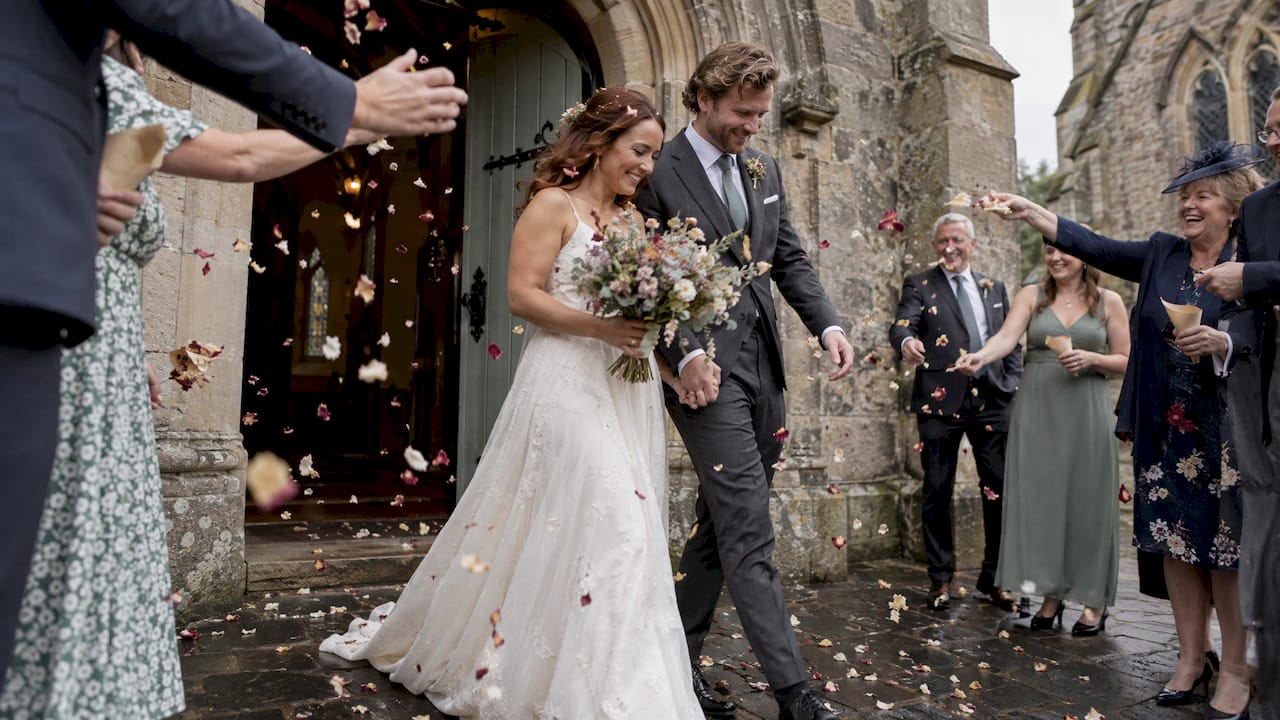
For most UK weddings, the safest biodegradable confetti is dried flower petals. Venues accept them most widely, they break down quickly outdoors, and they look better in photographs than flat paper circles. Biodegradable paper can work too, but “biodegradable” describes the material and not the venue’s rules, so ask the venue before you order anything. The throw lasts a few seconds and your photographs last for decades, so it is worth choosing well.
This guide covers what the label means, how the main types differ, how much to buy, how to read venue rules and how to set up the moment so it photographs well.
Key Takeaways
Dried petals are the most widely accepted option at UK venues. Paper is accepted at some venues and refused at others.
“Eco-friendly” on a label proves nothing. Look for a plain description of the material and check for plastic, foil, glitter or synthetic dye.
Ask your venue three things before ordering: is confetti allowed, must it be biodegradable, and where may it be thrown.
Plan roughly one handful per guest, then adjust for how many guests will actually throw and how it is handed out.
Brief your photographer on the timing, so the throw happens in good light, in a sheltered spot, with space to see faces.
Table of Contents
What “biodegradable” actually means for confetti
Biodegradable confetti is made from materials that break down through natural biological processes instead of lingering as plastic litter. For weddings that usually means real flower petals, dried leaves or seed paper, which leave only organic matter behind.
The problem is the word itself. Standard confetti can be made from foil, acrylic, leather and plastic, and foil and sequin confetti are a type of microplastic that never breaks down and can reach soil and water. Biodegradable confetti is plastic-free. Even so, inks and dyes can stop paper or dried flowers from being truly biodegradable.
Two more points save disappointment:
Biodegradable does not mean instantly gone. Breakdown depends on the material and where it ends up: soil, water or a bin. Testing of one biodegradable paper found natural breakdown can take up to six weeks, especially in dry weather, and conditions change the timetable.
Biodegradable does not mean allowed. A venue can still ban a biodegradable product because it can be slippery, stain surfaces or get left on a path.
The main types compared
The table sums up the options you will meet when searching for eco-friendly confetti in the UK. The notes underneath give the sources.
Type | Material | Look and behaviour | Things to watch |
Freeze-dried petals | Real petals, dried to keep shape | Natural shape, float and flutter, photograph well | Costs more than heat-dried |
Heat-dried petals | Real petals | Deep, rich colour, flatter and papery | Budget-friendly |
Biodegradable paper | Paper shapes, often 1.5cm circles | Uniform and bright, flutters | Needs keeping dry, can clump in damp air; some venues refuse it |
Seed paper | Paper with seeds | Biodegradable, often sold for scattering on soil | Check the venue is happy for seeds to land on its grounds |
Fresh petals | Real petals | Soft, natural | Short shelf life, so order close to the day |
Rice | Grain | Technically biodegradable | Does not break down fast and is often restricted |
Metallic, foil or plastic | Plastic-based | Shiny | Persistent and increasingly banned |
The differences between heat-dried petals, freeze-dried petals and paper come from The Dried Petal Company’s 2026 guide. The list of main confetti types, including seed paper and the restrictions on metallic and plastic confetti, is in this UK confetti guide.
Petals or paper?
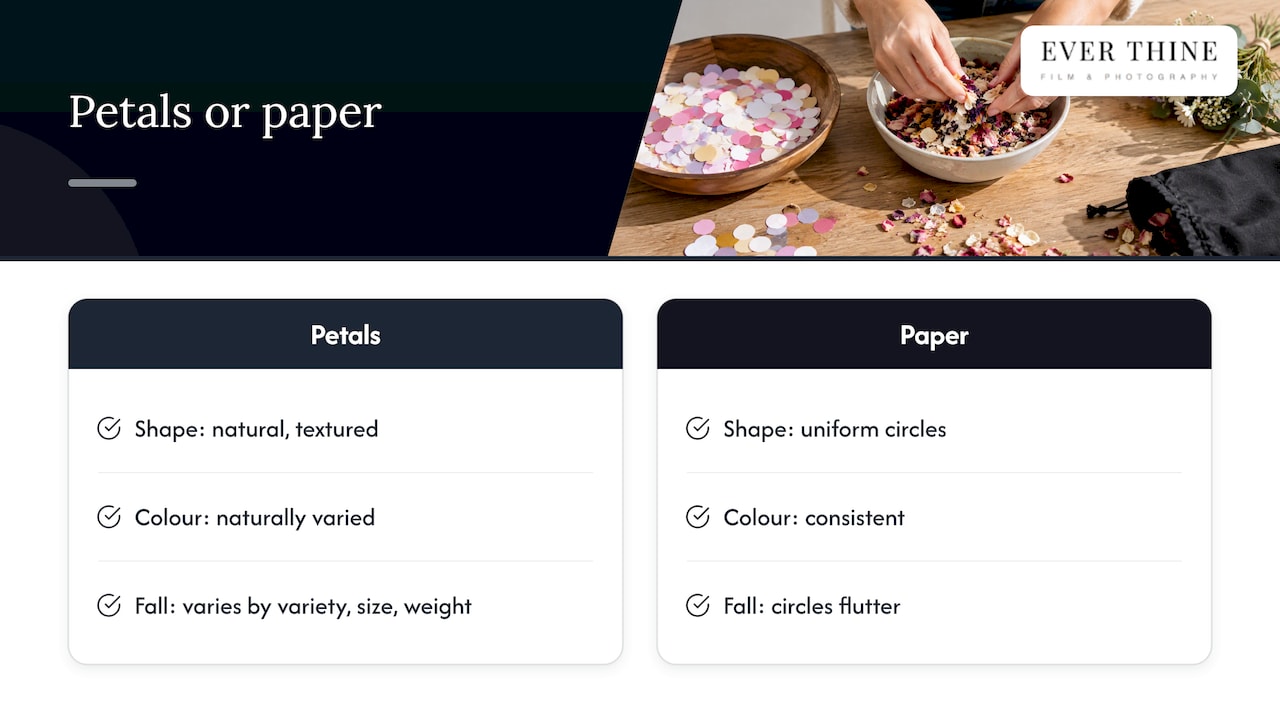
Real petals have natural shapes, textures and colour variation. Biodegradable paper arrives as uniform circles in consistent colour, according to this petal and paper comparison. How petals fall depends on variety, size and weight, while paper circles flutter.
If your venue allows both, petals are the better choice for most couples. Churches generally prefer real dried petals because they break down quickly and completely and leave very little to clear. If you love the crisp look of paper, ask the venue by name whether biodegradable paper is acceptable, rather than assuming.
Watch out for bioplastics, glitter and dye
Three products are sold as green and deserve a second look:
PLA confetti. PLA (polylactic acid) is a plant-based bioplastic made from materials such as cornstarch. It is marketed as biodegradable but needs industrial composting to break down efficiently, and often takes years in nature.
“Biodegradable” glitter. Even biodegradable glitter often contains a plastic core that persists in soil and water for years.
Dyed petals. “Natural petals” does not always mean undyed. Petals coloured with plant pigment are not colour-fast and can transfer colour to clothing. If that worries you, choose white petals.
The practical rule: look for a clear description of what the confetti is made from, and ask the seller how it should be disposed of. If the listing only says “eco” and gives no material, move on.
Will your venue allow it?
This is the question that decides everything else. Confetti is the part of a wedding most likely to be restricted, and rules vary widely. As a general pattern, most churches allow biodegradable confetti outside only, indoor venues tend to be the most restrictive, and some registry offices do not allow confetti at all.
Official venue terms show how different the answers can be:
Council-run venue, strict. Chichester City Council’s venue hiring terms state that confetti is not allowed inside or outside the building.
Council-run venue, limited. Bath and North East Somerset Council’s Georgian Room at the Guildhall permits a small amount of biodegradable confetti or natural dried petals at the south door. Confetti cannons are not permitted anywhere in the council area.
Country house, designated spot. Wynyard Hall’s 2026 wedding terms require all confetti to be biodegradable and allow throwing only outside the Chapel. The venue can add a charge for clearing if the rules are not followed.
Listed building, colour rules. Islington’s Town Hall allows only biodegradable paper in white, cream or pastel colours, or flower petals, thrown outside. It asks couples to avoid plastic or foil, brightly coloured confetti that stains the stone, and rice, which it describes as a safety risk on stairs in bad weather and a wildlife attractant.
These are examples, not your venue’s rules. Your venue may sit anywhere between them, whether it is a barn in Staffordshire, a hall in Warwickshire or a church in Derbyshire.
Questions to put to the venue
Email, so you have the answer in writing:
Is confetti allowed at all, indoors or outdoors?
Must it be biodegradable, and do you prefer petals or paper?
Is there a designated area for the throw?
Are confetti cannons allowed?
Who clears up afterwards, and is there a charge?
That list follows the checks recommended for UK churches and venues, where dried petals are described as the most universally accepted type. Our own guide to confetti rules for UK weddings goes through what venues typically allow in more detail. If your ceremony is in a church, the church wedding photo rules checklist is worth sending at the same time, as the same conversation often covers both.
How much confetti to buy
Suppliers give slightly different rules of thumb, so treat these as a range:
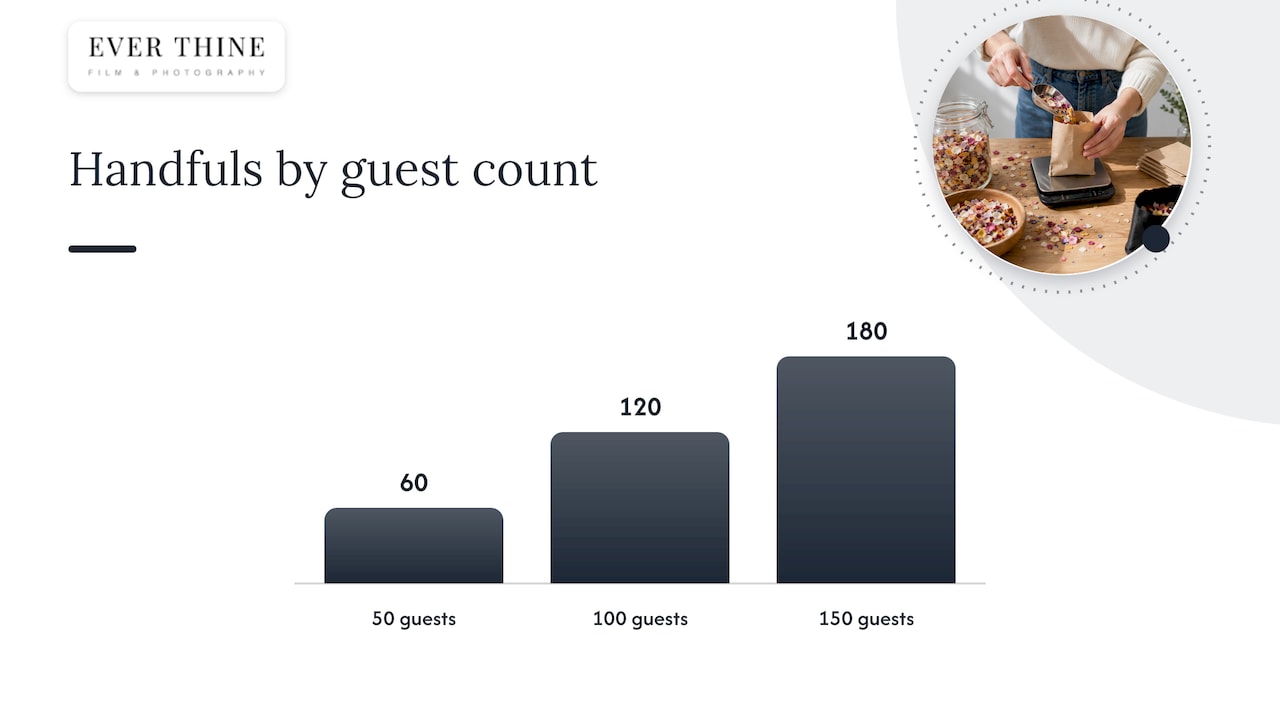
One handful per guest, or 1.5 handfuls if you hand it out in cones or bags, or two if you use a basket. That works out at 60 handfuls for 50 guests, 120 for 100 and 180 for 150.
About 1 litre per 15 to 20 guests. One litre of small petals gives 10 to 15 loose handfuls, and lightly scattered covers roughly a metre of aisle.
Plan for at least half your guests to throw. One litre gives about 10 to 12 handfuls, so 100 guests with 50 throwing needs about 5 litres, and 10 litres if everyone joins in.
A worked example: 80 guests, a church exit, confetti in cones. Using the one-handful-per-guest rule with the 1.5 multiplier for cones, you need about 120 handfuls. At 10 to 12 handfuls per litre, that is roughly 10 to 12 litres. If you expect a quarter of the guests to hold back, you can comfortably order a little less. Round up slightly, because a thin throw photographs poorly.
Order petal confetti about three months ahead and keep it in a cool, dry place. Keep biodegradable paper dry and protected from moisture until the throw, as it can clump in damp air.
To keep costs sensible, choose one colour or a simple mix rather than many, buy to a plan rather than guessing, and check the full price including delivery before you commit.
Handing it out and keeping everyone safe
A good throw is planned, not improvised. The steps below are drawn from UK guidance on organising the throw:
Choose the moment, often as you leave the ceremony.
Pick a sheltered spot away from doors, paths and vehicles.
Hand confetti out in advance in small cones, bags or boxes.
Tell guests the rules with a sign or a word from whoever is leading the ceremony.
Brief your photographer on timing and direction.
Agree who clears up before the day, with a brush, dustpan and bags to hand.
The same guidance flags guests with allergies or asthma, children who may put things in their mouths, and wheelchair users, since loose confetti can be slippery or catch in wheels. If a guest has a known allergy or breathing condition, let them stand at the back or hold the cone without throwing. Outdoors, check whether the area is grazed: untreated, dye-free petals are the wildlife-friendly choice, but livestock areas call for extra care.
Indoors, ordinary confetti may seem less of a problem if it is swept up, but once it reaches landfill the non-biodegradability issue returns. Another reason to choose biodegradable even when the venue does not insist.
Choosing confetti for the photographs
The throw is one of the few wedding moments that cannot be repeated, so the type you choose changes what the picture looks like.
Petals that float. Freeze-dried petals keep their natural shape and size, float and flutter, so they photograph well and stay visible in the air for longer.
Colour against your clothes. White or soft, natural tones show against dark suits and stay gentle on a pale dress. Remember that dyed petals can transfer colour, particularly with prolonged contact.
Size matters for cannons. Some small petals suit confetti cannons while large rose petals are too big, and many venues ban cannons altogether, so confirm first.
Plenty, not a pinch. A full handful per person fills the frame. A few scattered pieces disappear.
Light and shelter. A shaded spot with open light on the faces works better than a doorway in harsh sun.
For ideas on framing, see our pieces on creative wedding confetti photo ideas and the confetti photo workflow.
Your confetti photographed by people who shoot it as it happens
We are a husband-and-wife team shooting documentary-style wedding photography and cinematic films, based in Staffordshire and working across the West Midlands and the UK, including destination weddings. A natural, unobtrusive approach suits a confetti moment, because the best frames are the unplanned laughs and the faces in the crowd, not a staged pose.
[

If you want the throw captured as photographs, see our wedding photography, or add wedding videography to see the petals move. Our wedding content creation service starts from £600 one-off. Get in touch with your date and venue and we will talk it through.
Our view on confetti
We have been photographing weddings for over a decade, and confetti is one of those moments couples either plan well or leave to chance. Our advice is simple: decide early, ask the venue in writing, and choose real petals if the venue allows them. Our approach is documentary-led and unobtrusive. We would rather catch your grandmother mid-laugh with a petal in her hair than ask everyone to freeze and pose. That is why a generous, well-handed-out throw matters to us: it gives the camera real reactions to find. Tell us the venue and the planned moment, and we can build the throw into the timeline of the day. The confetti you choose then does what it is meant to do: look beautiful for a few seconds and stay in your photographs for a lifetime. Dawn & Carl
FAQ
Is biodegradable confetti allowed at every UK venue?
No. Many venues require biodegradable confetti, but some ban all confetti, some limit it to a designated outdoor area and some do not allow cannons. Ask your venue in writing before you order.
What is the best biodegradable confetti for a wedding?
Dried flower petals are the most widely accepted option and are usually preferred by churches and countryside venues. Biodegradable paper is accepted at some venues and refused at others, so confirm first. Choose untreated petals, or white ones if colour transfer concerns you.
How long does biodegradable confetti take to break down?
It depends on the material and conditions. Testing of one biodegradable paper showed breakdown can take up to six weeks, particularly in dry weather, and it is not a guaranteed timetable. Biodegradable does not mean it disappears at once, so clear up as the venue asks.
Is eco-friendly confetti always plastic-free?
Not always. Some products labelled eco-friendly contain plastic backing or synthetic dyes, and glitter often has a plastic core even when described as biodegradable. Check the ingredient or material description, not the marketing.
How much confetti do I need for 100 guests?
A common rule is one handful per guest, or 1.5 if you hand it out in cones or bags. With about 10 to 12 handfuls per litre, that is roughly 10 to 15 litres if everyone throws, and about 5 litres if half the guests do.
Sources
Recommended
Comments