
How to brief your photographer: a checklist for couples
Updated: Aug 2

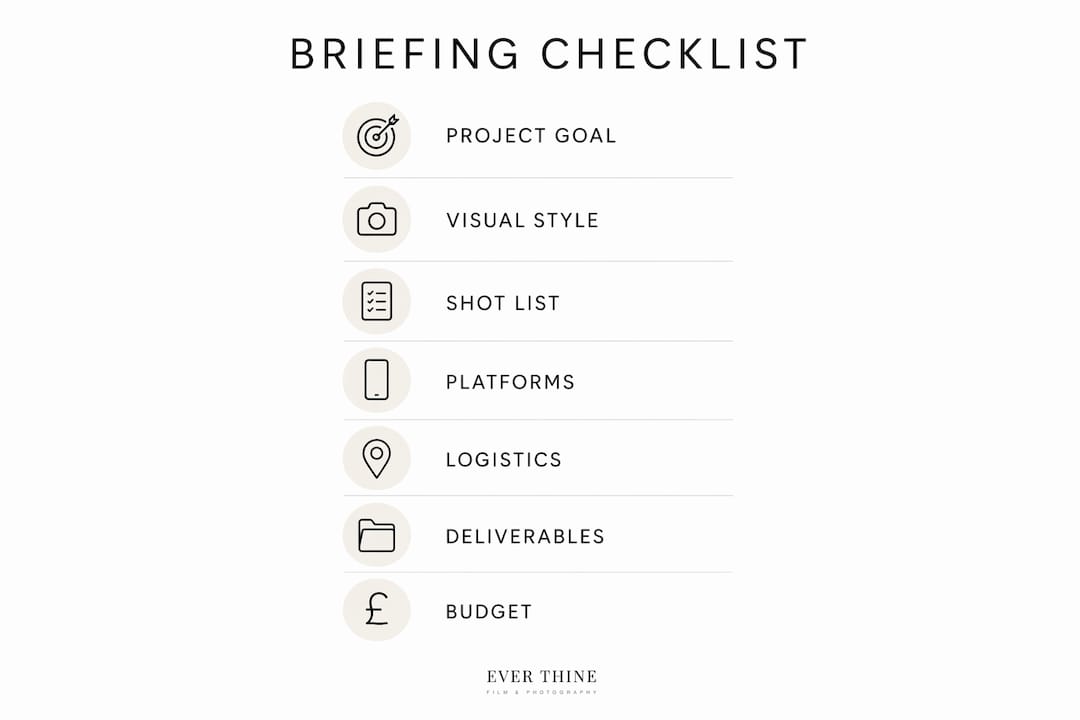
A good photographer brief covers nine things: your project goal, who the images are for, where they will be used, a moodboard or style references, a prioritised shot list, full logistics, deliverable counts, budget, and a single named contact. Get those nine elements into one or two pages and your photographer can plan, price, and shoot with confidence.
Brief at a glance:
Project goal and marketing objective
Audience and intended platforms (website, social, print, ads)
Visual style references or moodboard link
Shot list: must-haves first, nice-to-haves second
Location, access, arrival time, permits, contingency
Deliverables: image count, format, resolution, deadline
Budget range and who covers extras
Point of contact and on-the-day phone number
Licensing scope (social, print, advertising)
One-line sample brief you can paste into an email:
Table of Contents
What should your photographer’s brief include?
A brief works best when it moves from the big picture down to the practical detail. Start with your marketing goals and audience rather than jumping straight to technical specs — the creative choices follow naturally once the photographer knows who the images must speak to.
Project goal and audience
State what the images must achieve and who will see them. “Product shots for our spring campaign aimed at women aged 25–40 shopping on mobile” gives a photographer far more to work with than “nice lifestyle photos.” One or two sentences here shapes every decision that follows.
Visual style references
Moodboards communicate style far more precisely than adjectives. Words like “bright” or “moody” mean different things to different people; a curated board of ten images does not. Use Pinterest, a shared Google Drive folder, or a tool like Milanote to collect references, then annotate each one briefly: “love the window light here” or “this colour tone, not the composition.”

Shot list: must-haves versus nice-to-haves
Separate your shots into two tiers. Must-haves are non-negotiable (the ring exchange, the family group, the hero product on white). Nice-to-haves are bonus frames if time allows. Keeping the must-have list to five or six shots gives the photographer room to work creatively around them rather than racing through a checklist.

Platforms and usage rights
List every place the images will appear: website, Instagram, print brochure, paid ads, merchandise. Usage directly affects the licence the photographer grants and, often, their quote. Omitting this detail is one of the most common causes of unexpected invoices after delivery.
Logistics and schedule
Include the full address, nearest car park, arrival time, access codes, any permit requirements, and a named on-site contact. Missing logistics are a leading cause of shoot delays. Add a brief contingency note too: if it rains, where does the shoot move? If a key person is late, what gets dropped first?
Deliverables and post-production
Be specific: “60 colour-graded JPEGs at 300 dpi, delivered via WeTransfer within 14 days, with light retouching only.” Vague deliverable counts lead to scope creep. State the review process as well: one round of feedback, or two? Who has final sign-off?
Budget and extras
You do not have to reveal your ceiling upfront, but giving a realistic range helps the photographer tailor their approach and avoids wasted time on both sides. Clarify what the budget covers (shoot time, editing, travel) and who pays for extras such as props, permits, or additional retouching.
Brief element | What to include | Why it matters |
Project goal | One sentence on what images must achieve | Shapes every creative decision |
Audience | Who sees the images and on which device | Informs composition and format |
Moodboard | 8–12 annotated reference images | Reduces style ambiguity |
Shot list | Must-haves (max 6) + nice-to-haves | Protects priorities, allows creativity |
Logistics | Address, parking, arrival time, permits | Prevents delays |
Deliverables | Count, format, resolution, deadline | Avoids scope creep |
Budget | Range + what it covers | Enables accurate quoting |
Licensing | All intended uses listed | Prevents disputes |
Contact | One named person + phone | Speeds decisions on the day |
Pro Tip: Annotate your moodboard images with one short note each (“love the shadow detail here”, “avoid this level of retouching”). It takes five minutes and saves a lengthy phone call.
Copy-and-paste brief template and examples
A practical creative brief fits one to two pages. The template below works as an email body or a shared Google Doc.
PHOTOGRAPHY BRIEF
Project name:
Date and time:
Location / address:
Arrival time for photographer:
Primary goal: (what must these images achieve?)
Audience: (who will see them, and where?)
Moodboard link:
Must-have shots: (list 3–5)
Nice-to-have shots: (list 2–3)
Number of final images:
File format and resolution:
Retouching level: (e.g. colour grade only / full retouch)
Delivery deadline:
Budget range:
Primary contact name and phone:
On-the-day contact (if different):
Contingency plan: (e.g. wet weather, delayed access)
Wedding example
Project: Sarah & James wedding, Shugborough Estate, Staffordshire Date: 14 June, 11:00 AM ceremony Must-haves: Ceremony exchange, first kiss, family group (list attached), first dance, cake cut Deliverables: 400 edited JPEGs, 4 weeks after the wedding Contact for decisions: Sarah’s mum, Jane — 07700 900000 Contingency: If rain, portraits move to the orangery
Commercial example
Project: Spring product shoot, skincare range Date: 22 April, studio hire from 9:00 AM Must-haves: Hero flat-lay on white, three lifestyle shots on model, close-up texture detail Usage: Website, Instagram, paid Facebook ads (UK only) Deliverables: 30 retouched TIFFs at 300 dpi + 30 web-optimised JPEGs, 7 days after shoot Budget: £800 all-in, excluding props Contact: Marketing manager, Tom — 07700 911111
When attaching a moodboard, a shared Pinterest board or a Google Drive folder both work well. Keep the folder to 10–15 images maximum and name it clearly (“Spring Campaign Moodboard — April 2026”). More than 20 reference images tends to confuse rather than clarify.
Pro Tip: Add a one-line note to each reference image explaining what you like about it specifically. “Love the warm tones, not the wide-angle lens” tells the photographer far more than the image alone.
How to share the brief and prepare before the shoot
Sharing the brief at the right moment matters as much as what is in it. Too early and details change; too late and the photographer cannot prepare properly.
Send the first draft 4–6 weeks before the shoot. This gives the photographer time to flag questions, check the location, and arrange any permits or equipment.
Book a 20-minute call 1–2 weeks out. Walk through the shot list together, confirm the schedule, and ask the photographer if anything is unclear. This call is where most ambiguities surface.
Share a call sheet 48 hours before. A call sheet is a single page covering arrival time, full address, parking instructions, on-site contact name and number, nearest café or toilet, and any access codes. It is not the same as the brief; it is the operational summary for the day itself.
Confirm the contingency plan the day before. A quick message checking the weather plan and confirming the shoot is going ahead takes two minutes and prevents last-minute panic.
Designate one decision-maker for the day. The photographer should have one phone number to call if something changes. Multiple approvers slow decisions at exactly the wrong moment.
For sharing tools, a shared Google Doc works well for collaborative editing before the shoot. Pinterest is the standard for moodboards. For the call sheet, a single PDF sent via email or WhatsApp is usually clearest.
When asking the photographer for clarifications, keep questions concrete: “Will you need a power socket for lighting?” or “Is there anything on the shot list you’d approach differently?” Vague questions get vague answers.
Pro Tip: For weddings, share a separate family shot list with the photographer at least a week before. Include the names of the people in each group so the photographer can call them by name on the day.
What mistakes do clients make when briefing photographers?
The most common errors are easy to avoid once you know what to look for.
Vague goals. “We want beautiful images” tells a photographer nothing. State what the images must do: drive traffic, sell a product, document an event.
Missing usage information. Omitting where images will appear is one of the most frequent causes of licensing disputes and unexpected costs after delivery.
No moodboard. Describing style in words alone almost always leads to mismatched expectations.
Too many approvers. If three people can change the brief or override decisions on the day, the photographer cannot work efficiently.
Unclear deliverable counts. “Lots of images” is not a deliverable. State a number.
Unrealistic timelines. Asking for 200 fully retouched images within 48 hours is not reasonable. Ask your photographer what their standard turnaround is before setting a deadline.
Photographers consistently say they prefer visual references over long text descriptions, a clear and prioritised shot list, an honest budget range, and a single point of contact. A brief that trusts the photographer to solve problems creatively on the day produces better results than one that scripts every frame.
Pro Tip: Frame must-have shots as outcomes, not instructions. “A natural group photo of the immediate family after the ceremony” works better than “Stand everyone in a line by the door at 2:15 PM.” The first gives the photographer a goal; the second removes their ability to find the best light or angle.
Your one-page checklist to send to the photographer
Copy this into an email or paste it into a Google Doc. Fill in the blanks and send.
Project name:
Date and time:
Location and full address:
Arrival time:
Primary goal:
Audience and usage platforms:
Moodboard link:
Must-have shots (3–5):
Number of final images:
File format and crop:
Budget range:
Primary contact name and phone:
Contingency plan:
Suggested email snippet:
A photoshoot brief checklist should begin with subject and goal, then move through deliverables, audience, references and timeline in that order. Keeping the email short and the checklist attached as a separate document (rather than buried in a long email) makes it easier for the photographer to refer back to on the day.
Pro Tip: Save this checklist as a Google Doc template. For every new shoot, duplicate it, fill in the blanks, and share the link rather than sending an attachment. The photographer can leave comments directly in the document if they have questions.
Key takeaways
A photography brief that leads with goal and usage, shows style through a moodboard, prioritises shots clearly, and names one decision-maker gives your photographer everything they need to plan, price, and deliver the images you want.
Point | Details |
Lead with goal and usage | State what images must achieve and where they will appear before anything else. |
Show style, don’t just describe it | A moodboard of 8–12 annotated images removes ambiguity that words cannot. |
Prioritise your shot list | Limit must-haves to five or six shots; leave room for the photographer’s creative judgement. |
Be explicit about deliverables | State image count, format, resolution, retouching level, and delivery deadline. |
Weddingfilmphotography’s approach | Documentary-style coverage with a pre-shoot planning call and a clear brief review built into every booking. |
Why the brief matters more for documentary weddings
Most briefing advice assumes a controlled commercial shoot where every variable can be planned. A wedding is the opposite: the light changes, the schedule slips, and the most powerful moments are the ones nobody scripted. That is precisely why the brief matters more, not less.
For documentary wedding coverage, the brief’s job is not to choreograph the day but to protect the moments that genuinely cannot be missed. The ceremony exchange, the family group, the first dance — these are the non-negotiables. Everything else is the photographer’s territory. A brief that tries to script 40 posed shots across a 10-hour day will produce 40 posed shots and very little else. A brief that lists six must-haves and then steps back will produce those six shots plus a hundred frames the couple never thought to ask for.
Practically, this means the most useful sections of a wedding brief are the family shot list (names included), the ceremony timing, the getting-ready window, and the single contact who can make decisions. The moodboard matters too, but for weddings it is less about replicating a specific look and more about communicating emotional tone: relaxed and candid versus formal and structured.
One thing couples consistently underestimate is the getting-ready window. If the brief says “getting ready from 10:00 AM,” the photographer needs to know whether that means the photographer arrives at 10:00 or the couple is dressed and ready by 10:00. That single ambiguity, unresolved, costs 30 minutes of the most intimate coverage of the day.
For anyone planning a wedding in Staffordshire or the surrounding counties, the brief is also the moment to flag venue-specific constraints: restricted areas, no-flash ceremonies, or a registrar who limits photographer movement. A good documentary photographer will work within those constraints; they just need to know about them in advance.
The brief is not a contract. It is a conversation starter. The best outcomes come when the couple shares their priorities clearly and then trusts the photographer to find the best way to capture them.
Weddingfilmphotography: documentary coverage with a planning process built in
Couples who want natural, unposed wedding coverage often find that the hardest part is not finding a photographer but communicating what they actually want. Weddingfilmphotography offers documentary-style wedding photography and cinematic videography across Staffordshire, Derbyshire, Worcestershire, and the wider UK, with a pre-shoot planning process that includes a brief review and a dedicated planning call before every wedding.
[
Rather than handing couples a blank brief template and hoping for the best, Weddingfilmphotography works through the key details together: shot priorities, family groups, venue constraints, and timeline. The result is coverage that protects the moments that matter while leaving room for the candid, emotional frames that make a wedding film or album genuinely worth keeping.
If you are planning a wedding in Staffordshire, Derbyshire, or Worcestershire, get in touch to check availability and talk through your brief.
Useful sources
Further reading and templates for couples and clients building their first photography brief.
How to write a quality photography brief — Giles Christopher: Practical guidance on moodboards and style communication, with annotated examples.
How to write the perfect photography brief — Adam Hollier: A photographer’s perspective on what makes a brief genuinely useful versus one that hinders creative work.
Creative brief for a photoshoot — Cullengo: Template-led guide covering concept through to deliverables in one or two pages.
Photography project brief example — Twine: Useful for understanding how usage rights and licensing should be stated in a brief.
How to write a photography brief — Connor Mollison: Emphasises starting with audience and marketing goal before moving to technical detail.
How to write a photography brief — London Filmed: Detailed logistics checklist including parking, access, and permit notes.
Photoshoot brief guide — Milanote: Step-by-step checklist tool with a recommended sequence from subject and goal through to timeline.
Creative photography briefs — VSCO: Overview of brief components by shoot type (portrait, event, product, commercial).
Questions to ask your wedding photographer — Weddings Hub: Useful checklist of questions to confirm contracts, deliverables, and backup plans with your photographer.
RPS model release form: The Royal Photographic Society’s model release template — relevant if your brief involves identifiable people in commercial or advertising usage.
Questions to ask your photographer — Weddingfilmphotography: A detailed guide to confirming shot priorities, contracts, and deliverables with a wedding photographer.
How to communicate with your photographer — Weddingfilmphotography: Practical advice on aligning expectations and communication style before and on the wedding day.
Resource | Best for |
Giles Christopher | Moodboard construction and style annotation |
Adam Hollier | Understanding photographer preferences |
Cullengo | Downloadable brief template |
Milanote | Step-by-step checklist tool |
RPS model release | Commercial usage and model consent |
Weddingfilmphotography | Wedding-specific brief guidance and planning support |
FAQ
How do you write a brief for a photographer?
Start with your goal and audience, then add a moodboard, a prioritised shot list, full logistics, deliverable counts, budget range, and a single named contact. Keep it to one or two pages and send it at least four weeks before the shoot.
What should a photography brief always include?
At minimum: project goal, intended usage and platforms, a moodboard or style references, must-have shots, image count, file format, delivery deadline, budget range, and one contact person with a phone number.
How do I communicate my style to a photographer?
A moodboard of 8–12 images with short annotations is more precise than any written description. Collect references on Pinterest or in a shared Google Drive folder, note what you like about each image specifically, and share the link in your brief.
What is the difference between a must-have and a nice-to-have shot?
Must-have shots are non-negotiable frames the photographer must capture regardless of timing or conditions. Nice-to-haves are bonus shots if time and light allow. Keeping must-haves to five or six protects priorities without removing the photographer’s creative freedom.
How far in advance should I send the brief?
Send a first draft four to six weeks before the shoot, follow up with a call one to two weeks out, and share a final call sheet 48 hours before. For weddings, the family shot list should reach the photographer at least a week before the day.
Recommended


Comments