
How to capture candid moments: a practical guide

TL;DR:
Candid photography captures spontaneous moments that reveal genuine emotion and personality without posing.
Proper camera settings, anticipation skills, discretion, and natural prompts are essential for authentic images.
Candid photography is defined as the art of capturing spontaneous, unposed moments that reveal genuine emotion and personality. Knowing how to capture candid moments separates a technically competent photographer from one who produces images people actually feel something about. The techniques covered here apply whether you are photographing a family picnic in the garden, a child’s birthday party, or a wedding reception in Staffordshire. You do not need expensive gear or years of training. You need the right settings, the right mindset, and a few proven methods that professional photographers use every day.
How to capture candid moments: camera settings that actually work
The correct camera configuration is the foundation of every successful candid shot. Without it, you will miss the moment before you even press the shutter.

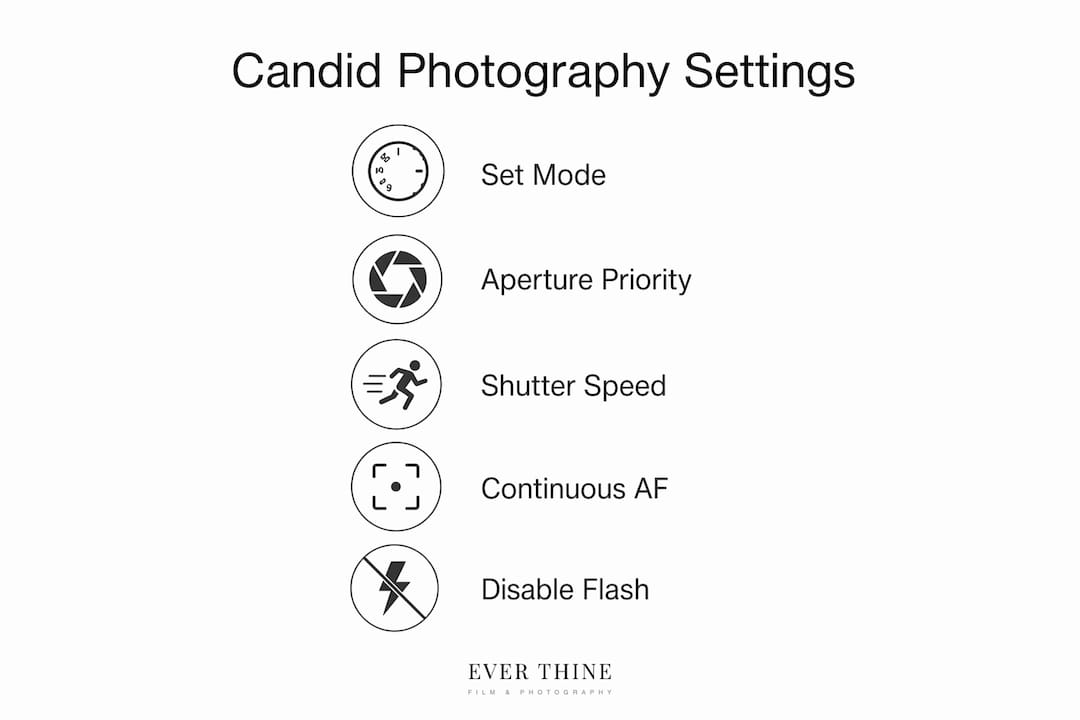
Aperture Priority mode is the recommended starting point for candid photography. It lets you control depth of field while the camera adjusts exposure automatically, which is exactly what you need when light changes quickly. Professional guidance recommends a minimum shutter speed of 1/250s and an aperture between f/1.4 and f/2.8 for sharp, intimate portraits. That combination freezes movement and separates your subject from a busy background.
Autofocus is equally critical. Continuous AF with Face/Eye detection and burst mode at 8–15 fps gives you the best chance of catching a fleeting micro-expression. The camera tracks the subject’s eye across the frame, so you stay sharp even when someone turns their head mid-laugh.
Disabling flash is non-negotiable for candid work. Flash alerts subjects instantly and kills the natural atmosphere you are trying to preserve. Raise your ISO and widen your aperture instead. Most modern cameras handle ISO 3200 cleanly enough for family and event photography.
Setting | Recommended value | Why it matters |
Mode | Aperture Priority | Balances control and speed in changing light |
Shutter speed | 1/250s minimum | Freezes natural movement without blur |
Aperture | f/1.4 to f/2.8 | Creates subject separation and intimacy |
Autofocus | AF-C / AI-Servo with Eye AF | Tracks moving subjects reliably |
Burst rate | 8–15 fps | Captures micro-expressions between poses |
Flash | Off | Keeps subjects unaware and relaxed |
Pro Tip: Save a custom camera mode with these settings pre-loaded. One dial click puts you in candid mode instantly, so you never miss a moment fumbling through menus.
How do you anticipate a candid moment before it happens?
Anticipation is the single skill that separates good candid photographers from great ones. Practising “seeing the future” means reading a scene and predicting what will happen next, then positioning yourself before the moment arrives.
The skill is learnable. Start by watching body language rather than faces. A child leaning towards a birthday cake is about to blow out the candles. Two people leaning in close are about to share a laugh or a secret. A grandparent reaching for a grandchild’s hand is about to produce exactly the kind of image that ends up on a mantelpiece.
Here is a practical process for building anticipation skills:
Observe before you shoot. Spend the first ten minutes at any event watching, not photographing. Identify the social clusters, the emotional hot spots, and the people most likely to produce genuine reactions.
Track micro-expressions. A slight eyebrow raise, a lip twitch, or a shoulder drop all signal an incoming emotional response. Position yourself and pre-focus before the expression fully forms.
Read environmental cues. A toast being poured, a door about to open, or a child running towards a parent all signal moments worth framing in advance.
Pre-focus on a fixed point. If you know someone will walk through a doorway or reach a particular spot, lock focus there and wait. The moment comes to you.
Pro Tip: Set a mental countdown when you see a social interaction building. If two people are mid-conversation and one is clearly about to react, give yourself three seconds and keep the shutter half-pressed.
For more on applying these skills specifically to weddings, the candid wedding photography guide from Weddingfilmphotography covers the full workflow in detail.
How do you stay discreet while shooting candid photos?
Discretion is not about being invisible. It is about being unremarkable. The moment subjects notice you watching them intently, their behaviour changes and the authenticity you are chasing disappears.
Lens choice plays a bigger role than most photographers realise. A 28mm or 35mm prime lens forces you to get physically closer to your subject, which sounds counterintuitive but actually produces more genuine connection than shooting from a distance with a telephoto. Telephoto lenses create a voyeuristic distance that subjects sometimes sense, even without seeing the camera. A prime at close range feels more natural because you are simply present in the scene.
Practical discreet shooting habits include:
Dress to blend in. At a family event, wear what the guests wear. At a formal occasion, match the dress code. A photographer in full black tactical gear at a garden party is not discreet.
Shoot from the hip occasionally. Pre-focus at a fixed distance, hold the camera at waist height, and shoot without raising it to your eye. You lose some compositional control but gain complete invisibility.
Move slowly and deliberately. Quick movements attract attention. Slow, purposeful repositioning reads as normal behaviour to the people around you.
Use a small, quiet camera body. Mirrorless cameras with electronic shutters produce almost no sound. That silence keeps subjects unaware far longer than a loud mechanical shutter.
Ethical candid photography means respecting the people in front of your lens. Always obtain consent when photographing children, and be prepared to delete images if a subject objects. Discretion is a technique, not a licence to photograph people without regard for their comfort or dignity.
What techniques help subjects act naturally in front of a camera?
The most common mistake photographers make is issuing verbal commands. “Stand here,” “look at me,” “smile” all produce the same result: a stiff, self-conscious subject who looks exactly like they are being told what to do.
Shifting from static poses to action-based prompts produces far more natural expressions and body language. Instead of telling someone to smile, ask them to walk towards you and tell their partner something they love about them. The movement and the conversation produce a genuine reaction that no verbal instruction ever could.
Here is a step-by-step approach to evoking natural reactions:
Use the Mirroring Technique. Demonstrate the movement or expression you want rather than describing it. 84% of subjects report feeling more confident and moving naturally when photographers use mirroring rather than verbal instructions. Show, do not tell.
Give action prompts, not pose commands. “Walk to that tree and point out something you both like” produces a real interaction. “Stand by the tree and smile” produces a photograph that looks like a school portrait.
Keep talking softly throughout. A continuous, low-key dialogue reduces awkwardness. Ask easy questions about the day, the venue, or a shared memory. The conversation keeps subjects mentally occupied and physically relaxed.
Shoot immediately after the prompt ends. Authentic emotions peak in the 2–3 seconds after formal direction stops. Keep the camera to your eye and your finger on the shutter during that window.
Notify subjects in advance. Prior notification significantly reduces self-conscious behaviour. Telling guests at the start of an event that you will be moving around taking natural shots sets expectations and lowers their guard.
Pro Tip: After any posed group shot, keep shooting for a full five seconds while people relax and talk to each other. Those five seconds consistently produce the best images of the entire session.
The role of candid moments in wedding photography explores why these techniques matter so much when the stakes are highest.
Key takeaways
Capturing genuine candid moments requires the right camera settings, trained anticipation, discreet presence, and prompts that produce real reactions rather than performed ones.
Point | Details |
Use Aperture Priority mode | Set 1/250s minimum shutter speed and f/1.4–f/2.8 aperture for sharp, intimate shots. |
Enable continuous autofocus | AF-C with Eye AF and burst mode at 8–15 fps catches micro-expressions reliably. |
Anticipate before you shoot | Observe body language and environmental cues to position yourself before the moment unfolds. |
Mirror, do not command | Demonstrate movements rather than issuing verbal instructions to keep subjects relaxed and natural. |
Shoot after the prompt ends | Authentic expressions peak 2–3 seconds after formal direction stops, so keep the shutter ready. |
What I have learned from years of candid photography
The technical side of candid photography is genuinely learnable in an afternoon. The harder part is the patience. Most photographers give up on a scene thirty seconds before it delivers the image they came for.
The biggest shift in my own practice came when I stopped thinking about photographs and started thinking about people. When your attention is on the person rather than the frame, you naturally position yourself better, you anticipate more accurately, and you stop fussing with settings at the wrong moment. The camera becomes secondary to the observation.
The other thing I would push back on is the idea that candid photography means never interacting with your subjects. The best candid images I have seen, and the ones Weddingfilmphotography produces consistently, come from photographers who are warm and present in the room. Subjects relax around people they trust. That trust is built through conversation, eye contact, and genuine interest in the people you are photographing, not by hiding behind a long lens in the corner.
Practise at low-stakes events first. Family dinners, children’s sports days, and casual gatherings are perfect training grounds. The pressure is low, the moments are plentiful, and you can experiment with settings and positions without worrying about missing a once-in-a-lifetime shot. Build the habit of observing before shooting, and the technical skills will follow naturally.
— Ever
Candid photography expertise from Weddingfilmphotography
Weddingfilmphotography specialises in documentary-style wedding coverage across Derbyshire, Staffordshire, and Worcestershire, with a reputation built on capturing the moments couples did not know were happening.
[
If you are planning a wedding and want photography that feels real rather than rehearsed, the team at Weddingfilmphotography brings the same anticipation skills, discreet presence, and natural prompting techniques covered in this guide to every event they shoot. Their wedding photography in Staffordshire service is multi-award-winning, and their Derbyshire wedding photography covers venues across the region with the same documentary approach. For families and couples who want to learn more before booking, the guide to planning candid wedding shots is a practical next step.
FAQ
What camera mode is best for candid photography?
Aperture Priority mode is the best choice for candid photography. Set a minimum shutter speed of 1/250s and an aperture between f/1.4 and f/2.8 to keep subjects sharp and backgrounds soft.
How do I stop subjects looking stiff in candid photos?
Use action-based prompts rather than verbal pose commands, and keep a soft conversation going throughout the shoot. Authentic expressions appear most strongly in the 2–3 seconds after formal direction ends, so keep shooting past the obvious moment.
Should I use a telephoto or prime lens for candid shots?
A 28mm or 35mm prime lens produces more intimate and genuine candid images than a telephoto. Getting physically closer to your subject creates connection rather than the detached, observed quality that long lenses often produce.
Is it legal to photograph people candidly in the UK?
In public spaces in the UK, photographing people without explicit consent is generally lawful. Always obtain consent when photographing children, and respect any request to delete an image. Ethical practice protects both your subjects and your reputation.
How do I capture candid moments at a family event?
Spend the first ten minutes observing rather than shooting. Identify the social clusters most likely to produce genuine reactions, disable your flash, and use burst mode to catch expressions as they form. Prior notification to guests that you will be taking natural shots significantly reduces self-conscious behaviour.
Recommended


Comments