
Role of location scouts: film and wedding guide

TL;DR:
A location scout identifies and evaluates potential shooting sites during pre-production to ensure they meet creative and practical needs. Building relationships with property owners and using technology like virtual tours enhances efficiency and access, leading to better shoot outcomes. Thorough scouting improves final images, minimizes risks, and is essential for successful film and wedding photography productions.
A location scout is the professional responsible for finding, evaluating, and securing shooting venues that meet both creative vision and practical demands. In film production and wedding photography alike, the role of location scouts sits at the heart of pre-production planning. Without thorough scouting, even the most talented photographer or director risks arriving on shoot day to discover poor light, noise interference, or access problems that no amount of skill can fix. The industry term for the broader discipline is “location scouting,” and it encompasses everything from initial research to legal clearance.
What does a location scout do?
A location scout finds and documents potential shooting sites during pre-production, then hands the baton to a location manager who handles formal permits and on-set logistics. This distinction matters. The scout identifies and negotiates initial access, while the location manager finalises contracts and ensures the production complies with agreed terms on the day. Conflating the two roles leads to gaps in both creative preparation and legal compliance.
The core responsibilities of a location scout break down into four areas:
Research and sourcing: Reading the creative brief or script, then identifying candidate sites through location libraries, local knowledge, and online research.
Technical evaluation: Assessing light quality at specific shooting times, ambient sound, power availability, and physical access for crew and equipment.
Preliminary negotiation: Making first contact with property owners, explaining the production’s needs, and gauging willingness to host a shoot.
Documentation: Photographing and cataloguing each site with detailed notes on dimensions, orientation, and any restrictions.
In the UK, no mandatory formal qualifications exist for location scouts. Most progress through location assistant roles or arrive from photography and production backgrounds. What counts is the quality of a scout’s location library and the strength of their professional references.
Pro Tip: Build your location library from day one. A well-organised archive of scouted sites, complete with photographs, measurements, and owner contact details, is the most tangible proof of your competence as a scout.

How does the location scouting process work?
The scouting process follows a clear sequence from creative brief to shoot-ready location. Each stage builds on the last, and skipping any step creates risk.
Script or brief breakdown. The scout reads the brief carefully, identifying the mood, period, and practical requirements for each scene or shoot segment. A wedding photographer’s brief might specify golden-hour portraits and a grand staircase; a film brief might demand a derelict industrial space with controllable light.
Desk research. The scout searches location libraries, planning databases, and image archives to build a longlist of candidates before visiting a single site.
Look-see visits. The scout visits shortlisted sites alone, capturing photographs and video to assess atmosphere, light, and access. These visits are informal and low-cost.
Technical scout. The scout returns with the director, director of photography, and production designer. Technical scouting requires evaluating lighting at the precise times planned for shooting. Apps such as Sun Seeker and Sun Surveyor map sun positioning accurately, preventing costly surprises on shoot day.
Negotiation and legal clearance. The scout opens access discussions with the property owner. The location manager then finalises formal permissions and contracts before any crew arrives.
Ongoing management. During production, the scout or manager monitors compliance with agreed terms and manages any issues that arise on location.
The table below compares the two main types of scout visit by purpose and participants.
Visit type | Purpose | Typical participants |
Look-see visit | Assess atmosphere, light, and access informally | Scout only |
Technical scout | Detailed evaluation with creative heads | Scout, director, DP, production designer |
Effective scouting results in locations that enhance the story by reflecting character and narrative mood, not simply providing a visually pleasing backdrop. A location chosen purely for aesthetics often fails to serve the emotional tone of the scene. The best scouts think like storytellers, not just logistics coordinators.
What makes a great location scout?
The skills that separate a competent scout from an exceptional one go well beyond knowing how to take a decent photograph. Advanced skills include evaluating floor load capacity, electrical power availability, and ambient noise sources such as proximity to flight paths or schools. These are the details that entry-level guides routinely overlook, and they are precisely the details that derail shoots.
The deeper capabilities of a top-tier scout include:
Logistical literacy: Understanding whether a building’s floor can support heavy camera rigs, whether the power supply can handle lighting equipment, and whether background noise will contaminate audio.
Cinematographic vision: The ability to visualise how a lens will render a space, including how wide-angle distortion or compression will affect the final image.
Relationship management: Diplomacy toward property owners is not a soft courtesy. It is a professional necessity. Owners who feel respected are far more likely to welcome future productions, which protects the scout’s access network over time.
Technology fluency: 360° virtual tours combined with LiDAR data now allow directors and designers to explore locations remotely in precise detail, reducing the number of physical recce visits needed. This saves time and budget without sacrificing accuracy.
Pro Tip: When assessing a location for sound, visit at the same time of day you plan to shoot. A quiet country house at 10AM can sit directly under a busy flight path at 2PM.
The scout who masters both the technical and interpersonal sides of the role becomes indispensable to any production. Technical skill without diplomacy burns access. Diplomacy without technical skill wastes everyone’s time.
How do location scouts support wedding photography shoots?
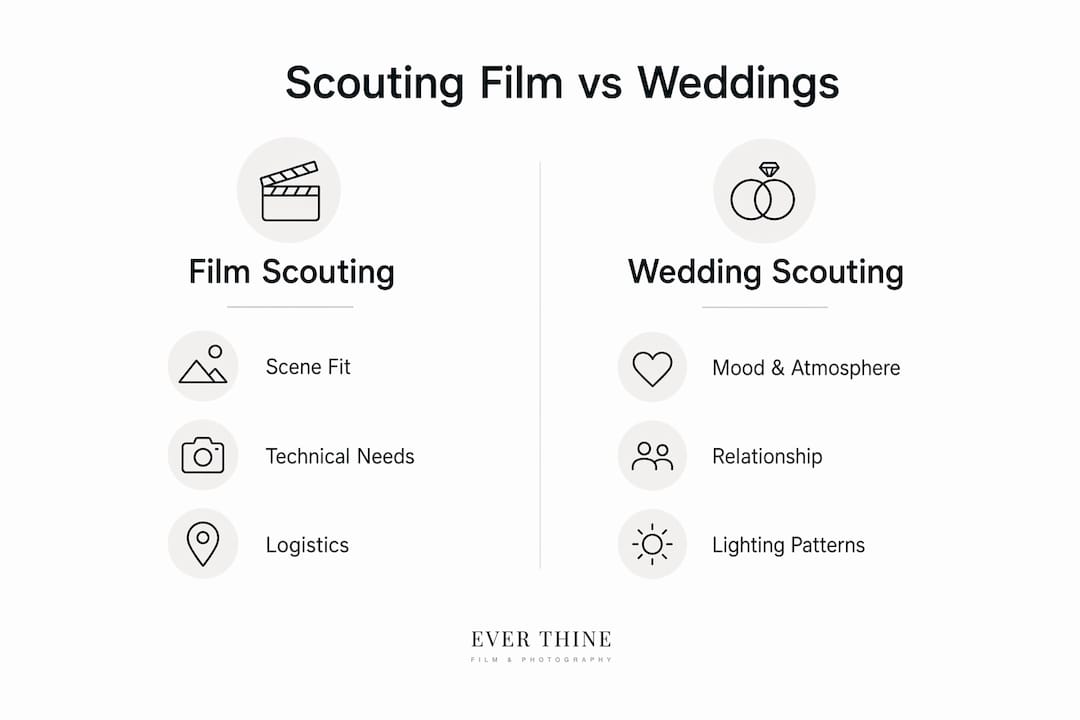
Wedding photography scouting carries its own set of demands that differ meaningfully from film production. The timeline is fixed, the light will not wait, and there is no second take. Wedding photography scouting focuses on building relationships with venue staff and developing a thorough understanding of the venue’s layout to avoid complications on the day.
The specific priorities for wedding venue scouting are:
Identifying photographic opportunities beyond the obvious. Every venue has a brochure shot. A good scout finds the hidden courtyard, the staircase with north-facing light, and the garden corner that catches the last of the evening sun.
Mapping light patterns through the day. Knowing exactly where the light falls at 3PM in october versus 5PM in june changes the entire shooting plan.
Understanding access restrictions. Some venues restrict photography in certain rooms or during the ceremony. Knowing this in advance allows the photographer to plan alternatives rather than improvise under pressure.
Building rapport with venue coordinators. Scouts who introduce themselves months before the wedding day gain advantages that last-minute arrivals never access. Exclusive shooting access in restricted areas, early entry, and extended time in key spaces are all negotiated through relationship, not on the day itself.
Contingency planning. A scouted venue includes a wet-weather plan, an alternative ceremony backdrop, and a clear understanding of which spaces work under artificial light.
For couples planning event shoots in Salzburg or other destination venues, the same principles apply. Early contact with venue staff and a thorough pre-visit are the difference between a reactive shoot and a confident one.
The venue’s role in wedding photos extends far beyond providing a backdrop. A well-scouted venue actively shapes the mood, pacing, and quality of every image captured on the day. Scouts who understand this produce work that looks effortless precisely because the preparation was thorough.
Wedding industry scouts who visit venues well before the event and build genuine relationships typically gain “first-in, last-out” shooting privileges. That access produces exclusive images that couples cannot get from a photographer who arrives on the morning with no prior knowledge of the space.
Key takeaways
The role of location scouts is to evaluate and secure shooting venues that serve both creative and logistical needs, making thorough pre-production scouting the single most reliable way to protect shoot-day quality.
Point | Details |
Scouts differ from managers | Scouts identify and assess sites; location managers finalise permits and on-set logistics. |
Technical evaluation is non-negotiable | Assess light, sound, power, and floor load at the planned shooting time, not just on a casual visit. |
Diplomacy protects access | Respectful relationships with property owners secure future location availability across productions. |
Wedding scouting needs early contact | Pre-introducing yourself to venue staff months ahead gains access to restricted areas and smoother workflows. |
Technology reduces recce costs | 360° virtual tours and LiDAR data allow remote location assessment, cutting unnecessary physical visits. |
Why I think most people underestimate location scouting
The most common mistake I see is treating scouting as a box-ticking exercise rather than a creative and logistical discipline in its own right. Professionals arrive at a venue, take a few photographs, and declare it “suitable.” They have not checked the floor load. They have not stood in the room at 4PM to see where the light actually falls. They have not spoken to the venue coordinator about which areas are genuinely off-limits.
The second mistake is neglecting the relationship side entirely. A scout who treats a property owner as an obstacle to be managed will find that owner unavailable the next time a production calls. The scouts with the best location libraries are almost always the ones with the best reputations among property owners. Those two things are not coincidental.
Technology is changing the discipline faster than most practitioners realise. Virtual tours and LiDAR scanning mean that a director in London can walk through a barn in Shropshire without leaving their desk. That is genuinely useful, but it does not replace the physical visit for final confirmation. Use technology to narrow the shortlist, then commit to the recce for the sites that make the cut.
The detail that consistently surprises people is how much a well-scouted location improves the final images without anyone being able to say exactly why. The light is right. The background serves the subject. The workflow on the day is calm. None of that happens by accident. It happens because someone did the work beforehand.
For wedding photographers specifically, I would say this: venue scouting for UK couples is not a luxury service. It is the foundation of a confident, well-executed shoot. The couples who benefit most are the ones whose photographers treated the venue as a creative partner, not just a setting.
— Ever
How Weddingfilmphotography approaches venue preparation
Weddingfilmphotography brings the same pre-production discipline to every wedding shoot across Derbyshire, Staffordshire, and Worcestershire. Every venue is assessed for light, access, and photographic opportunity before the wedding day, so nothing is left to chance when the moment arrives.
[
Whether you are planning an intimate ceremony or a large celebration, Weddingfilmphotography’s preparation means your photographer arrives knowing exactly where the best light falls, which spaces tell your story most powerfully, and how to work with your venue team from the first moment. Couples in Derbyshire can explore award-winning photography services built on meticulous venue knowledge, while those in Staffordshire and Worcestershire benefit from the same depth of preparation. Get in touch to discuss how thorough venue preparation can shape your wedding photography from the ground up.
FAQ
What is the role of location scouts in film production?
A location scout identifies, photographs, and evaluates potential shooting sites during pre-production, then initiates access negotiations with property owners. The location manager takes over to finalise formal permits and manage on-set logistics.
How does location scouting differ for wedding photography?
Wedding scouting prioritises relationship-building with venue coordinators, mapping light patterns through the day, and identifying photographic opportunities beyond the standard brochure shots. Early contact with venue staff often secures exclusive access to restricted areas.
What skills do location scouts need?
The core skills are logistical literacy, photography, diplomacy, and organisation. Advanced scouts also assess floor load capacity, power supply, and ambient noise, and use tools such as Sun Seeker to map sun positioning accurately.
Do location scouts need formal qualifications in the UK?
No mandatory formal qualifications exist for location scouts in the UK. Most build their careers through location assistant roles or photography backgrounds, with their location library and professional references serving as the primary measure of competence.
How does technology support the location scouting process?
360° virtual tours combined with LiDAR data allow directors and designers to explore locations remotely in precise detail, reducing the number of physical recce visits required without sacrificing accuracy in pre-production planning.
Recommended
Comments