
Wedding social media etiquette: who owns what, and posting right

The photographer owns the copyright on your wedding photos the moment the shutter clicks. Couples get a personal use licence, not the images outright, which means you can post to your own social channels freely, but you can’t hand the gallery to your florist for their Instagram grid without checking first. Get the terms straight before the big day, not after someone’s tagged the wrong vendor at 11pm on the night itself.
The single most important thing to sort before the wedding: agree, in writing, who can post what, when, and on which platforms.
Photographer holds copyright; you hold a personal use licence
Tag and credit the photographer (and other vendors) whenever you post
Don’t forward full-resolution galleries to vendors for their marketing
Set an embargo or request sneak-peeks if timing matters to you
Put social-media terms in the contract, not in a text message afterwards
Key Takeaways
Wedding social media etiquette rests on one principle: the photographer owns the copyright, couples hold a personal use licence, and every posting decision should follow from that.
Point | Details |
Photographer owns copyright | UK law makes the photographer the default owner; couples receive a personal use licence, not full rights. |
Credit every vendor | Tag the photographer and vendor team accurately in captions to support their work and increase reshares. |
Agree timing in advance | Set sneak-peek and embargo terms in the contract, then tell guests via the website, signage or officiant. |
Never forward full galleries | Redirect vendors requesting images to the photographer for a proper commercial licence. |
Weddingfilmphotography builds terms in from booking | Licence terms, sneak-peeks and privacy addenda are agreed upfront, not renegotiated after delivery. |
Table of Contents
Wedding social media etiquette starts with who owns the photos
Under the Copyright, Designs and Patents Act 1988, the photographer is the default owner of every image they take at your wedding, and that copyright doesn’t transfer to you just because you paid for the day. What you’re buying, in nearly every UK wedding photography contract, is a personal use licence: permission to print, share with family, and post to your own social media without falling foul of copyright.
That licence has real edges. It typically covers:
Printing photos for albums, frames and cards
Sharing digital copies with family and friends
Posting to your personal Instagram, Facebook or similar accounts
It typically excludes commercial use by anyone else, including vendors who want the images for their own marketing. Full copyright transfer does happen, but it’s uncommon and usually comes with a separate buyout fee, because photographers own the copyright to their images for 70 years after their death under UK law. That duration matters practically: it’s why a photographer’s portfolio rights and your personal use rights need to be spelled out separately, not assumed to be the same thing.
How to credit and tag your photographer and vendor team
Getting credits right isn’t just good manners. It’s how small creative businesses get found by their next client.
Tag the photographer in every post that uses their images, on the image itself where the platform allows it and in the caption every time.
Build a vendor list before the wedding: florist, venue, hair and make-up, band, caterer. Ask each for their preferred handle.
Double-check spellings and handles against the vendor’s own bio. A mistyped handle means no tag notification and no reshare.
Ask your photographer whether they prefer a caption credit, an on-image watermark, or both. Preferences vary.
Keep the credit list somewhere you can copy and paste from, so tagging fifteen vendors across a dozen posts doesn’t become a chore you skip.
Accurate tagging increases the odds a vendor reshares your post to their own audience, which is free advertising for them and often a faster way to get your photos in front of mutual friends.
Pro Tip: Save your vendor handle list as a note on your phone before the wedding. You’ll be tagging people from the taxi home, and nobody remembers a florist’s Instagram handle from memory at midnight.
Posting timelines: sneak-peeks, embargoes and full galleries
Most couples don’t want to wait two months to post a single photo, and most photographers don’t want their edit rushed out before it’s finished. The compromise that works for both sides is a timeline agreed in advance.
Sneak-peeks: a handful of edited images, often delivered within 24 to 48 hours, purely for social sharing. Ask for this at booking, not the week before the wedding, and get it into the contract.
Full gallery: typically delivered in four to eight weeks, depending on the season and the photographer’s workload.
Couple-first embargo: an agreement that nobody, including guests, posts photos publicly until the couple has shared their own. This protects your right to announce your own day, on your own terms.
Communicate your chosen timeline to guests before they arrive. A line on the wedding website, a small sign at the reception, or a gentle mention from the officiant or MC all work. It’s far easier than trying to untag yourself from twenty posts on the Monday after.
What to do when a vendor asks for your wedding gallery
Forwarding your full-resolution gallery to a vendor for their marketing sits outside almost every personal use licence, even if it feels like a harmless favour. The gallery was licensed to you for personal use, not for redistribution, and passing it on technically counts as unauthorised distribution of someone else’s copyrighted work.
The fix is simple: point vendors back to the photographer. Photographers generally prefer this anyway, since they can supply properly credited, marketing-ready files instead of a compressed Instagram export.
That’s the script. It’s polite, it’s accurate, and it takes you out of the middle of a licensing conversation you didn’t sign up for.
Don’t email or airdrop the full gallery to vendors, ever
Do share the photographer’s contact details on request
Do mention it in your booking chat if you know a vendor will ask early
Contract clauses that cover social sharing properly
A wedding photography contract that only mentions “delivery of images” leaves too much unsaid. Ask for, or include, these specific clauses:
Licence type. State clearly that the couple receives a personal use licence, not copyright, unless a buyout has been separately negotiated and paid for.
Model release. This is what lets the photographer use images in their own portfolio, website and marketing. It’s a separate permission from copyright itself, since a model release governs marketing rights, not bare ownership.
Social-media terms. Embargo length, which platforms are covered, when sneak-peeks arrive, and how a commercial licence request should be handled if a vendor comes asking.
Privacy addendum. For couples who want limited or no public sharing of their images, this should be recorded in writing, not agreed verbally and forgotten. Recent UK data protection rules make this worth formalising rather than assuming.
Couples planning a wedding with unusual privacy needs, a public profile, or strict family preferences should raise these terms early. Most photographers welcome the conversation; it’s far easier to agree custom terms before the contract is signed than to renegotiate after delivery. Worth asking about when you’re interviewing potential photographers.
A quick checklist before you post any wedding photo
Run through this before hitting share, whether it’s the morning after or three weeks later:
Confirm you’re within your personal use licence, not distributing to a vendor or business.
Check the agreed embargo hasn’t been broken by posting too early.
Use the photographer’s approved edit. Don’t crop out their composition or apply a filter over their colour grading.
Tag the photographer and any vendors visible in the shot.
Never send the full gallery to anyone requesting images for their own marketing. Redirect them to the photographer instead.
Back up your originals somewhere other than social media, since platform terms grant broad licence rights to the platform itself and accounts can be lost or deleted.
Pro Tip: If a vendor messages asking for photos, reply with one line: “Please contact [photographer name] directly, they handle licensing for all our wedding images.” Copy, paste, done.
Heavy filters are the one habit that quietly undoes a photographer’s work. A carefully graded, moody film-style edit loses its tone under a default Instagram filter, and most photographers would rather you post their edit untouched than a version that no longer looks like their work.
Guest etiquette during the ceremony and reception
Guests posting mid ceremony is one of the fastest ways to spoil a couple’s own reveal, and it’s worth being direct with your wedding party about the boundaries you want.
The ceremony itself is the moment most couples ask guests to put phones away entirely. An “unplugged ceremony” request, whether spoken by the officiant or printed on an order of service, asks guests not to take photos or video during vows, so the professional photographer isn’t dodging raised phones in every aisle shot, and guests aren’t watching the moment through a screen instead of experiencing it.
The reception is more relaxed, but a few boundaries still help:
Ask guests to hold off posting until after the couple has shared their own first photos, if an embargo is in place.
Discourage guests from posting unflattering candids, especially of other guests who haven’t consented to being tagged.
If there’s a couple hashtag, share it clearly so guests use one tag rather than scattering photos across untraceable posts.
Remind guests that speeches and toasts sometimes touch on sensitive family topics that shouldn’t end up as a public video clip.
A short, friendly note goes further than a stern one. Most guests want to respect the couple’s wishes; they just need to be told what those wishes are before they’re holding a phone at the ceremony door.
Respecting the couple’s privacy preferences on social media
Not every couple wants their wedding broadcast in real time, and that preference deserves the same respect as any other request on the day.
Some couples are entirely happy with guests posting freely throughout. Others want a strict embargo, a no-faces-of-children rule, or no guest posting at all, often because of professional visibility, a blended family situation, or simply a wish to control their own announcement. None of these preferences need justifying, and none should be treated as high-maintenance.
The clearest approach is stating preferences plainly rather than hoping people intuit them. If you want zero guest posts of children in your wedding party, say so directly to parents beforehand, not as a general comment to the room. If you’d rather nothing goes up before your own official post, say that specifically, with a rough timeframe attached.
Photographers and content creators can help enforce this too. A photographer briefed on your privacy preferences will avoid sharing certain images publicly on their own accounts, and a same-day content creator can be told explicitly which shots are for your eyes only. This is worth raising at your first planning meeting, not assumed as obvious.

Where family members disagree with the couple’s stated preference, and that does happen, the couple’s wishes take priority. It’s their wedding, their images, and their right to decide how the day appears online, regardless of how enthusiastic an aunt might be with her camera roll.
Handling sensitive moments and unflattering photos with care
Every wedding produces a few photos nobody wants shared: a stumble on the dance floor, a tearful moment during a speech, an unfiltered laugh caught mid-word. How these get handled says a lot about respect for the people in them.
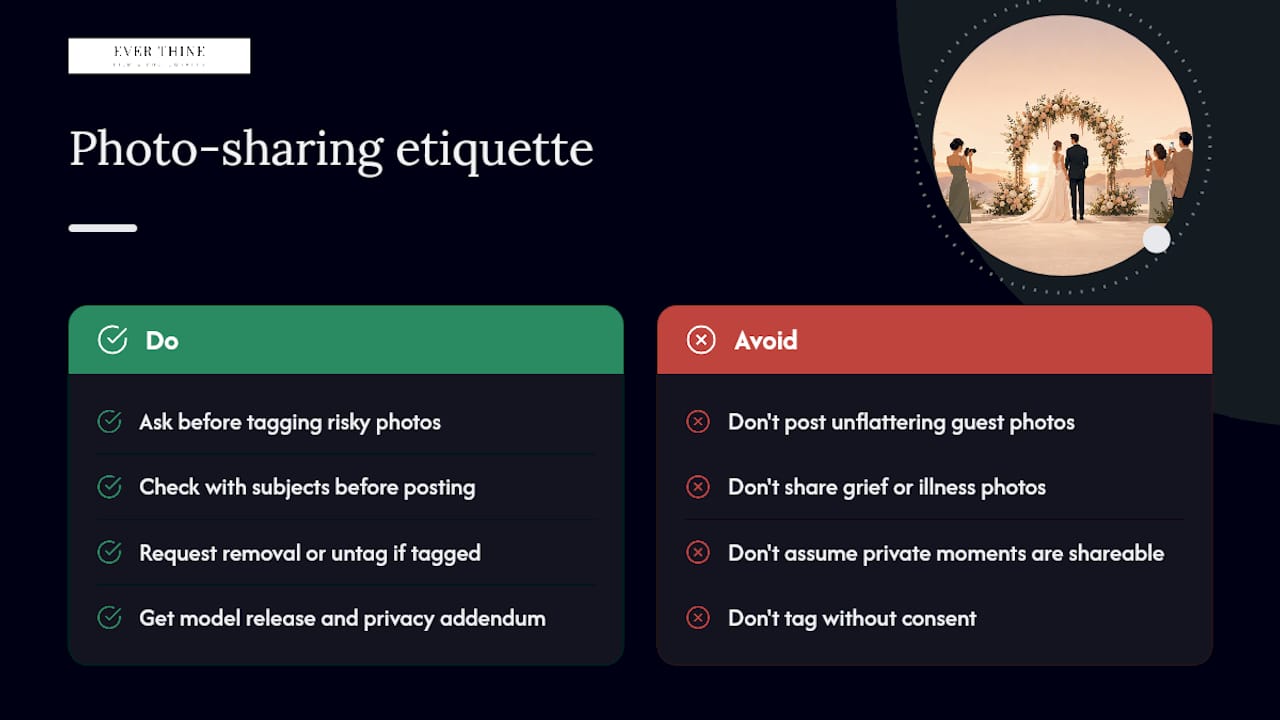
The basic rule: ask before tagging anyone in a photo that could embarrass them, and never post a genuinely unflattering shot of a guest without checking first. This applies doubly to photos involving grief, illness, or a family situation that’s clearly emotional rather than celebratory, moments that a good documentary photographer will capture beautifully but that weren’t necessarily meant for public consumption.
If you’re tagged in something you’d rather wasn’t public, most platforms let you request removal or untag yourself, and it’s a reasonable ask to make of the person who posted it. Couples should feel just as comfortable asking a guest to take something down as a guest would asking the couple.
Photographers face this dilemma too. A striking, artistically shot image of a private family moment might be portfolio-worthy, but it’s not automatically shareable without checking with the couple first, which is exactly why a model release and a privacy addendum in the contract matter. They give the photographer clear permission for specific uses, rather than leaving it to guesswork after the fact.
Setting expectations with guests before the wedding day
The best guest etiquette happens before anyone arrives at the venue, not during a hurried announcement as people take their seats.
Three channels do most of the work:
The wedding website. A short paragraph on posting preferences, the couple’s hashtag, and whether the ceremony is unplugged reaches guests who actually read the details.
Signage on the day. A small, well-designed sign at the ceremony entrance reminding guests to put phones away works better than a spoken request, because it catches people right as they’re deciding whether to reach for their phone.
A word from the officiant or MC. A brief, warm mention before the ceremony begins, something like “we’d love for you to be fully present rather than filming, our photographer has this covered”, sets the tone without sounding like a rule being enforced.
Couples who skip this step usually find out why it mattered when they see the professional gallery, dozens of guests visible mid photo, arms raised with phones, blocking the exact angle the photographer was working for. It’s an easy problem to avoid and a hard one to fix retroactively.
When it’s fine to post videos and stories during the event
Stories and short video clips move faster than static photos, and that speed is exactly why they need a touch more thought before posting mid-event.
A quick story of the room during cocktail hour, the band setting up, or a candid laugh at the bar rarely causes issues. Where it gets trickier is the ceremony and the speeches. Posting a live video or story during vows can undercut the couple’s own reveal, especially if they’ve asked for an unplugged ceremony or a couple-first embargo, and speeches often include personal or sensitive content that the speaker didn’t necessarily sign up to have broadcast in real time to hundreds of followers.
A sensible middle ground: save ceremony and speech footage until after the event, then check with the couple before posting anything longer than a few seconds. Reception dancing, the first dance, and general atmosphere shots are usually safe to post live, since they’re the parts of the day couples are typically happiest to see shared immediately.
If you’re working with a same-day content creator, this is exactly the kind of pacing they’re briefed to manage, delivering highlight clips at a sensible point in the evening rather than mid-ceremony, so the couple’s own moment isn’t scooped by a guest’s Instagram Story.
What the photographer’s edit is really protecting
A wedding photographer doesn’t just take pictures. They make dozens of small decisions, about colour, crop, pacing, which moment out of three hundred frames actually tells the story, and those decisions are the work you’re paying for. Posting a heavily filtered or cropped version of that edit isn’t a small thing; it’s overwriting someone else’s craft with a preset.
Clear agreements protect more than copyright. They protect the working relationship between couples and the people who documented their day, and they save both sides from awkward conversations that could have been settled in a five-minute chat before the wedding. If your circumstances need something non-standard, a stricter privacy clause, a longer embargo, a specific portfolio restriction, ask for it directly. Most photographers would rather negotiate custom terms upfront than deal with a dispute after delivery.
— Ever
How Weddingfilmphotography handles licences and sneak-peeks
Sorting out embargoes, sneak-peeks and licence terms after the wedding is the wrong order. Weddingfilmphotography builds these conversations into the booking process itself, so couples know exactly what they can post, when, and who to point vendors towards, before the day even arrives.
[
Every booking includes clarity on personal use licence terms from the outset, with sneak-peek delivery and privacy addenda available for couples who want them, and a straightforward process for handling any vendor requesting a commercial licence directly from us rather than through you. Same-day content creator options are also available for couples who want highlight clips moving during the reception without the pacing problems that come from guest-shot footage. If you’re planning a wedding in the region and want social-media terms settled properly from day one, take a look at our Staffordshire wedding photography services or our Derbyshire coverage, and ask us for sample contract wording when you enquire.
Sources
FAQ
Who owns the copyright to wedding photos in the UK?
The photographer owns the copyright by default under the Copyright, Designs and Patents Act 1988, unless the contract specifically transfers it, which is uncommon and usually costs extra.
Can I post my wedding photos on Instagram?
Yes, a personal use licence typically covers posting to your own social channels, but check your contract for any embargo period agreed with your photographer.
Do I need to credit my photographer when I post?
Yes, tagging and crediting the photographer and other vendors is standard etiquette and helps their business get discovered through reshares.
Can I send my wedding gallery to my florist for their marketing?
No, forwarding the full gallery for someone else’s commercial use typically falls outside a personal use licence; direct the vendor to the photographer for a proper licence instead.
How long should I wait before posting wedding photos?
Many couples request sneak-peeks within 24 to 48 hours, with full galleries arriving in four to eight weeks, though an agreed embargo may extend the timeline further.
Is it rude to ask guests not to post during the ceremony?
No, an unplugged ceremony request is common and widely respected; a note on the wedding website or a mention from the officiant usually covers it.
Recommended


Comments