
What is a documentary edit: a guide for UK couples

TL;DR:
A documentary edit transforms raw wedding footage into an honest, emotionally coherent story by prioritizing authentic moments and audio. The process involves careful organization, audio-focused story development, and deliberate pacing to create films that resonate deeply and feel personal across multiple viewings. This approach emphasizes memory and emotional truth, ensuring your wedding film preserves genuine experiences beyond superficial visual beauty.
Most people assume a documentary edit is simply raw footage stitched together in order, unpolished and unplanned. That assumption sells the whole craft short. A documentary edit is one of the most deliberate forms of storytelling in film, and understanding what a documentary edit truly involves will completely change how you think about your wedding film. This guide breaks down what the term actually means, how editors build these films, and why the approach produces wedding videos that feel genuinely alive rather than staged.
Table of Contents
What a documentary edit means in wedding videography
At its heart, a documentary edit shapes real footage into a story that feels honest and emotionally coherent by organising interviews, B-roll, and natural audio into a clear narrative arc. In wedding videography, that means your editor is working with everything that actually happened: the nervous laughter before the ceremony, your mum’s face when you walked in, the off-script moment in your vows. Nothing is manufactured. Everything is found.
The footage your videographer captures on your wedding day is enormous in volume and completely unscripted. The editor’s job is to sift through it and find the story hiding inside. That requires real editorial judgement, not just technical skill. The final film you watch is the result of dozens of decisions about what to keep, what to cut, and in what order to place things so the emotion lands correctly.
What separates a strong documentary wedding video from a weak one is narrative clarity. A good documentary edit has a shape: tension builds, emotion peaks, and the film resolves in a way that feels satisfying. Your wedding film should leave you and everyone who watches it feeling something specific, not just vaguely moved.
Here is what a documentary edit prioritises:
Candid, unscripted moments such as speeches, raw reactions, and stolen glances between you and your partner
Emotional truth over visual perfection or staged shots
A clear narrative arc that guides the viewer from one emotional beat to the next
Purposeful B-roll that deepens the story rather than decorating it
Pro Tip: When reviewing a videographer’s portfolio, watch their films with your eyes closed for 30 seconds. If the audio alone tells you a story, that is a strong sign they understand documentary editing.
The editing workflow behind documentary storytelling
Understanding the workflow helps us appreciate the craft behind documentary edits, but how does this differ from other editing styles? Documentary post-production is staged into clear milestones, evolving the story over time rather than ending at filming. Each stage serves a purpose, and skipping any one of them produces a weaker film.
Here is how a disciplined documentary editor approaches the process:
Organise and log all footage. Before a single cut is made, every clip is reviewed and labelled. On a wedding day, this might mean hundreds of clips covering ten or twelve hours. Good organisation at this stage saves enormous time later and prevents strong moments from being overlooked.
Build an assembly cut. This is the rough framework of the film, often overlong and imperfect. The editor is simply placing the main pieces in logical order to see what they have to work with.
Develop a radio cut. This is where documentary editing truly separates itself. A radio cut focuses on dialogue and audio, testing whether the story makes sense through sound alone before any visuals are confirmed. For a wedding film, this means the speeches, the vows, and the ambient sound of the day must carry the story on their own.
Refine through rough and fine cuts. Visuals are now placed and adjusted against the audio foundation. The editor trims, reorders, and shapes the pacing until each scene breathes correctly.
Reach picture lock. At this point, no further changes are made to the timeline. Colour grading and audio mixing happen after picture lock, but the story itself is fixed.
“Documentary editing is not about what happened first. It is about what the audience needs to feel next.”
Knowing these wedding video editing steps helps you understand why a finished wedding film takes weeks rather than days to produce properly. Each pass through the timeline is a deliberate refinement, not a repeat of work already done.
Documentary editing compared to traditional wedding film styles
Knowing these differences helps you ask better questions when choosing your videographer. The contrast between documentary and traditional wedding editing is sharper than most couples realise.
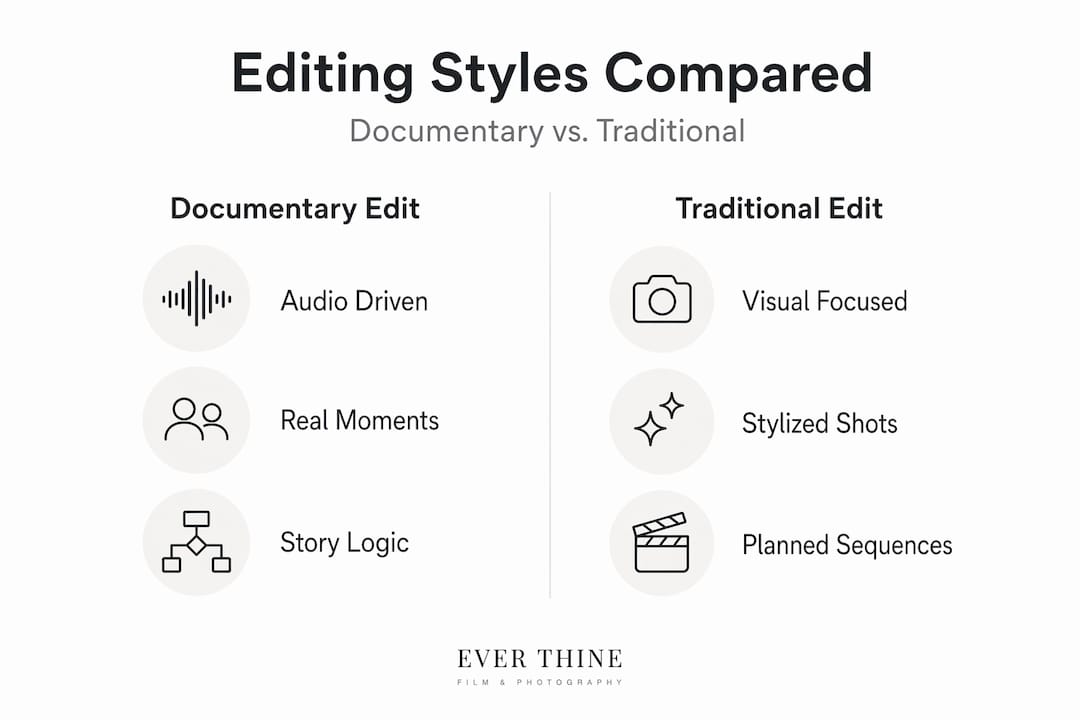
Feature | Documentary edit | Traditional/cinematic edit |
Story foundation | Audio and authentic moments | Visuals and staged shots |
B-roll usage | Purposeful, emotionally driven | Often decorative or generic |
Scripting | None; story found in real footage | Often relies on posed sequences |
Emotional approach | Raw, honest, unfiltered | Polished, stylised, produced |
Narrative structure | Built from sound first | Built from visual sequences |
Tone | Intimate and personal | Cinematic and stylised |
Documentary editors prioritise story logic and audio first, unlike many traditional wedding edits that lead with visuals or depend on staged shots for their impact. A slow-motion walk down a path looks beautiful. But if there is no emotional audio beneath it, it is wallpaper.
The B-roll in documentary editing is disciplined and deliberate. Every shot of a detail, a reaction, or a location is chosen because it adds context or deepens an emotional beat. Nothing is inserted simply because it looks nice. This is a meaningful distinction when you are comparing wedding films, because it is often the B-roll choices that reveal how much thought went into the edit.

Pro Tip: Ask any videographer you are considering to explain their B-roll philosophy. If they talk about it purely in visual terms, that tells you something. If they talk about it in emotional and narrative terms, you are probably in good hands.
Couples who want creative wedding editing should understand that documentary does not mean simple. It means intentional. The craft is in what gets left out as much as what stays in.
How documentary editing principles enhance your wedding film
Having seen how documentary edits create authentic stories, it is worth knowing exactly what to look for and ask for when commissioning your wedding film.
Here is what to consider when evaluating a videographer’s documentary editing approach:
Audio drives the story first. Your editor should build the story from sound before locking any visuals. Ask them directly: do they start with a radio cut?
A clear narrative arc with emotional rises and resolutions. Your film should not simply follow the schedule of the day. It should have a shape that mirrors the emotional journey you went through.
B-roll that deepens, not distracts. Every supporting shot should earn its place by adding emotional context, not just filling gaps.
Emotional pacing that keeps viewers connected. A wedding video storytelling approach that rushes through every moment leaves nothing to breathe. Pacing is where editors earn their fee.
Understanding these principles also makes you a better client. When you can articulate what you value in a wedding film, your videographer can tailor their approach accordingly. A wedding videography guide can help you understand what questions to ask before the booking is even made.
Pro Tip: When you watch sample films from a videographer, pay attention to moments of silence or near-silence. Do they trust those quiet beats, or do they fill every second with music? Editors who trust silence tend to produce far more emotionally powerful films.
Reading more about the wedding video editing guide process will also help you understand realistic timelines and why the best films take time to build properly.
Why the documentary edit mindset transforms wedding memories
Here is the perspective most articles skip entirely: a documentary edit is not a style choice. It is a philosophical one.
When an editor sits down with your wedding footage and asks “what is the real story here?” rather than “what looks best?”, they are making a commitment to your actual experience. That sounds obvious. In practice, it is rare. Most wedding films are built to look impressive on the first watch. Documentary edits are built to mean something on the tenth watch, five years after your wedding day.
The editors who truly understand this mindset are not technicians. They are memory curators. They are making decisions about what version of your wedding day will exist permanently. Without a sound-first approach, edits risk becoming visually busy but emotionally hollow. The most beautifully colour-graded film in the world cannot save a story that was never properly found.
This is also why the documentary edit approach requires patience. Couples sometimes wonder why their film takes three to four weeks to deliver. The answer is that building a story properly, reviewing audio meticulously, testing pacing, and making hundreds of small editorial decisions takes real time. Rushing that process produces a film that looks fine but does not feel personal.
When you commission a documentary wedding video, you are not just paying for footage of your day. You are investing in someone who will spend far more time with your wedding memories than you might expect, finding the moments that matter and placing them where they will hit hardest.
Discover documentary-style wedding videography with Ever Thine
If you have read this far, you already know what to look for in a wedding videographer. At Ever Thine Film & Photography, documentary editing is not an add-on option. It is the only way we work.
[
Every film we create begins with your story, built from real moments, honest audio, and genuine emotion. We cover weddings across Derbyshire, Staffordshire, and Worcestershire, with tailored packages designed around your day rather than a template. Whether your wedding is intimate or large, we bring the same deliberate, story-first approach to every edit. Get in touch to talk about how your wedding film can feel as genuine as the day itself.
Frequently asked questions
What exactly is a documentary edit in wedding videography?
A documentary edit shapes your real wedding footage — speeches, reactions, candid moments — into an honest and emotional story with a clear narrative flow, rather than a sequence of polished but staged scenes.
How does a ‘radio cut’ help in editing wedding films?
A radio cut tests whether the story works through audio alone before visuals are confirmed, ensuring that speeches, vows, and natural sound carry the emotional weight of the film.
Why is B-roll selection important in documentary editing?
Documentary editors treat B-roll as contextual support for emotional beats rather than decoration, which keeps the film feeling authentic and purposeful rather than padded or generic.
Can documentary editing principles be applied to any wedding film style?
Yes. The radio-cut mindset and prioritising authentic audio over staged visuals can improve the emotional impact of almost any wedding film style, not just those marketed as documentary.
Recommended


Comments